
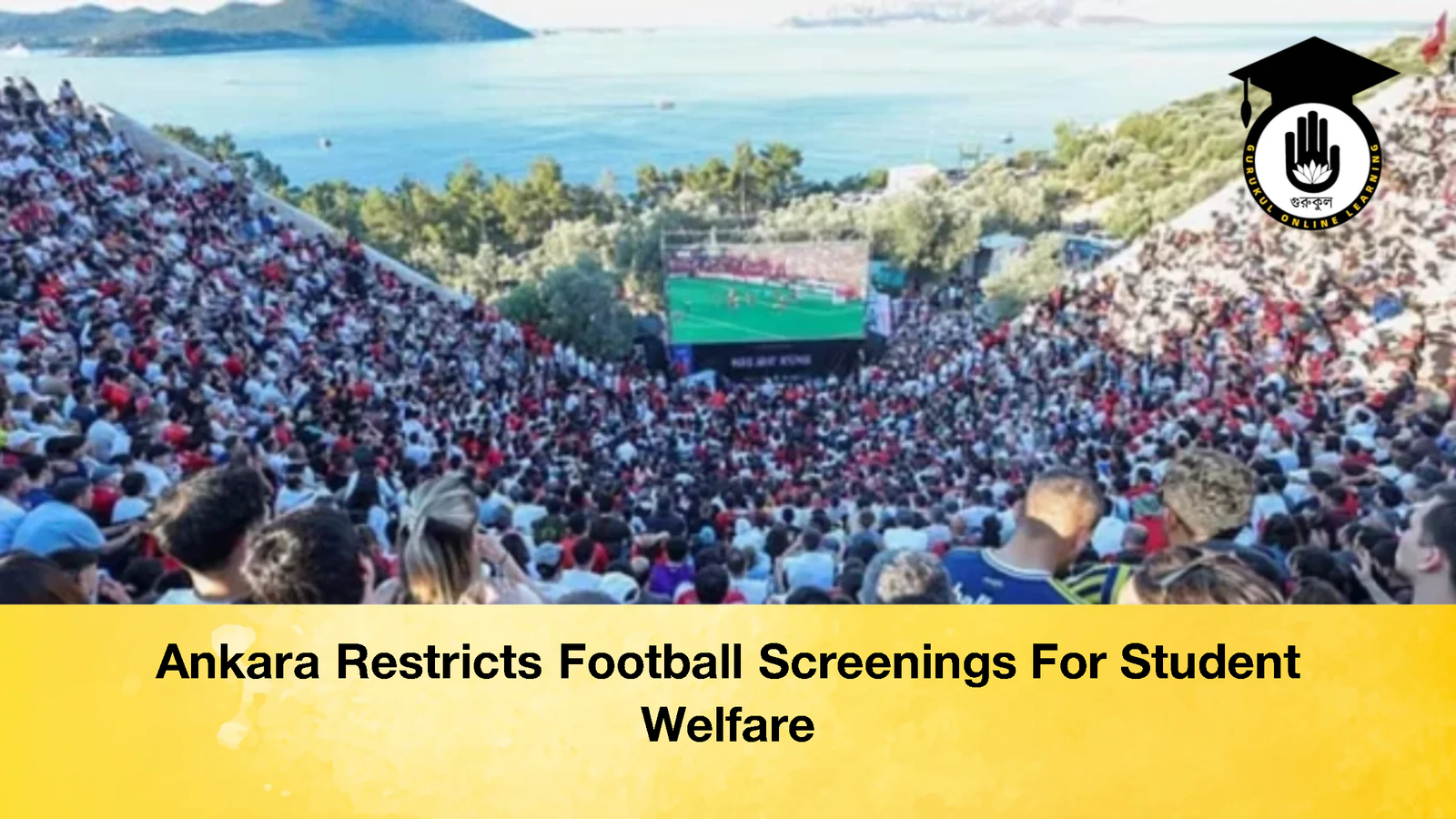

The Ministry of Interior of the Republic of Turkey has officially issued a comprehensive nationwide directive strictly prohibiting the installation and operation of large public viewing screens for the national football team’s upcoming tournament match. The high-level administrative decision was communicated directly via formal circulars to the governors of all provinces across the sovereign territory of the state. The binding decree mandates the absolute suspension of public broadcasting permissions for the national squad’s second group-stage fixture against Paraguay, which is officially scheduled to take place on Saturday morning. The primary objective of this sudden state intervention is to safeguard the acoustic and logistical environment for hundreds of thousands of student candidates who are registered to participate in crucial, career-defining higher education entry examinations over the course of the weekend.
According to the formal public statement released by the central Ministry of Interior, the blanket ban on large-screen public gatherings and communal fan zones is explicitly designed to minimise ambient noise pollution and mitigate potential urban traffic congestion within major metropolitan hubs. The central government has deemed these stringent preventative measures entirely necessary to ensure optimal, distraction-free conditions for the students undertaking these high-stakes university entrance examinations, which are scheduled to occur sequentially on both Saturday and Sunday.
The Structure and Significance of the YKS Examinations
The national examination in question is formally known as the Yükseköğretim Kurumları Sınavı, which is commonly abbreviated and referred to across the nation as the YKS. This centralized higher education institutional examination represents a pivotal academic milestone within the Turkish educational framework, serving as the mandatory, legally enforced prerequisite for any secondary school graduate seeking entry into public or private institutions of higher learning across the country.
Given the highly competitive nature of the domestic tertiary education sector, several hundred thousand student candidates register for and sit the multi-session YKS examinations annually. The strict testing schedule requires absolute mental concentration from the applicants, making the management of public spaces and urban noise a matter of critical national administrative priority during this specific examination weekend. Local municipal authorities emphasized that preventing any form of auditory disruption or acute logistical delay caused by gridlocked roads is imperative to ensure that all registered candidates can safely arrive at their designated examination centres promptly and perform without external structural distractions.
Disruption to Municipal Screening Preparations
Prior to the sudden issuance of the centralised ministerial directive, numerous local government bodies, municipal councils, and regional authorities across various major Turkish cities had already finalised elaborate logistical arrangements to broadcast the highly anticipated match against Paraguay. These extensive initial plans involved erecting massive public screens and high-power audio systems in central public squares, metropolitan parks, and designated open-air fan zones to comfortably accommodate the massive turnouts of sports enthusiasts.
However, immediately upon receiving the binding orders from the central government, the respective municipal administrations across the country rescinded their prior authorisations and cancelled all scheduled public viewing events with immediate effect. Local authorities have publicised their compliance with the ministry, reiterating that the collective academic welfare and future prospects of the student population supersedes recreational public gatherings during this specific forty-eight-hour testing window.
Football Enthusiasm and Historical Context in Turkey
Football retains immense cultural, economic, and social significance in Turkey, a nation with a registered domestic population of approximately 86 million citizens. The public interest surrounding the current international tournament is particularly pronounced because this campaign marks the very first time that the Turkish national football team has successfully qualified for the final stages of the World Cup since their historic performance in the 2002 tournament, where the team secured a third-place finish globally.
| Group D Match Timeline | Date of Fixture | Opponent | Match Outcome / Status | Public Screening Status |
| Fixture One | 15 June 2026 | Australia | Lost 2–0 | Permitted (Staged in parks and historical sites) |
| Fixture Two | 20 June 2026 | Paraguay | Pending | Prohibited (Suspended by ministerial decree) |
| Fixture Three | To be confirmed | United States | Pending | Subject to regional administrative review |
Despite the widespread national enthusiasm, the team faces significant sporting challenges in their bid to progress to the knockout stages of the competition. Competing in Group D, Turkey is currently at a statistical disadvantage following a decisive 2–0 defeat against Australia in their opening match on 15 June. The group also features the United States national team, which intensifies the competitive pressure on the upcoming fixture against Paraguay.
The initial match against Australia on 15 June had witnessed widespread public engagement and large gatherings across the country. Large public screens had been deployed in major metropolitan areas, including the financial and cultural hub of Istanbul, drawing vast crowds to public parks. Furthermore, in the southern province of Antalya, thousands of spectators had congregated inside a well-preserved ancient amphitheatre to view the live broadcast. Following the latest ministerial decree, such mass public viewings will remain entirely restricted until the conclusion of the academic examination period on Sunday evening.