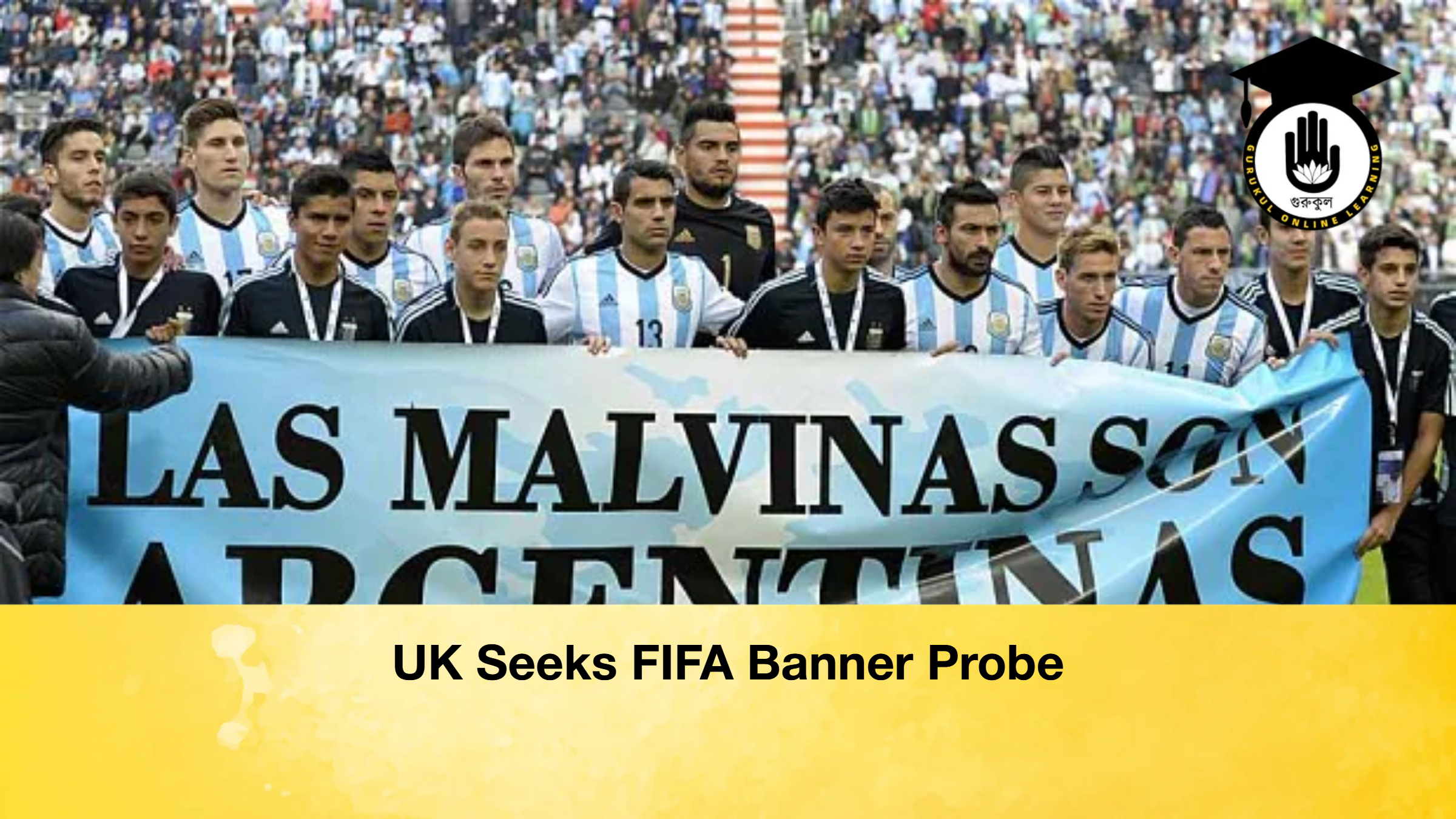

Britain has called on FIFA to investigate Argentina after its players displayed a banner declaring “Las Malvinas son Argentinas” (“The Falklands are Argentine”) following their 2–1 victory over England in the FIFA World Cup semi-final in Atlanta.
The post-match display has reignited the long-running sovereignty dispute over the Falkland Islands, prompting sharp criticism from the UK government. Ministers argued that political messages have no place on the football pitch and urged the sport’s governing body to determine whether FIFA regulations were breached.
Business Secretary Peter Kyle described the banner as an “egregious violation” of FIFA’s rules prohibiting political statements and symbols during official matches.
Speaking to the BBC, Kyle insisted that football should remain separate from political disputes.
“Politics needs to be separate from football. In fact, the World Cup has one of its central tenets that politics is separate from football. That is now a matter for FIFA. We expect FIFA to undertake a thorough investigation into this.”
His comments were endorsed by Prime Minister Sir Keir Starmer’s Downing Street office, which reaffirmed the United Kingdom’s position on the sovereignty of the South Atlantic archipelago.
“The World Cup might not be ours,” a Downing Street spokesperson said, “but the Falkland Islands definitely are.”
FIFA had not publicly commented on the incident at the time of reporting.
The dispute centres on the Falkland Islands, a British Overseas Territory located in the South Atlantic. Britain has administered the islands since the 19th century, while Argentina continues to maintain that the territory—known there as Las Malvinas—forms part of its national territory.
The issue remains one of the most sensitive subjects in relations between London and Buenos Aires. Tensions escalated dramatically in 1982 when Argentina invaded the islands, prompting then Prime Minister Margaret Thatcher to dispatch a naval task force. British forces regained control after a 74-day conflict that claimed the lives of 649 Argentine and 255 British military personnel.
Ahead of Wednesday’s semi-final, Argentina’s Vice President Victoria Villarruel further inflamed tensions by referring to the English as “usurping pirates”, remarks that attracted widespread attention before kick-off.
Diplomatic friction intensified again shortly after Argentina’s victory.
Foreign Minister Pablo Quirno announced that Argentina had lodged a formal diplomatic protest concerning the movements of the Royal Navy patrol vessel HMS Medway, which is permanently stationed in the Falkland Islands.
Writing on X, Quirno expressed what he described as Argentina’s “strongest rejection” of the ship’s “unconsulted and illegal” passage through waters claimed by Buenos Aires. He alleged that the United Kingdom had failed to provide the required prior notification and said a diplomatic note dated 13 July had been delivered to the British Embassy in Buenos Aires accusing HMS Medway of breaching bilateral agreements.
The United Kingdom has not publicly responded to those allegations.
Key developments
| Issue | Details |
|---|---|
| Match | Argentina defeated England 2–1 in the World Cup semi-final in Atlanta |
| Controversy | Argentina’s players displayed a banner reading “Las Malvinas son Argentinas” |
| UK response | Business Secretary Peter Kyle called for a FIFA investigation |
| Downing Street | Backed the request, insisting politics should remain separate from football |
| FIFA | No official response issued at the time of publication |
| Diplomatic dispute | Argentina protested the movement of HMS Medway near the Falkland Islands |
| Historical context | The 1982 Falklands War resulted in 649 Argentine and 255 British military deaths |
The controversy has once again highlighted how the decades-old Falklands sovereignty dispute continues to influence political and sporting relations between the United Kingdom and Argentina. While FIFA’s statutes generally prohibit political messaging during official competitions, it remains to be seen whether football’s governing body considers the banner sufficient grounds for disciplinary action.
Beyond the immediate sporting fallout, the incident has added fresh strain to already delicate diplomatic ties. With competing sovereignty claims remaining firmly entrenched, both governments appear determined to reinforce their respective positions, ensuring that a football match has once again become the backdrop for one of the world’s longest-running territorial disputes.