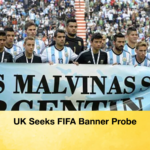

Argentina’s jubilant celebrations following a dramatic 2–1 World Cup semi-final victory over England have ignited a political controversy after players displayed a banner proclaiming “Las Malvinas son Argentinas” (“The Malvinas are Argentine”), a slogan directly linked to the long-running sovereignty dispute over the Falkland Islands.
The post-match scenes at Mercedes-Benz Stadium in Atlanta have prompted questions over whether the Argentine team could face disciplinary action from FIFA, whose regulations prohibit political messaging during official matches.
The incident has added a contentious chapter to one of football’s fiercest international rivalries, a fixture whose significance extends well beyond the sport.
A rivalry shaped by history
England and Argentina share one of international football’s most emotionally charged rivalries, influenced not only by memorable World Cup encounters but also by the 1982 Falklands War.
The 74-day conflict followed Argentina’s invasion of the Falkland Islands—known in Argentina as Las Malvinas—a British Overseas Territory in the South Atlantic. Britain responded by dispatching a naval task force, ultimately regaining control of the islands.
The conflict claimed the lives of 649 Argentine military personnel, 255 British service members, and three Falkland Islanders. More than four decades later, sovereignty over the islands remains one of the most contentious issues in UK–Argentina relations.
Ahead of Wednesday’s match, Argentina head coach Lionel Scaloni sought to distance football from geopolitics.
“Mixing the two would be crazy,” Scaloni said before kick-off, urging that the sporting contest should not be viewed through the lens of the historical conflict.
However, events following the final whistle took a different direction.
Banner displayed during celebrations
During the match, supporters in the Argentine section of the stadium displayed a large banner bearing the words “Las Malvinas son Argentinas.”
After Argentina completed a second-half comeback to book its place in the World Cup final, several players took possession of the banner and unfurled it on the pitch.
Reports indicated that midfielder Giovani Lo Celso was among the first to hold the banner alongside veteran defender Nicolás Otamendi. As celebrations continued, much of the squad assembled behind the message while acknowledging supporters in the Argentine end of the stadium.
Images of the celebration quickly spread across social media and international news outlets, drawing praise from some Argentine supporters while prompting criticism elsewhere for introducing a politically sensitive issue into a global sporting event.
Could FIFA intervene?
The banner’s display has raised the possibility of disciplinary action under FIFA and International Football Association Board (IFAB) regulations.
Both governing bodies maintain strict rules designed to prevent political, religious or personal messages from appearing during official competitions.
FIFA’s stadium code of conduct prohibits political banners, flags and other materials that contain political statements or discriminatory messaging. Likewise, the IFAB Laws of the Game state that players must not display political slogans or imagery on equipment or clothing, with breaches potentially resulting in sanctions imposed by the competition organiser, the relevant football association or FIFA.
At the time of publication, FIFA had not issued a public statement regarding the incident, and it remains unclear whether disciplinary proceedings will be opened.
Previous precedent
While any punishment affecting Argentina’s participation in Sunday’s World Cup final would be considered highly unlikely, financial sanctions would have precedent.
In 2014, FIFA fined the Argentine Football Association approximately £20,000 after players displayed a similar banner referencing the Falkland Islands before an international friendly against Slovenia.
Should FIFA determine that Wednesday’s display breached its regulations, a comparable financial penalty could be considered.
Focus shifts to the final
Despite the controversy, Argentina’s immediate attention will now turn to the World Cup final against Spain, where Lionel Scaloni’s side will attempt to retain the trophy and secure a fourth FIFA World Cup title.
Spain, meanwhile, will be pursuing only its second world championship, having lifted the trophy for the first time in 2010.
Whether FIFA chooses to investigate the celebrations before the final remains uncertain, but the incident has once again demonstrated how football can become intertwined with longstanding political and historical disputes.
Key facts
| Category | Details |
|---|---|
| Match | Argentina 2–1 England (World Cup semi-final) |
| Venue | Mercedes-Benz Stadium, Atlanta |
| Controversy | Players displayed banner reading “Las Malvinas son Argentinas” |
| Translation | “The Malvinas (Falklands) are Argentine” |
| FIFA regulations | Political messages and banners are prohibited during official competitions |
| Potential sanctions | Possible disciplinary action or financial fine; no FIFA decision announced |
| Historical context | 1982 Falklands War lasted 74 days |
| War casualties | 649 Argentines, 255 British personnel, and three Falkland Islanders killed |
| Previous precedent | Argentina fined approximately £20,000 by FIFA in 2014 over a similar banner |
| Next fixture | Argentina vs Spain in the World Cup final |