
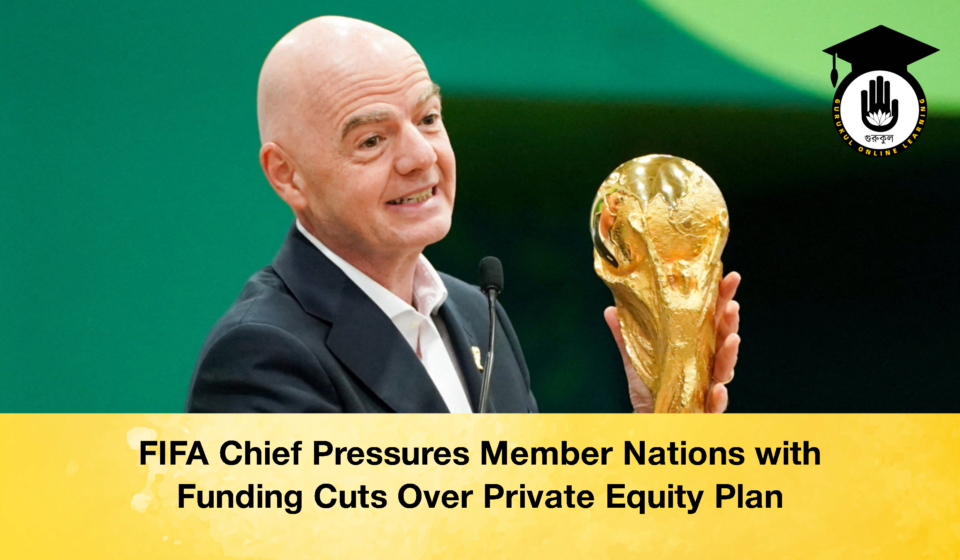

Gianni Infantino, the president of FIFA, has issued an ultimatum to the world governing body’s 211 constituent football associations. Funding packages worth up to $30 million (£23.5 million / BDT 3.7 billion) per nation could be on the line if members refuse to endorse a controversial scheme to bring private capital into World Cup commercial operations. The move represents a high-stakes effort by football’s global administration to use financial incentives—and penalties—to force through a major structural overhaul.
Reporting by British daily The Independent reveals that member associations have been handed a strict 53-day window to digest the proposal before a crucial vote on 19 September. If passed, the initiative will launch a dedicated commercial entity designated as FIFA Forward Enterprise (FFE). This new vehicle is designed to oversee lucrative broadcasting contracts, corporate sponsorships, match-day ticketing, and associated commercial assets for the Men’s World Cup and other flagship tournaments, opening the door to private equity ownership for the first time in the sport’s history.
The proposed financial blueprint lays out starkly contrasting outcomes for member associations based on their support. Voting in favour of the restructuring promises an increase in baseline FIFA Forward grants from roughly $8 million to $20 million across the 2027–2031 cycle, alongside a single supplementary grant of $20 million for supportive nations. Should the reform be rejected, standard payouts will cap at $10 million, effectively penalising dissenting associations by up to $30 million. Through this private capital venture, Zurich executives hope to raise around $4.2 billion, with projections to boost development allocations further to $24 million per member state for the 2035–2038 cycle.
| Financial Parameter / Allocation | Baseline Status Quo | Proposed Scheme (If Approved) | Default Scheme (If Rejected) |
| FIFA Forward Grant (2027–2031) | ~$8 million | $20 million | $10 million |
| One-Off Support Bonus | $0 | $20 million | $0 |
| Total Potential Funding (2027–2031) | ~$8 million | $40 million | $10 million |
| Projected Future Grant (2035–2038) | Standard Baseline | $24 million | Standard Baseline |
| Global Capital Raising Target | N/A | $4.2 billion | N/A |
| Voting Window Provided | N/A | 53 days | N/A |
| Decision Threshold Required | N/A | >50% Member Votes + Council | N/A |
| Potential Loss for Dissenters | N/A | N/A | Up to $30 million |
| Impacted FIFA Member Nations | 211 countries | 211 countries | 211 countries |
| Currency Equivalent (Max Grant) | N/A | ~£23.5 million / BDT 3.7 bn | N/A |
For developing football nations such as Bangladesh, the outcome of this vote carries immense weight. The Bangladesh Football Federation (BFF), alongside dozens of smaller member bodies, relies heavily on FIFA grants to maintain basic infrastructure, conduct national squad camps, and run grassroots academies. Infantino himself has previously observed that without Zurich’s direct financial intervention, organised football would founder in nearly 150 nations worldwide. Depriving these smaller bodies of expanded grants could stall football development across South Asia and similar regions for years to come.
Despite the promise of substantial cash injections, the plan has provoked fierce opposition from influential European figures. European football governing body UEFA strongly condemned the strategy, warning that FIFA risks commercialising the core identity of the sport. European executives have held urgent discussions to map out a collective strategy, with some representatives raising the prospect of a World Cup boycott should the reform proceed unchanged.
The English Football Association (FA) similarly voiced severe disappointment, confirming it received no prior briefing before the announcement. An official FA statement highlighted deep unease regarding governance standards, procedural transparency, and the overall ethics of the proposal, adding that a complete evaluation will follow full disclosure of the plans. CONCACAF, which represents North and Central America, has expressed similar scepticism. Nevertheless, Infantino remains confident that solid alignment across Asian, African, and South American delegations will comfortably deliver the simple majority required alongside FIFA Council ratification.