
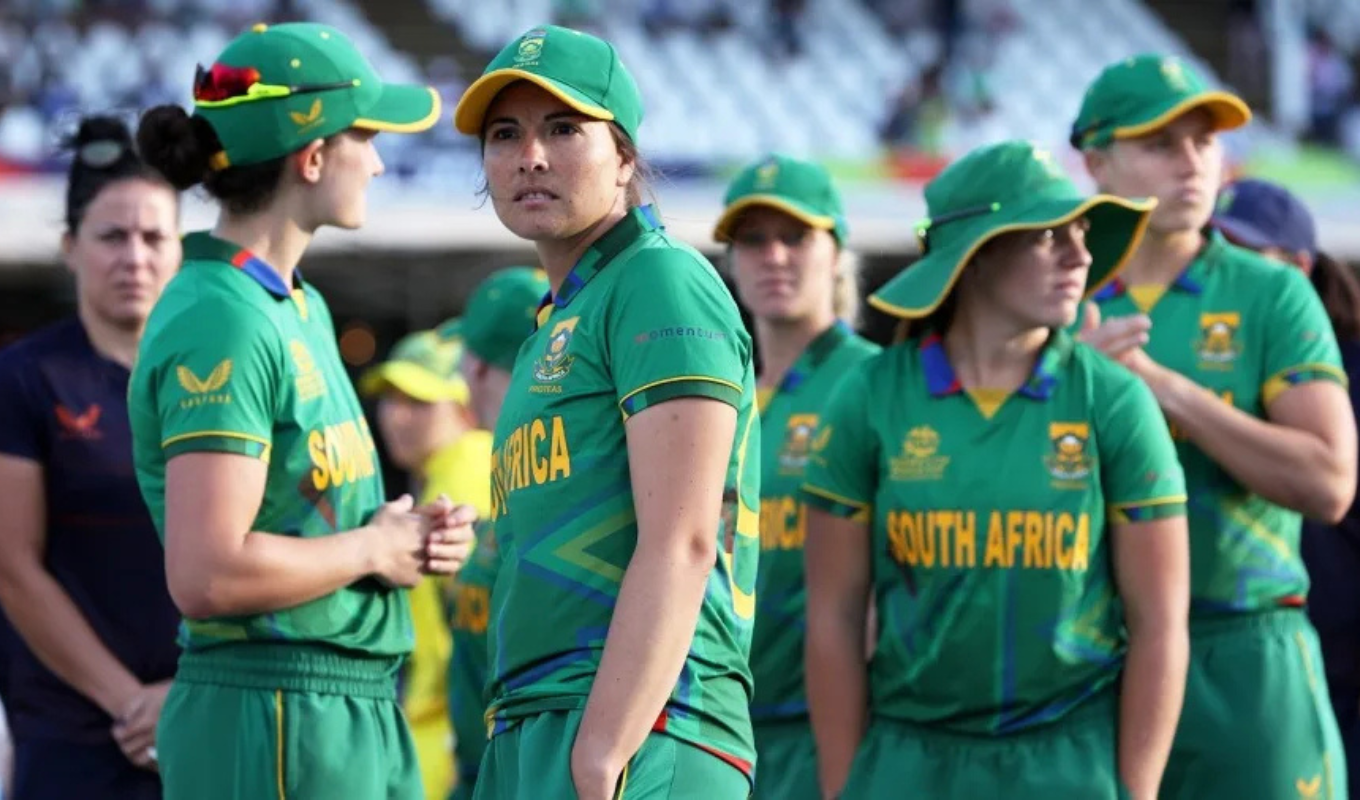

When the Indian team were celebrating their title victory at Mumbai’s DY Patil Stadium after the final, the scene in the South African dugout was one of heartbreak. Marizanne Kapp, perhaps playing in her last ODI World Cup, sat with tears in her eyes. Beside her, captain Laura Wolvaardt and Nadine de Klerk looked stunned, struggling to maintain composure. Tazmin Brits sat alone, perhaps thinking, “If only we’d done just a little more…”
Another final, another shattered dream—this scene seems almost like a curse that has followed South African cricket. Whether men’s or women’s, the story of falling short at the decisive moment is an old one for the Proteas. And so, the question arises once more: are South Africa still the ‘chokers’?
In the 2023 T20 World Cup, the South African women’s team reached the final for the first time, on home soil. Though they ended as runners-up, it was a historic moment. This time, with a more mature and balanced squad, they reached the final of the ODI World Cup. After demolishing England in the semi-final, they fought valiantly against hosts India in the final—but the outcome was the same: heartbreak.
Many believe something happens to South Africa in finals—they simply cannot handle the pressure. Yet, looking at their performance this time, that assumption seems less fair. They fought hard, created chances, but once again, luck deserted them at the crucial moments. Legendary batter Wolvaardt had a phenomenal tournament—she was the top run-scorer of the edition and the second-highest in the history of the Women’s ODI World Cup. She scored back-to-back centuries in the semi-final and final, took eight catches, and led her team superbly on the field. And yet, the trophy slipped away from her grasp.
After the match, Wolvaardt said, “Today (yesterday), we fell behind—India played better than us. But we played some brilliant cricket throughout this tournament. At one point, we won five consecutive matches. That’s a huge achievement for our team. What’s most important now is to build consistency.”
She added that throughout the tournament, different players stepped up at different times. “We played well against spin in subcontinental conditions. Our pacers were outstanding too—at times even more economical than the spinners. Kapp was exceptional, and Nadine performed brilliantly as well.”
Before the World Cup, South Africa had won only six of their 13 ODIs in a year. They had lost a series to England and failed to reach the final in a tri-series involving India and Sri Lanka. Yet, in the World Cup, they defeated both those teams and exacted revenge on England—after being bowled out for 69 in the group stage, they crushed the same opponent by 125 runs in the semi-final.
Coach Dinesha Devnarain’s assistant, MANDLA MASHIMBYI—who took charge just ten months ago—expressed immense pride in the team’s progress. “Since I took over, I’ve been proud to see how far the team has come. When no one gave us a chance, we believed in ourselves. Reaching the final itself shows that we are moving forward.”
While South Africa’s men’s team has long matured, the women’s side are still building. It has been just over a decade since the establishment of their professional cricket structure. Yet, in this short time, they have reached six finals across various formats and levels. “Cricket in South Africa is in a great place right now,” Mashimbyi said. “We are learning from our mistakes and growing stronger.”