
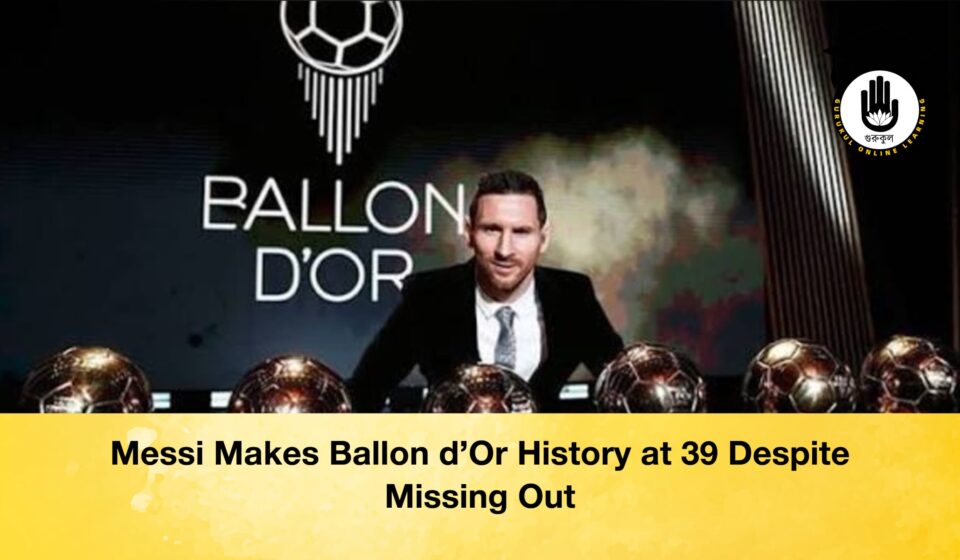

Lionel Messi may have missed out on the 2026 Ballon d’Or, but the Argentine superstar has still secured a place in the award’s record books. At 39 years and four months, he has become the oldest outfield player to finish in the top five, adding another milestone to a career that has spanned more than two decades at the highest level.
England captain Harry Kane claimed the prestigious individual honour, while Messi finished fifth in the rankings. Although he fell short of another Ballon d’Or triumph, his position among the leading contenders underlines his remarkable longevity and continued relevance in elite football.
For most outfield players, maintaining a place among the world’s best becomes increasingly difficult with age. Modern football demands sustained fitness, quick reactions, tactical awareness and the ability to perform under intense physical pressure. Messi’s achievement at 39 highlights his capacity to remain competitive despite those challenges.
Throughout his career, Messi has earned acclaim for his exceptional ball control, vision, passing and goalscoring ability. His influence is not limited to finding the net. He can dictate the pace of a match, create opportunities for teammates and produce decisive moments that change the course of a game. Those qualities have helped him remain a prominent figure in world football long after many players of his generation have retired.
There is, however, an important distinction to the age record. Messi is the oldest outfield player to finish in the Ballon d’Or top five, but he does not hold the overall record when goalkeepers are included.
That distinction belongs to Italian goalkeeping legend Gianluigi Buffon, who finished fourth in the 2017 Ballon d’Or rankings at the age of 39 years and 10 months. His achievement remains a notable example of longevity in elite football, where experience, anticipation and composure can allow goalkeepers to compete at the highest level well into their late thirties.
Messi’s record applies specifically to outfield players, whose roles generally involve more continuous running and physical engagement. Finishing fifth at 39 years and four months places him in a unique position among the award’s leading contenders and reflects his ability to adapt his game as he has grown older.
The year 2026 was also significant for Messi on the international stage. He helped Argentina reach the World Cup final, raising hopes that he could add another major international title to his collection. Argentina, however, fell short at the final hurdle, losing to Spain.
Winning the World Cup might have strengthened Messi’s case for another Ballon d’Or, although the award is not determined by the outcome of a single tournament alone. Performances for club and country, individual contributions and achievements throughout the season all help shape the final rankings.
Messi has already won the Ballon d’Or eight times, more than any other player in the award’s history. His latest finish did not bring a ninth title, but it has added a different kind of distinction to his remarkable career. At an age when many footballers have left elite competition behind, he remains capable of challenging the sport’s leading names.
His fifth-place finish is therefore significant beyond the final standings. It serves as a reminder that longevity, technical excellence and consistency can be just as remarkable as winning another trophy.
For Messi, the 2026 Ballon d’Or may not have delivered the ultimate prize, but it has provided another reason for his name to remain firmly embedded in football history.