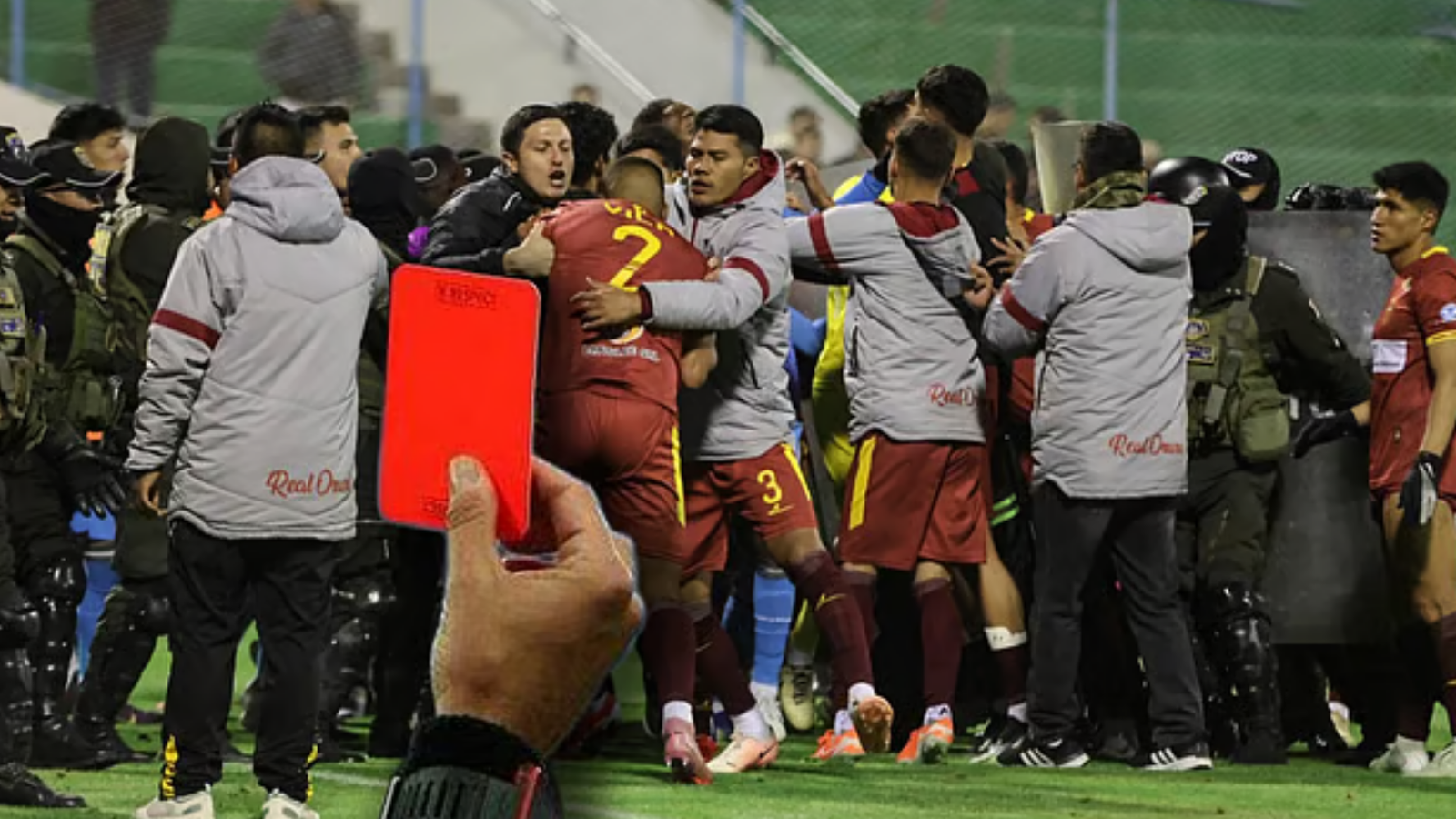

The annual Bolivian Cup, known locally as the Copa Bolivia, is usually an event filled with excitement, crowd enthusiasm and footballing passion. However, this year’s quarter-final second leg between Real Oruro and Blooming has stolen the spotlight for all the wrong reasons. What should have been a decisive and competitive fixture ended in utter chaos, culminating in an astonishing seventeen red cards, widespread violence and police intervention involving tear gas.
The match took place at the Jesús Bermúdez Stadium, where Real Oruro played host to Blooming. Having secured a 2–1 victory in the first leg, Blooming only needed a draw to progress. They did exactly that, finishing the second leg with a 2–2 scoreline and advancing to the semi-finals with a superior aggregate. But the football result was quickly overshadowed by what followed.
According to Bolivian outlet El Potosí, the violent incident erupted immediately after the final whistle. Real Oruro’s players and coaching staff reportedly initiated the confrontation, seemingly unable to accept their elimination. Tensions that had simmered throughout the match erupted suddenly into full-blown physical aggression.
Video footage broadcast by official channels shows Real Oruro players Sebastián Ceballos and Julio Villa, along with head coach Marcelo Robledo, charging onto the adjacent athletics track to confront Blooming players and staff. Ceballos appeared to be repeatedly restrained by Blooming’s footballers as he attempted to continue the altercation. Coach Robledo was seen embroiled in a heated scuffle with a member of Bolivia’s national team staff. Meanwhile, Villa landed a punch squarely on the face of a Blooming player, inflaming the situation further.
The cause of the brawl remains uncertain. Some reports suggest that Real Oruro’s players simply refused to accept the aggregate outcome, losing their composure in frustration. Others believe the incident stemmed from bitterness accumulated during the match, with repeated fouls and verbal clashes serving as precursors to the eruption.
What followed was nothing short of pandemonium. As pushing, punching and shouting escalated, twenty police officers rushed onto the pitch in riot gear. Struggling to control the situation, they were forced to fire tear gas to disperse the players and staff. Spectators witnessed a scene more reminiscent of civil unrest than a football match. Many were left coughing and scrambling for safety as the gas drifted into the stands.
The Mirror reported that, according to the official match document, Blooming saw seven players sent off, while Real Oruro had four players dismissed. A further six members of the coaching and support staff from both sides were also shown red. This brought the total to a staggering seventeen dismissals, marking one of the most extreme disciplinary episodes in recent football history.
The consequences will be severe. At least six Blooming players are already suspended for upcoming Copa Bolivia fixtures, jeopardising their squad depth ahead of the semi-finals. The referee, Renan Castillo, has submitted a supplementary report to the Bolivian Sports Disciplinary Tribunal, where even harsher sanctions may be imposed.
Meanwhile, Real Oruro head coach Marcelo Robledo sustained a shoulder injury during the melee and required hospital treatment. Bolivian outlet Vision360 confirmed his condition as stable but requiring rest.
Authorities in Bolivia have launched a full investigation, with expectations of strict disciplinary actions. Many critics argue that the event has tarnished the nation’s football image, calling for stronger security protocols and harsher punishments to prevent such incidents in the future.
Ultimately, the night will be remembered not for the beautiful game, but for an ugly episode of violence that stunned the world of sport.