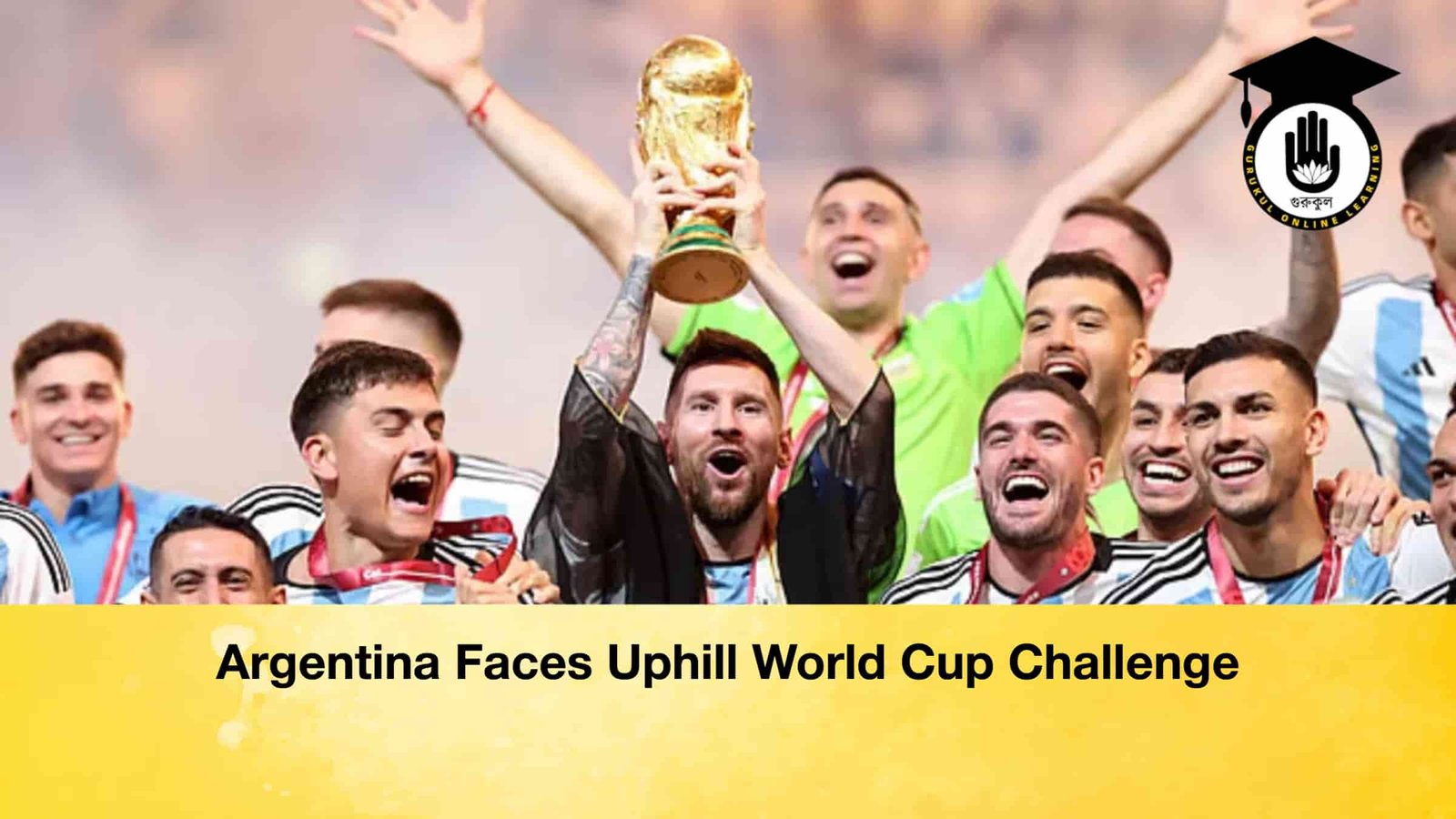
Three and a half years ago, a spellbinding night unfolded in Lusail. Lionel Messi lifted the World Cup, and for many, football seemed to reach its zenith. Seven goals in seven matches, two in the final, and three assists—Messi’s golden ball was a natural acknowledgement of his mastery. He was not merely Argentina’s captain; he was the heartbeat of the team, the embodiment of their spirit.
Yet, to call Argentina simply “Messi’s team” would be an injustice. Players such as Julián Álvarez, Alexis Mac Allister, and Enzo Fernández emerged as stars on the global stage. Fernández won the award for the tournament’s best young player. Nicolás Otamendi marshalled the defence with unyielding resolve. Ángel Di María dazzled with his skill, while Emiliano Martínez became a nightmare for opponents during penalty shootouts.
The resilience Argentina showed after their shock defeat to Saudi Arabia—bouncing back with unmatched unity—remains unparalleled.
Current State Ahead of 2026
Now, with the 2026 World Cup approaching, the picture is far less clear. Lionel Scaloni’s side has shown signs of decline in their dominance. Preparations have been erratic, leaving much of the burden once again on Messi, now 37 years old, to carry the team forward.
Statistically, Argentina performed well in qualifiers, topping the CONMEBOL table with nine points ahead of Ecuador and securing World Cup qualification. Messi, with eight goals, led the scoring charts for the first time in a qualifying campaign.
| Player | Role | Key Notes for 2026 |
|---|---|---|
| Lionel Messi | Forward | 37 years old, form still vital; 4 goals in 4 MLS matches |
| Julián Álvarez | Forward | In top form with Atlético Madrid |
| Lautaro Martínez | Forward | Strong season at Inter Milan |
| Enzo Fernández | Midfield | Emerging star, scored in recent friendlies |
| Nicolás Otamendi | Defence | 38 years old, slower, more errors |
| Emiliano Martínez | Goalkeeper | Experienced but occasional mistakes |
| Ángel Di María | Forward | Retired from international football |
| Nico Paz | Midfield | Young talent, limited experience |
However, numbers can be misleading. Losses to Uruguay and Paraguay, and a draw against Colombia, suggest vulnerability. Even Copa América victory did not showcase Argentina at their peak—they won, but did not inspire awe. Friendly matches against lower-ranked sides such as Mauritania (115th in FIFA rankings) and Zambia (91st) have revealed a lack of intensity and cohesion.
Scaloni himself acknowledged the team’s underwhelming display, and Martínez labelled it “one of our worst friendly performances.” The cancellation of the Finalissima against Spain, due to geopolitical conflict, removed a valuable opportunity to face top-tier opposition, leaving Argentina untested against Europe’s elite.
With ageing defenders, inconsistent midfielders, and the uncertainty surrounding Messi’s participation, Argentina faces a daunting path. The team will rely heavily on glimpses of brilliance from Álvarez, Lautaro Martínez, and Fernández, but the squad’s overall depth is thin compared to rivals like Spain and France.
In short, Argentina’s 2026 World Cup campaign will demand near-miraculous resilience. The question remains: does Messi still possess the magic to guide his nation once more?