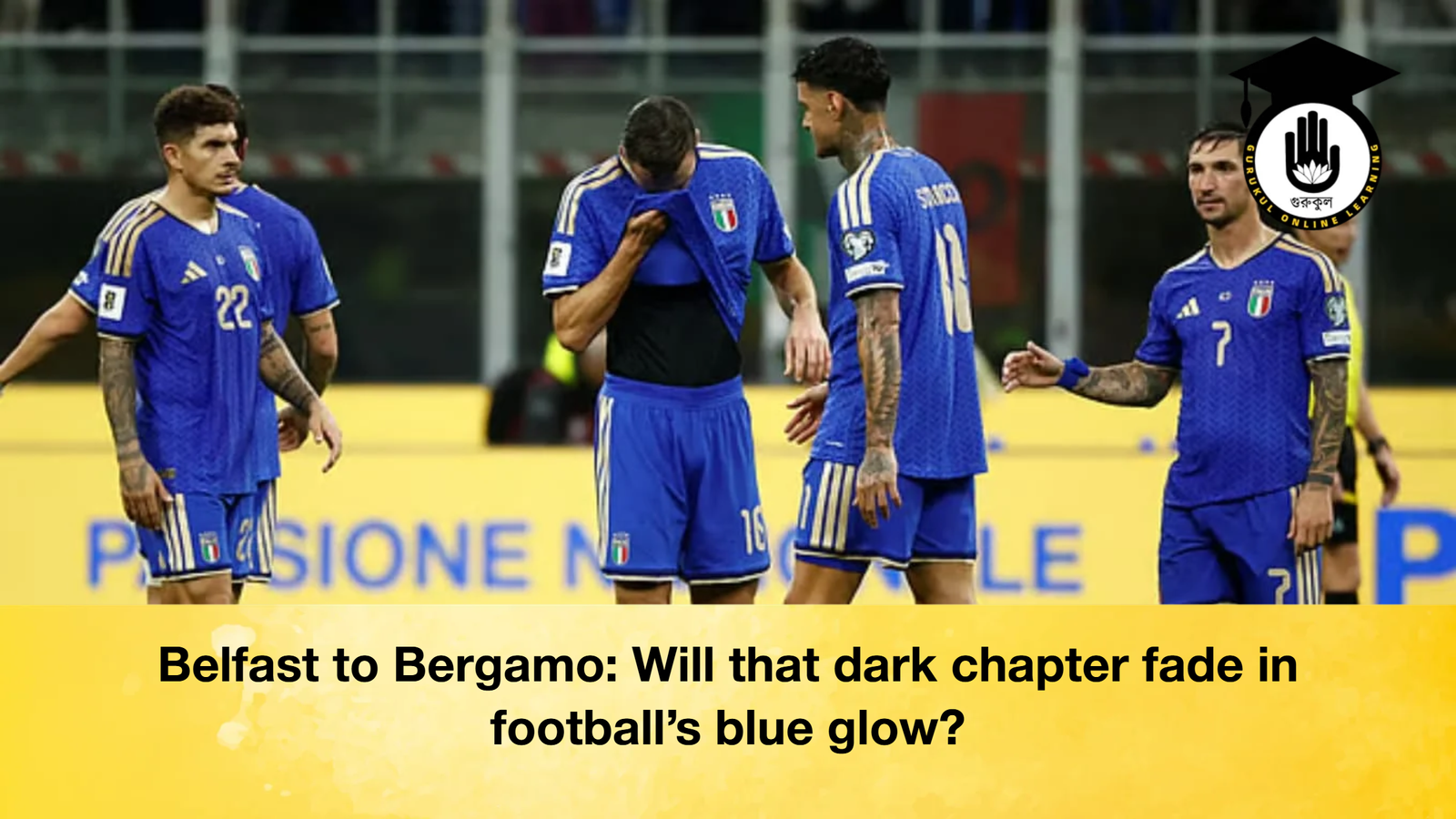
The journey from Belfast to Bergamo is not merely a passage across time and geography; it is a narrative woven deeply into Italy’s footballing psyche. Nearly 68 years after one of the most controversial and emotionally charged episodes in its sporting history, Italy once again finds itself facing Northern Ireland at a decisive moment. Under the stewardship of Gennaro Gattuso, the Azzurri are not only required to win this fixture but must also negotiate a subsequent play-off final to secure qualification for the 2026 World Cup.
Unlike the tense group-stage decider of 1958, this encounter takes place in a knockout context and, crucially, on Italian soil. Yet despite the change in setting, the echoes of Belfast continue to reverberate through Italian football memory, casting a long psychological shadow over the present generation.
The Foni Era and the Birth of Catenaccio
Following Italy’s disappointing exit from the 1954 World Cup group stage, Alfredo Foni—successful with Inter Milan in Serie A—was appointed national coach. He introduced a defensive philosophy that would later evolve into the famed catenaccio system: a sweeper behind three central defenders, designed to create an almost impenetrable defensive structure supported by rapid counter-attacks.
However, Italy’s attacking limitations proved significant. The domestic game lacked prolific forwards, prompting reliance on naturalised players of Italian descent (oriundi) such as Juan Schiaffino and others from South America. By the mid-1950s, however, many of these players were approaching the twilight of their careers.
Road to Crisis
Italy’s qualification campaign for the 1958 World Cup placed them alongside Portugal and Northern Ireland. While they began promisingly with a 1–0 victory in Rome over Northern Ireland, momentum quickly collapsed following a humiliating 6–1 defeat to Yugoslavia and a 3–0 loss in Lisbon.
Qualification Group Summary
| Team | Played | Points Situation (Context) | Key Result vs Italy |
|---|---|---|---|
| Italy | 4 | Eliminated | 1–0 win, 2 defeats |
| Northern Ireland | 4 | Qualified | 2–2 draw (abandoned fixture context) |
| Portugal | 4 | Contended | 3–0 win vs Italy |
| Yugoslavia | — | Strongest side | 6–1 vs Italy |
In this fragile context emerged the infamous “Battle of Belfast”.
The Belfast Turmoil
On 4 December 1957, heavy fog disrupted arrangements for the match in Belfast, preventing the arrival of the appointed referee. Despite FIFA’s inclination to postpone the fixture, pressure from spectators led to a chaotic rearrangement, with the game effectively treated as a friendly before a replay was scheduled.
What followed descended into one of football’s darkest spectacles. Sections of the crowd invaded the pitch, and Italian players were reportedly assaulted. Radio commentary of the time captured the panic and confusion, while Northern Ireland captain Danny Blanchflower was instrumental in protecting opposition players and escorting them to safety.
Although the match ended 2–2, it was later declared unofficial, leaving Italy without any sporting benefit.
The Decisive Replay
The replay on 15 January 1958 was played in harsh winter conditions—freezing temperatures, persistent rain, and a heavily saturated pitch. Foni fielded an attacking trio including Ghiggia, Pivatelli, and Dino Da Costa, but Italy struggled to impose their rhythm.
Northern Ireland struck twice within the first half hour. Despite a second-half response from Da Costa, Italy’s hopes were further shattered when Alcides Ghiggia, hero of the 1950 Maracanazo, was sent off. Reduced to ten men, Italy succumbed 2–1 and were eliminated from World Cup qualification for the first time in their history.
Consequences and Collapse
The aftermath in Italy was immediate and severe. Press outrage dominated headlines, with La Gazzetta dello Sport describing it as a national football catastrophe. Foni was heavily criticised for tactical rigidity and overreliance on oriundi, while the Italian Football Federation underwent structural upheaval.
Many players never represented the national team again, and Foni’s tenure effectively ended.
Present-Day Echoes
Today, nearly seven decades later, Italy again faces Northern Ireland in a high-stakes encounter shaped by recent disappointments, including missing the 2018 and 2022 World Cups. A third consecutive absence would represent an unprecedented crisis in modern Italian football.
The parallels are impossible to ignore, even if circumstances have changed. The stage is now Bergamo, not Belfast; knockout pressure replaces group-stage tension; and redemption, rather than survival, defines the objective.