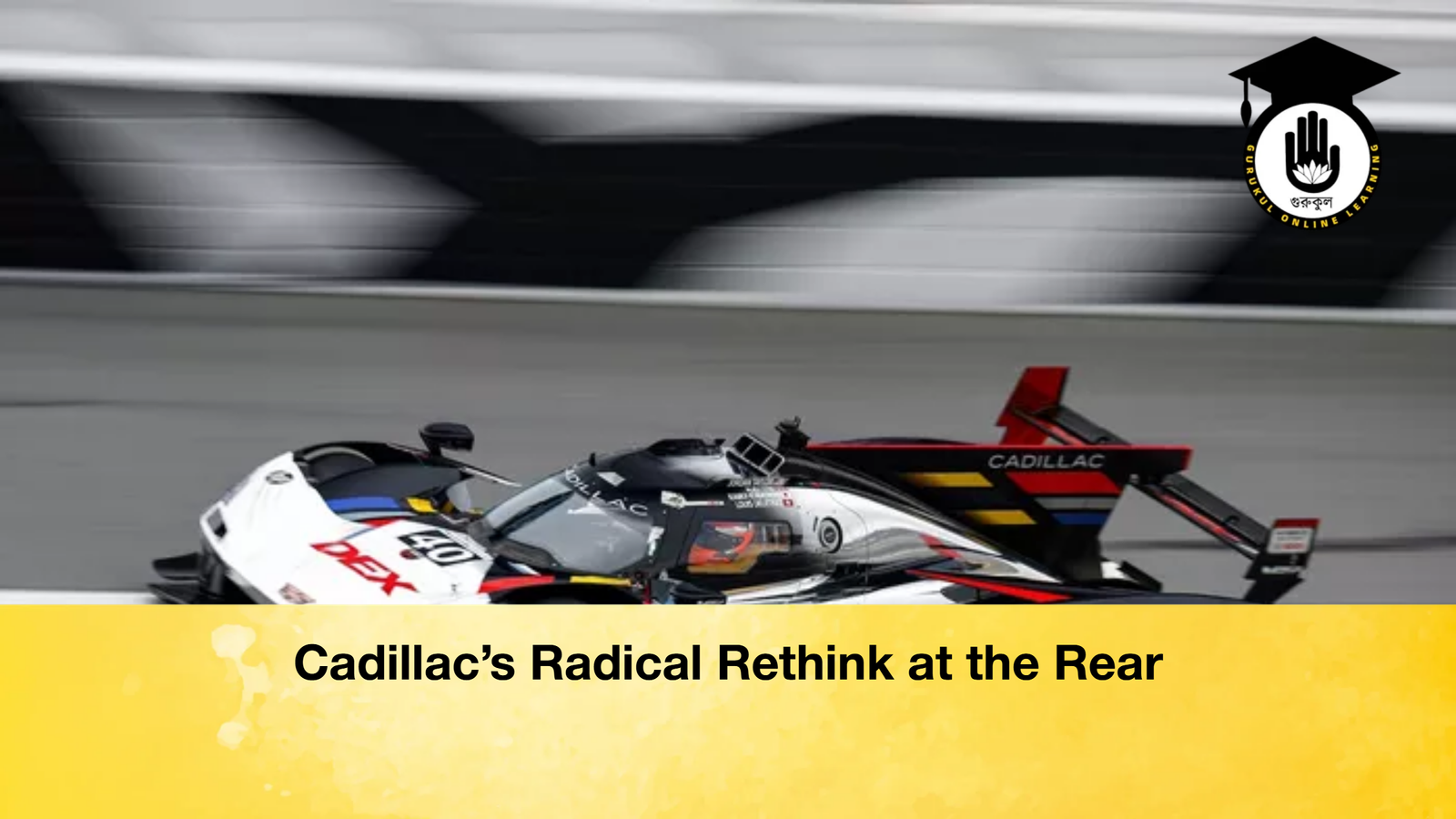
Cadillac’s LMDh programme has never lacked visual presence, but its latest evolution has taken even seasoned endurance racing observers by surprise. The 2026-specification Cadillac V-Series.R arrived at the Rolex 24 at Daytona sporting an unusually low-mounted rear wing, a design choice that immediately drew attention in the paddock. While striking to the eye, the new wing is not a stylistic flourish; it represents a deliberate and far-reaching shift in Cadillac’s aerodynamic philosophy.
Drivers were among the first to notice the change. Jordan Taylor described the new look as “cool and aggressive”, noting how different it felt compared with the more conventional rear wing used last season. By the time the Daytona race weekend began, however, the novelty had already worn off for the drivers, who had accumulated extensive mileage during the November pre-test and the Roar Before the 24.
The rationale behind the redesign lies in the constraints of LMDh regulations. Manufacturers are permitted only one adjustable aerodynamic device. In previous seasons, Cadillac elected to make the front splitter that tool, adjusting aero balance primarily through splitter settings and changes in rake. With the 2026 Evo package, that logic has been reversed. The rear wing is now the sole adjustable element, fundamentally altering how the team approaches set-up.
According to the Taylors, this has proved transformative. Rather than chasing balance through the front of the car, engineers can now tune the rear, offering a more intuitive and flexible means of adapting to different circuits. The change has also delivered a more stable and predictable platform, particularly over long stints.
Perhaps the most compelling motivation for the new wing, however, was the V-Series.R’s sensitivity to turbulent air. Cadillac’s World Endurance Championship partner Jota had identified this as a significant weakness in 2025. While the car was formidable in clean air, it became notoriously difficult to drive when tucked up behind traffic, making overtaking an exhausting and sometimes futile exercise.
Lowering the rear wing has addressed that issue directly. By placing the wing in a region of airflow that has already been conditioned by the car’s bodywork, Cadillac has reduced its exposure to the chaotic aerowash generated by cars ahead. The result is a more consistent aerodynamic platform when following rivals closely, improving confidence and raceability.
Importantly, the visual minimalism does not come at the expense of performance. All LMDh cars operate within a tightly controlled aerodynamic window, and drivers insist that the V-Series.R has lost no meaningful downforce. Instead, the redesign appears to have corrected a long-standing imbalance, preserving cornering strength while improving straight-line efficiency.
An unexpected consequence has been the altered view from the cockpit. With the wing sitting so low, it has all but disappeared from the mirrors, offering drivers a rearward perspective unlike anything they have previously experienced.
The first competitive test at Daytona suggested the theory works in practice. The Action Express Racing Cadillac remained a contender deep into the race, and those behind the wheel reported a markedly calmer and more forgiving car in traffic. In endurance racing, where adaptability and consistency are paramount, Cadillac’s bold aerodynamic rethink appears to have delivered exactly what was intended.
Cadillac V-Series.R: rear wing comparison
| Aspect | Previous design | 2026 Evo design |
|---|---|---|
| Wing position | High-mounted | Ultra-low mounted |
| Adjustable aero | Front splitter | Rear wing |
| Traffic behaviour | Sensitive to dirty air | Improved stability |
| Driver feedback | Strong in clean air | More consistent overall |
| Visual impact | Conventional | Striking and aggressive |
If Daytona is any indication, Cadillac’s low rear wing may prove to be one of the most influential LMDh developments of the new season.