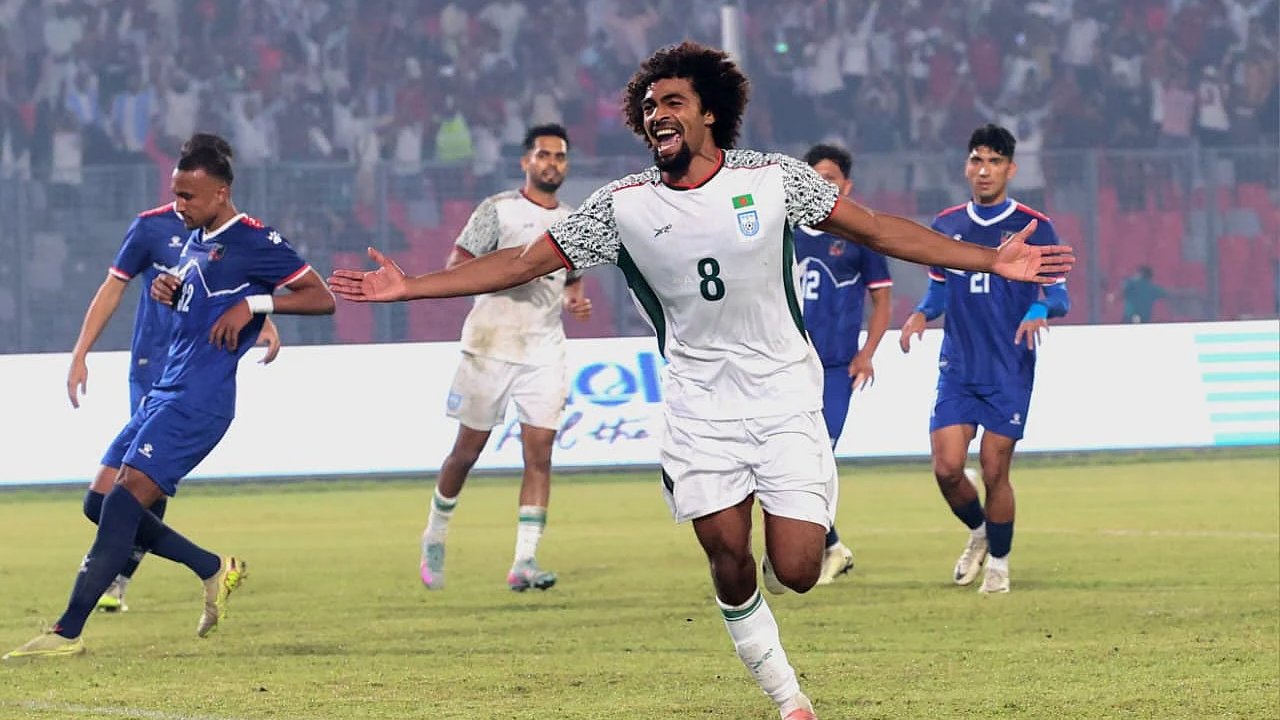
Bangladesh 2–2 Nepal
At the Bangabandhu National Stadium in Dhaka, Bangladesh once again fell victim to a last-minute lapse, drawing 2–2 with Nepal in an international friendly they seemed destined to win. Despite a spirited second-half display inspired by Hamza Choudhury’s brace, a stoppage-time equaliser from Ananta Tamang denied the home side a long-awaited victory.
The crowd turnout was modest, with nearly half the seats remaining empty. Unlike the recent matches against Singapore and Hong Kong, the stands lacked their usual roar, remaining subdued for much of the first half.
Nepal struck first in the 29th minute through Rohit Chand, who found the net with a low drive from the edge of the box after a clever cut-back from defender Sunit Shrestha. It was Chand’s second international goal in his 102nd appearance.
Coach Javier Cabrera introduced youngster Shommit Shom at the break, replacing Junior Sohel Rana, and the change immediately injected life into Bangladesh’s play. Within two minutes of the restart, Faisal Ahmed’s cross caused confusion inside the Nepali box, and from a loose ball, Jamal Bhuiyan’s delivery was met by Hamza Choudhury’s acrobatic bicycle kick to level the score at 1–1.
Moments later, Bangladesh were awarded a penalty. Hamza stepped up confidently and sent the goalkeeper the wrong way, turning the match on its head within five minutes of the restart. The English-born midfielder, who plays for Leicester City, has now scored four goals in just six appearances for the national team.
However, the joy was short-lived. Hamza was substituted in the 80th minute due to a knock, making way for debutant Kuba Mitchell. With victory within reach and fans already anticipating a first win over Nepal since 2020, disaster struck in stoppage time. From a corner, defender Ananta Tamang reacted quickest inside the crowded box to tap home, snatching a draw for the visitors and leaving Bangladeshi supporters heartbroken once more.
The pattern was painfully familiar. Bangladesh had also conceded late goals against both Singapore and Hong Kong in their previous fixtures. The team’s inability to stay composed in the dying moments has become a recurring concern for Cabrera.
Speaking after the match, former national goalkeeper Biplob Bhattacharjee expressed his frustration from the press box:
“Hamza’s magic nearly brought us a win, but it wasn’t to be. The midfield looked disjointed, and the overall performance lacked creativity. We didn’t control the game as we should have.”
In truth, the first half was a dismal one for Bangladesh. They managed only a single shot on target in the opening 40 minutes, struggling for rhythm and cohesion. The link-up play between Jamal and Sohel Rana faltered, while the midfield failed to produce any incisive passes.
Cabrera made three changes from the line-up that faced Hong Kong on 14 October. Injured forward Sheikh Morsalin was ruled out, with Shommit Shom and Shakil Ahad also left on the bench. Faisal Ahmed returned to the starting eleven and initially played on the right flank, later moving to his preferred left wing in the second half where he looked far more effective.
For Nepal, five of their starting eleven currently play in the Bangladesh Premier League, adding an extra layer of familiarity to the contest. Despite being under pressure for much of the second half, they showed admirable resilience and left the pitch celebrating the draw as if it were a win.
Bangladesh last defeated Nepal on 13 November 2020, winning 2–0. Since then, the sides have met four times, with two draws and two Nepali victories. Their most recent encounter in Kathmandu ended goalless in September.
Missing the chance to end that five-year drought will sting for Bangladesh, particularly with the crucial Asian Cup qualifier against India looming on 18 November. Cabrera’s men showed flashes of promise, but until they find consistency — and composure in the closing stages — their long wait for a statement win continues.