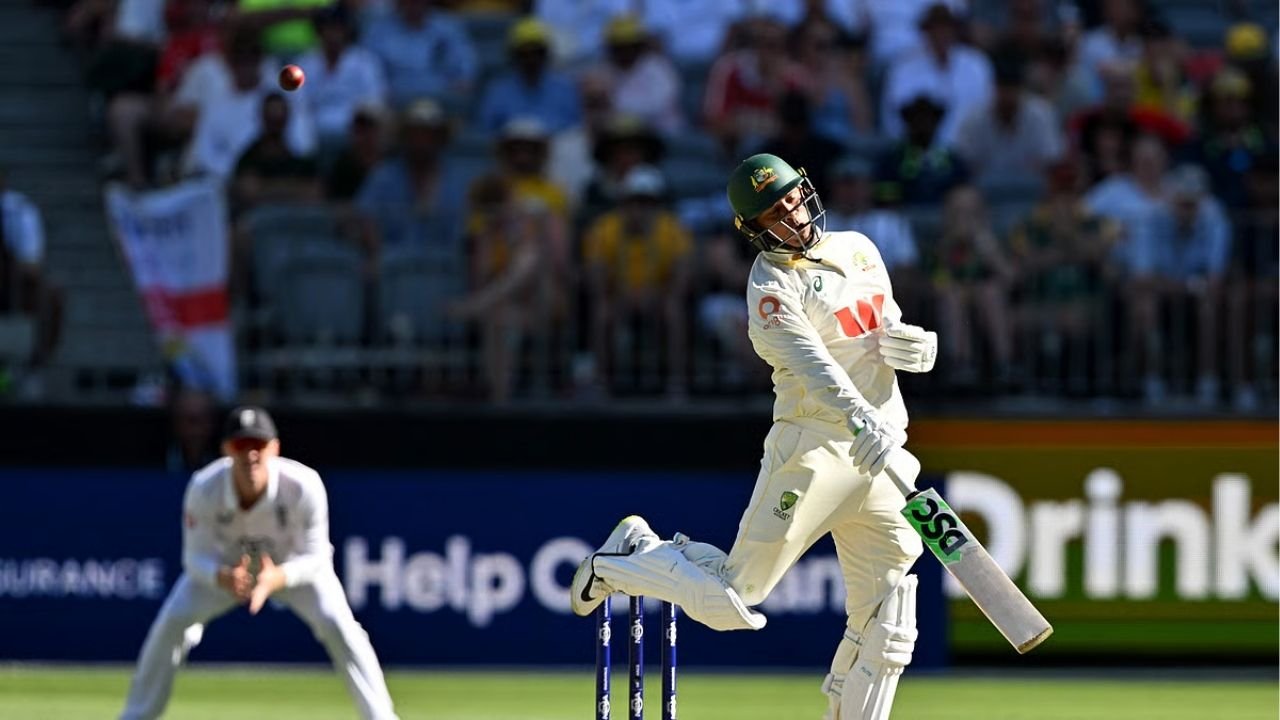
Australian opener Usman Khawaja was forced to bat at number four in the first Ashes Test in Perth, not out of choice but due to an ICC regulation. Khawaja, a seasoned Test campaigner with 153 innings, has batted at number four only twice in his career—the most recent being yesterday. Previously, he occupied the position in 2016 against Sri Lanka when Nathan Lyon was sent in as a nightwatchman at number three.
The unusual batting order was triggered by Khawaja being off the field for 19 minutes during England’s first innings. He left after the 29th over and returned in the 32nd over. During his absence, England lost their remaining three wickets, finishing at 172 all out. According to ICC Test Playing Condition 24.2.3, a player cannot spend more than eight minutes off the field without triggering penalties.
Under clause 24.2.3.2, if a player exceeds this time, they cannot bat until the equivalent penalty time has elapsed, unless five wickets fall in the team’s innings, in which case they may bat immediately. Any remaining penalty carries over to subsequent innings. Initially, Australian media reported that Khawaja exceeded his allotted break for a toilet and massage by 11 minutes. Cricket Australia later clarified that Khawaja struggled with muscle tightness throughout England’s innings, necessitating the extended break.
When Khawaja returned, Jake Weatherald was dismissed in the first over by Jofra Archer, and Khawaja was still serving his penalty. He could not take the number three position and only entered at number four after Marnus Labuschagne’s dismissal. Unfortunately, he scored just two runs before being dismissed.
This incident highlights the interplay between strict ICC regulations, player fitness, and match strategy, demonstrating how even top-order batsmen can be reshuffled due to rule enforcement and physical limitations.