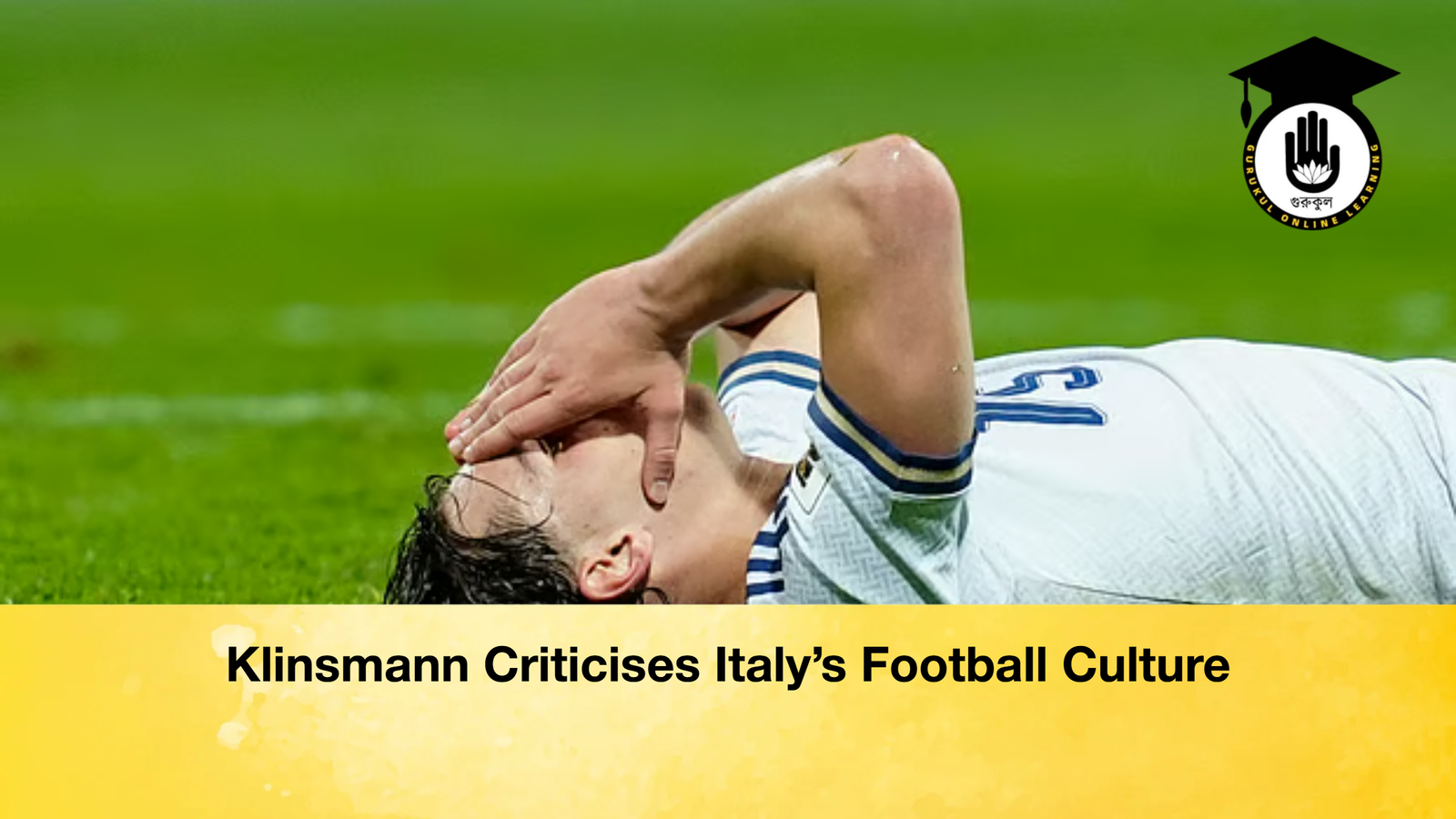
Germany legend Jürgen Klinsmann has delivered a scathing assessment of Italian football following the national team’s failure to qualify for the FIFA World Cup. Italy, once a dominant force in international football, has now missed out on the tournament for a third consecutive time—an unprecedented slump that has intensified scrutiny from pundits and former players alike.
The Azzurri’s latest disappointment came in the European play-off final against Bosnia and Herzegovina. After a tightly contested encounter ended 1–1 following both normal and extra time, Italy were comprehensively beaten 4–1 in the penalty shootout. The defeat sealed their elimination and extended a troubling pattern of underachievement on the global stage.
Klinsmann, who enjoyed a successful playing career in Italy with Inter Milan and Sampdoria, spoke with evident emotion about the outcome. Drawing on his long-standing connection with Italian football—and noting that his son, Jonathan Klinsmann, currently plays for Cesena FC—he expressed both personal disappointment and professional concern.
Speaking to an Italian sports outlet (newspaper name identified and omitted), Klinsmann revealed how deeply the result affected him: he spent the evening with Italian friends in Los Angeles and admitted he was unable to sleep afterwards due to the shock and sadness of the defeat.
Beyond emotion, however, his critique was sharply analytical. According to Klinsmann, Italy is suffering from a fundamental leadership deficit on the pitch. He argued that the current squad lacks players capable of consistently winning one-on-one duels or producing moments of individual brilliance—qualities increasingly vital in modern football.
To illustrate his point, Klinsmann invoked the examples of rising stars Lamine Yamal and Jamal Musiala. He suggested that, had such players emerged within Italy’s system, they might have been relegated to the second division under the pretext of “gaining experience,” rather than being fast-tracked into top-level competition. This, he implied, reflects a broader reluctance within Italian football to trust and develop young talent.
Klinsmann also criticised the country’s entrenched tactical philosophy. In his view, many Italian coaches remain overly cautious, prioritising defensive solidity and the avoidance of defeat rather than pursuing victory with ambition and attacking intent. While such pragmatism once defined Italy’s success, he argued that it has become outdated in a faster, more dynamic era of football.
The key factors behind Italy’s ongoing struggles can be summarised as follows:
| Factor | Explanation |
|---|---|
| Leadership gap | Lack of authoritative figures on the pitch |
| Limited creativity | Few players capable of decisive individual actions |
| Youth mistrust | Reluctance to promote and rely on young talent |
| Tactical conservatism | Emphasis on not losing rather than winning |
| Structural inertia | Slow adaptation to modern football trends |
Italy’s decline is not merely the result of isolated match setbacks but appears rooted in deeper systemic issues. Klinsmann’s forthright remarks underscore the urgency for reform, suggesting that without a shift in philosophy and greater faith in emerging talent, the Azzurri may continue to struggle to reclaim their former stature on the world stage.