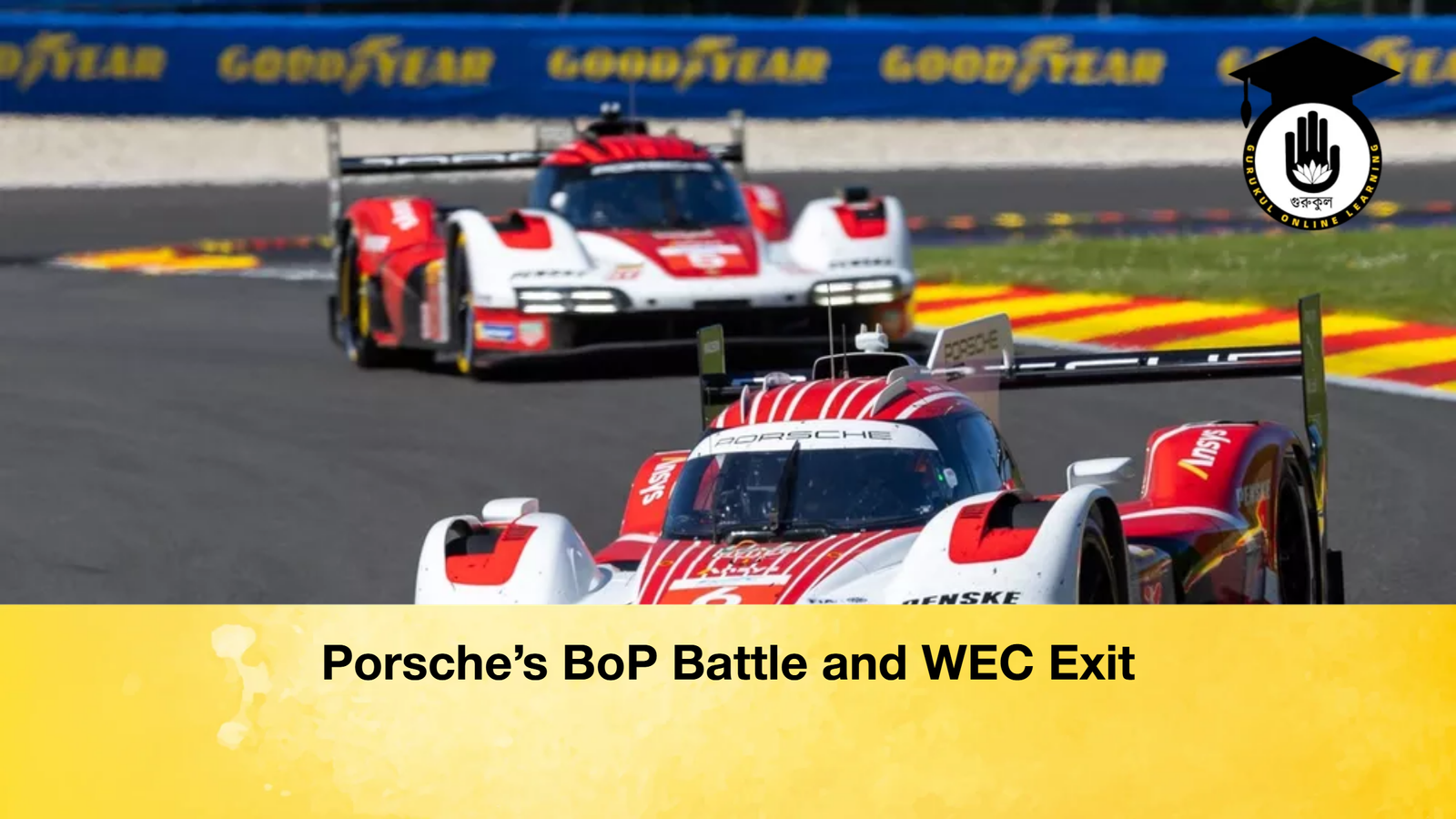
Porsche’s 2025 World Endurance Championship campaign will be remembered less for results than for what it revealed about the limits of the Hypercar rulebook. On pure performance, the Porsche 963 stood out as the fastest LMDh prototype over a season untouched by Balance of Performance adjustments. Paradoxically, it also spent much of the year carrying one of the least favourable power-to-weight ratios in the decisive speed range below 250km/h, a statistical contradiction that neatly encapsulates both Porsche Penske Motorsport’s technical excellence and its growing frustration with the championship.
Throughout 2025, the 963 was the only Hypercar built on a Multimatic chassis, and it consistently ran with the poorest sub-250km/h kg/kW figures among the LMDh contingent. That alone underlined how aggressively Porsche had developed the LMDh concept, squeezing every conceivable gain from the platform. The same approach paid handsome dividends in IMSA, where LMDh machinery dominates and Porsche has thrived. In WEC, however, the political and technical realities were far less forgiving.
Fresh from winning the 2024 drivers’ world championship, Porsche began 2025 under a heavy BoP burden. In Qatar and Imola it carried the second-worst power-to-weight ratio, behind only Toyota, and the results reflected that handicap. More surprisingly, ahead of Spa the 963’s rating deteriorated further, despite Porsche having achieved even less than Toyota in the opening rounds. The Ardennes race left the German marque effectively out of contention once again.
By the time Le Mans arrived, Porsche had scored just seven championship points from three races. The sacrifice was deliberate. Porsche committed to an all-out assault on the 24 Hours with a third works entry, accepting short-term pain for a shot at the one prize that truly mattered. Below 250km/h, the 963 was rated at a punishing 2.037kg/kW, second only to Peugeot’s 9X8. Above that threshold, however, it received an unusually favourable figure of 2.009kg/kW, making it devastatingly quick on the straights.
Even so, the Ferrari 499P remained the benchmark. Only a near-superhuman drive from the #6 Porsche crew of Kevin Estre, Laurens Vanthoor and Matt Campbell brought victory within reach. Without Ferrari in the equation, that car would have won by minutes, safety car or not. Instead, Porsche lost by just 14.084 seconds—one of the closest Le Mans finishes of the modern era—despite Ferrari overcoming penalties and a gearbox issue on the winning privateer entry. The sense of injustice cut deep.
Porsche’s view hardened thereafter. Internally, the belief grew that genuine convergence between LMH and LMDh was structurally impossible under the current rules, with Ferrari enjoying freedoms that LMDh cars could never access. Attempts to force a rapid unification after Le Mans failed, and once it became clear that no meaningful change would arrive before 2030, Porsche elected to withdraw from the WEC.
There were still flashes of brilliance. In Austin, despite receiving the harshest BoP hit of any Hypercar, Porsche mastered mixed conditions and Kevin Estre snatched a stirring victory. Fuji and São Paulo also showed how far the Penske squad had developed the 963 in its third season, fighting for podiums even under increasingly restrictive ratings. Bahrain, however, proved disastrous: burdened with the worst sub-250km/h figure of the entire field, Porsche compounded its misery with a flawed strategy call and slipped behind Toyota in the manufacturers’ standings.
As project boss Urs Kuratle bluntly admitted, 2025 ultimately became “more a discussion about kilos and kilowatts than tyres”. For the WEC, Porsche’s departure leaves a profound absence. New manufacturers may arrive, but none carry the same weight of history, success and symbolism. A return may yet come—but not before the next decade.
Key Porsche 963 BoP Highlights – WEC 2025
| Event / Phase | Sub-250km/h Rating (kg/kW) | Competitive Impact |
|---|---|---|
| Qatar / Imola | Second worst in field | Limited podium potential |
| Spa | Further deterioration | No victory challenge |
| Le Mans | 2.037 (sub-250km/h) / 2.009 (>250km/h) | Narrow loss by 14.084s |
| São Paulo | 2.102 | Front-running pace |
| Austin | Harshest BoP hit | Won in mixed conditions |
| Bahrain | 2.222 (worst overall) | Strategic failure, poor result |
Without Porsche, the WEC loses not just a competitor, but a cornerstone of its modern “golden era”.