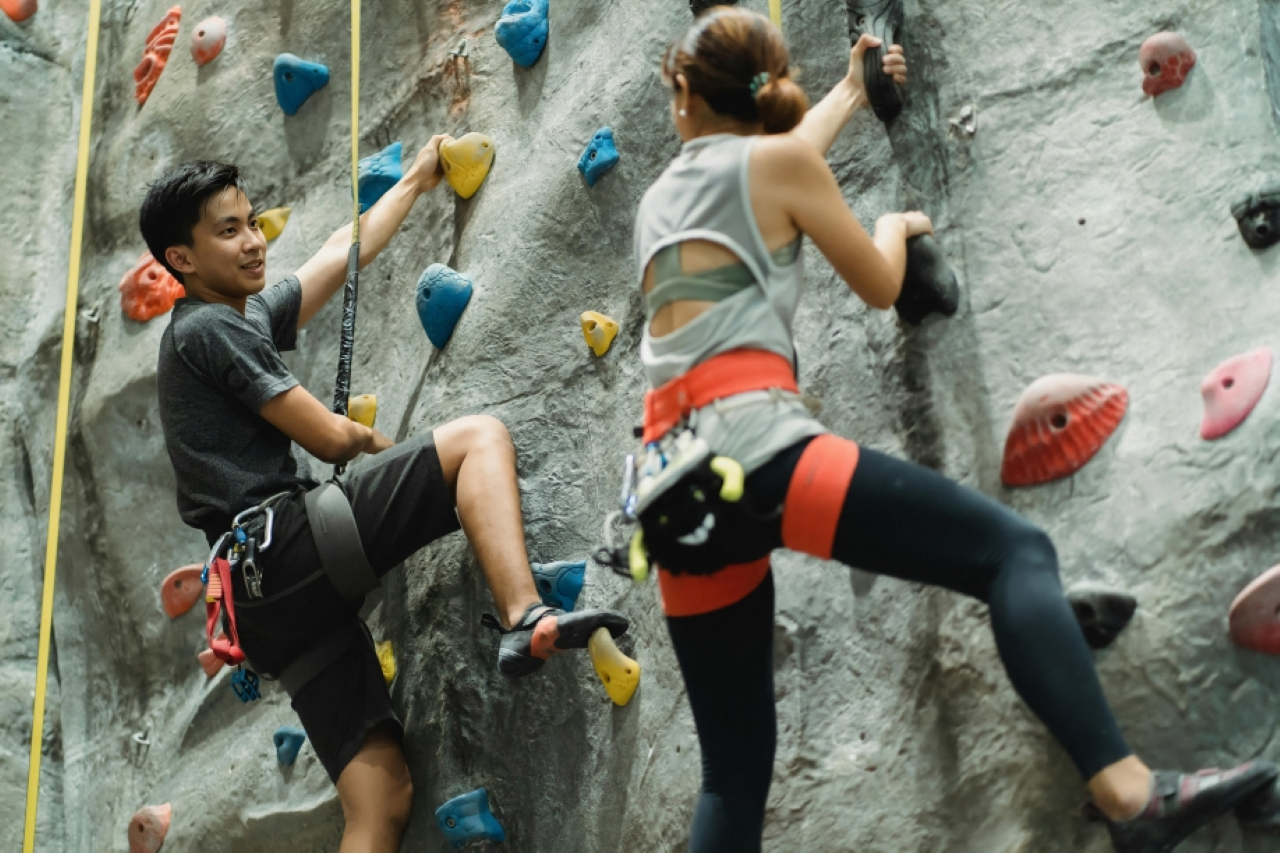
Few sports capture the human spirit quite like rock climbing — an elegant union of courage, balance, and intellect. To climb is to defy gravity itself, to embrace risk, and to transform fear into focus. What began as a necessity for survival has evolved into one of the world’s most visually striking and mentally demanding sports. And now, after centuries of evolution, rock climbing stands among the Olympic disciplines, symbolising humanity’s drive to conquer not others, but nature and oneself.
Rock climbing is not merely a contest of strength. It is a dialogue between athlete and stone — between human will and the immovable. In every ascent lies an element of art, as climbers choreograph their movement across vertical canvases of granite, limestone, and resin. From mountain crags to indoor gyms, climbing has undergone one of the most remarkable transformations in modern sport: from a dangerous pastime on remote cliffs to a global athletic pursuit with world championships, sponsorships, and Olympic glory.
The journey of this sport mirrors broader human progress — shaped by exploration, technology, and the search for meaning in challenge. To trace climbing’s rise is to tell a story of how an ancient instinct evolved into one of the 21st century’s most compelling expressions of physical and psychological mastery.
The Origins of Rock Climbing
Rock climbing’s roots stretch deep into human history, long before it was considered a sport. Early humans climbed cliffs to hunt, gather food, or find shelter. Ancient carvings in China and Greece depict humans scaling rock faces, while early records from the Ancestral Puebloans of North America show the use of primitive climbing techniques to access cliff dwellings. Yet, it wasn’t until the 18th and 19th centuries that climbing began to emerge as a deliberate, recreational pursuit.
The Birth of Mountaineering
Modern climbing was born in the shadow of the Alps. Europe’s fascination with mountains transformed during the Age of Enlightenment: what was once seen as a dangerous wilderness became a source of beauty and inspiration. The ascent of Mont Blanc in 1786 by Jacques Balmat and Michel-Gabriel Paccard marked the beginning of the Golden Age of Alpinism. For the next century, mountaineering became an obsession for explorers, scientists, and aristocrats seeking both adventure and prestige.
Britain, in particular, played a crucial role in shaping climbing’s early identity. Members of the Alpine Club, founded in London in 1857, documented climbs across Europe with scientific precision and gentlemanly enthusiasm. Climbing was then seen less as a sport and more as an intellectual and moral pursuit — a way to test endurance and discipline against nature’s majesty.
From Mountain Peaks to Rock Faces
While mountaineers sought summits, others began to focus on the sheer vertical challenges of individual rock faces. This marked the birth of rock climbing as a distinct sport. Early pioneers in the Lake District, North Wales, and the Dolomites began treating climbing as an art form rather than a stepping stone to mountaineering. The focus shifted from reaching the top of a mountain to mastering movement itself — a concept that would later define the ethos of sport climbing.
By the late 19th century, climbers such as Owen Glynne Jones in Britain and Hans Fiechtl in Germany were experimenting with techniques that would shape the modern discipline. Rope belays, pitons, and harnesses were developed, while grading systems emerged to categorise the difficulty of routes. Climbing was no longer simply exploration; it was performance.
The Golden Age of Climbing and the Birth of Modern Technique
The early 20th century marked a period of innovation, heroism, and philosophical tension. Climbing divided into two parallel worlds: one defined by traditional values of adventure and exploration, and another focused on precision, athleticism, and personal mastery.
The Rise of Free Climbing
In the 1910s and 1920s, climbers began to question the use of artificial aids such as ladders and pitons. The new ethos of free climbing — relying solely on physical ability and minimal equipment — emerged in Germany and Austria, particularly in the Elbe Sandstone Mountains. There, climbers like Rudolf Fehrmann set strict ethical standards: no metal protection, no hammering, no aid. Every move had to be made in direct contact with the rock, honouring the spirit of purity that still defines climbing today.
Simultaneously, climbers in Britain’s Peak District and Snowdonia began developing short, technically challenging routes, often climbing in wool sweaters and hobnail boots. It was dangerous, cold, and raw — but it laid the foundation for the technical mastery that would later blossom in sport climbing.
The Philosophical Divide
As climbing matured, debates raged over ethics and style. Should the goal be to conquer nature, or to collaborate with it? Some climbers viewed each ascent as a scientific or patriotic conquest, while others — like the romantic philosopher-climbers of the 1930s — saw it as a spiritual journey.
This tension between adventure climbing and sport climbing still echoes today. Adventure climbing values self-reliance and minimal gear, accepting risk as part of the experience. Sport climbing, on the other hand, prioritises athletic achievement, precision, and repetition on bolted routes where safety is controlled. Both traditions coexist, shaping climbing’s dual identity as both art and sport.
Technological Evolution
The mid-20th century saw rapid advancements in climbing gear. Nylon ropes replaced hemp, carabiners became lighter and stronger, and the first harnesses revolutionised safety and performance. With these innovations, climbers began pushing limits once thought impossible.
By the 1950s and 60s, iconic ascents such as Walter Bonatti’s solo climb of the Petit Dru and Royal Robbins’ ascents in Yosemite Valley redefined what could be achieved on vertical stone. Yosemite’s granite walls, especially El Capitan, became the proving ground for modern climbing ethics and athleticism. There, climbers like Warren Harding, Jim Bridwell, and Lynn Hill reimagined climbing as a craft — blending the purity of movement with calculated risk.
It was during this period that the concept of big wall climbing, involving days-long ascents on sheer vertical cliffs, captured the public imagination. The climber was no longer just a mountaineer, but an athlete performing a physical and psychological ballet.
The Indoor Revolution: Climbing Comes Indoors
The late 20th century ushered in a transformation that would take climbing from the wilderness to the urban world. As cities grew and access to natural crags became limited, a new phenomenon emerged: indoor climbing gyms.
From Crags to Concrete
The first artificial climbing walls appeared in Europe in the 1960s, but the concept gained real momentum in the 1980s. These walls allowed climbers to train year-round, regardless of weather or geography. For the first time, climbing was no longer restricted to those who lived near mountains. It became accessible, organised, and inclusive.
Artificial holds, modular routes, and textured surfaces recreated the feel of real rock while allowing for safety and control. Gyms provided a social environment, blending competition with community — a far cry from the solitude of traditional mountaineering.
A New Generation of Climbers
Indoor climbing attracted a younger, more diverse demographic. Without the risks and logistical challenges of outdoor climbing, beginners could learn quickly, while experienced climbers could refine technique. The sport’s visual appeal and physical artistry made it ideal for modern media and urban lifestyles.
As climbing walls spread across Europe, North America, and Asia, the sport’s image began to shift. No longer just for adventurers, climbing became part of mainstream fitness culture — an activity that trained strength, flexibility, and mindfulness.
The Birth of Competitive Climbing
With the indoor boom came the birth of organised competition. The first climbing competitions were held in the 1980s on artificial walls in Italy and the Soviet Union. In 1989, the inaugural World Cup Climbing Series brought together athletes from across continents under a unified set of rules. By the early 1990s, climbing was recognised as an international sport, complete with governing bodies and official championships.
These competitions marked a turning point: climbing was now being judged, timed, and broadcast. The sport had moved from exploration to performance, from personal pursuit to public spectacle.
Technology, Training, and Science
The rise of indoor climbing also sparked a revolution in training. Climbers began using campus boards, hangboards, and motion analysis to develop strength and refine efficiency. Sports science entered the vertical world, examining muscle recruitment, finger tendon load, and mental concentration. Nutrition, recovery, and psychological coaching became part of elite climbers’ regimens.
By the early 21st century, professional climbers trained with the precision of Olympic athletes. Names like Adam Ondra, Janja Garnbret, and Alex Megos embodied a new era of climbing — disciplined, data-driven, and globally celebrated.
From Subculture to Mainstream
The transition from outdoor cliffs to indoor arenas reshaped climbing’s social identity. Once seen as a niche pursuit for thrill-seekers, climbing became a community-driven, inclusive, and gender-balanced sport. It also gained visibility through film, photography, and digital storytelling. Documentaries like Free Solo and The Dawn Wall captivated global audiences, highlighting not just danger, but artistry, discipline, and emotional depth.
By the time the 2010s arrived, climbing was ready to make the leap to the world’s grandest sporting stage — the Olympic Games.
Competitive Climbing: From Subculture to Global Sport
The birth of competitive climbing represented a fundamental shift in how the sport was viewed, structured, and celebrated. What began as an informal display of ability between friends at climbing festivals in the 1980s gradually evolved into a professional, highly regulated international competition scene.
Early Competitions and the Rise of the IFSC
The first official climbing competitions took place in Europe, particularly in Italy and France, where artificial climbing walls were becoming popular training tools. In 1985, the Sportroccia competition in Bardonecchia, Italy, is often cited as the first major modern climbing contest. It drew athletes from across Europe, marking a new era in which climbing was no longer confined to mountain crags — it had entered the arena.
By 1989, the International Council for Competition Climbing (ICC) had been formed, creating a standardised structure for global events. In 2007, it evolved into the International Federation of Sport Climbing (IFSC), which continues to govern the sport today.
The IFSC established three distinct disciplines — Lead, Speed, and Bouldering — each testing a different dimension of climbing skill:
| Discipline | Focus | Format Summary |
|---|---|---|
| Lead | Endurance and technique | Climbers ascend tall routes (15–20 metres) with limited time, aiming to reach the highest hold. |
| Speed | Explosive power and precision | Athletes race on an identical 15-metre route; fastest to the top wins. |
| Bouldering | Strength and problem-solving | Climbers tackle short, powerful problems on low walls without ropes, relying on mats for protection. |
The Art of Controlled Chaos
Competitive climbing was designed not merely as a test of strength, but as a measure of composure under pressure. Unlike traditional climbing, where athletes have hours to complete a route, competition climbers often face strict time limits and cannot preview routes in detail before their attempt. This format challenges creativity, problem-solving, and adaptability — making climbing one of the few sports where intellect and instinct are equally vital.
Modern competitions feature music, lighting, and commentary, transforming what was once a silent, solitary pursuit into a thrilling spectator sport. In a world accustomed to high-paced action, climbing’s mix of tension and artistry struck a perfect balance — appealing both to purists and to audiences new to the vertical realm.
Icons of the Competitive Era
By the early 2000s, names like François Legrand, Tomáš Mrázek, and Josune Bereziartu defined climbing excellence. Later, athletes such as Adam Ondra, Chris Sharma, and Janja Garnbret elevated competition climbing to new artistic and athletic heights.
Janja Garnbret, the Slovenian prodigy, became a global symbol of modern climbing — dominating both bouldering and lead events, and later claiming the sport’s first Olympic gold medal. Her performances encapsulated climbing’s modern identity: graceful yet powerful, thoughtful yet daring.
Climbing’s Olympic Journey: From Fringe to Flame
Few sports have taken such a long and complex path to Olympic recognition as climbing. Its inclusion in the Tokyo 2020 Games marked not only a triumph for climbers worldwide, but also a moment of reflection — an acknowledgement that the definition of “sport” itself was evolving in the 21st century.
A Long Climb to Recognition
For decades, climbing existed in a grey zone between adventure and athletics. Its participants valued independence and creativity, often rejecting formal regulation. This spirit, while romantic, made Olympic inclusion challenging. The International Olympic Committee (IOC) sought a format that would be both spectator-friendly and globally representative, which climbing’s fragmented structure initially struggled to provide.
Persistent advocacy by the IFSC and support from the Tokyo Organising Committee eventually brought climbing into the Olympic fold. The sport made its debut in 2021 (delayed from 2020 due to the pandemic), featuring a combined format: athletes competed in all three disciplines — lead, speed, and bouldering — with cumulative scores determining the medals.
Tokyo 2020: The Breakthrough Moment
At Tokyo’s Aomi Urban Sports Park, climbing made its Olympic debut alongside skateboarding and surfing — a symbolic nod to youth culture and alternative sports. The spectacle was unlike anything in Olympic history. Athletes scaled 15-metre walls in record-breaking seconds, performed gravity-defying boulder moves, and exhibited endurance over dizzying lead routes.
Janja Garnbret of Slovenia and Alberto Ginés López of Spain emerged as the sport’s first Olympic champions. Both became instant global icons, not only for their victories but for representing climbing’s unique ethos of humility, creativity, and self-expression.
Paris 2024 and the Evolution of the Format
For the Paris 2024 Olympics, the combined format was refined: speed climbing was separated into its own medal event, while lead and bouldering were paired together. This decision acknowledged that each discipline demands distinct physiological and tactical skills — much as gymnastics differentiates its apparatuses or swimming its strokes.
The move was widely applauded by athletes, who argued that it preserved the integrity of climbing’s diverse forms. It also signalled the IOC’s confidence that climbing was not a novelty but a permanent fixture on the Olympic stage.
The Significance of Olympic Inclusion
Olympic recognition carries more than symbolic weight. It has transformed climbing’s infrastructure, funding, and global visibility. National federations now receive government support, climbing walls are being constructed in developing nations, and youth participation has skyrocketed.
Just as snowboarding revolutionised the Winter Olympics in the 1990s, climbing has brought a new spirit of adventure, inclusivity, and creativity to the Summer Games. It is no longer the domain of cliff-side dreamers — it is a sport of nations.
The Science and Training Behind Elite Climbers
To the casual observer, rock climbing might appear to be a contest of upper-body strength. In truth, elite climbing is an intricate interplay of physics, physiology, and psychology. Every movement involves balance, timing, and efficient energy use — a full-body symphony of control.
Anatomy of a Climber
Elite climbers combine the lean muscle mass of a gymnast with the endurance of a long-distance runner. Their physiques are built for precision rather than bulk. Strength-to-weight ratio is critical; even small gains in body control can mean the difference between victory and failure.
| Attribute | Physiological Advantage |
|---|---|
| Grip Strength | Allows sustained holds on small edges and volumes |
| Core Stability | Maintains body tension and movement efficiency |
| Flexibility | Enables dynamic movement and reach on complex routes |
| Finger Tendon Endurance | Vital for repeated holds on micro-edges |
| Mental Focus | Manages anxiety and sharpens problem-solving under time pressure |
Training regimens for professional climbers now incorporate biomechanics, motion tracking, and AI-assisted performance analysis. Climbers use hangboards, campus boards, and system walls to target specific muscle groups, while sensors monitor force output and fatigue levels.
The Mind as the True Muscle
Beyond physical ability, climbing demands supreme mental discipline. Climbers must plan sequences, visualise movements, and maintain composure while suspended metres above ground. Sports psychologists describe this as a “flow state” — an immersive concentration where thought and motion merge.
Unlike many sports, climbing punishes hesitation. Every pause costs energy; every doubt weakens grip. The world’s best climbers, therefore, train as much for psychological resilience as they do for power. Meditation, breathing control, and visualisation techniques are now integral to elite preparation.
Injury Prevention and Longevity
Climbing’s repetitive motions place enormous stress on fingers, shoulders, and elbows. Injuries such as tendonitis, pulley tears, and rotator cuff strains are common. As a result, physiotherapy and recovery have become vital components of the sport. Many top athletes, including Adam Ondra and Janja Garnbret, have adopted hybrid programmes combining yoga, mobility training, and physiotherapeutic conditioning to extend career longevity.
In recent years, sports science has also challenged old training myths — shifting focus from sheer strength to movement economy, flexibility, and coordination. As climbing continues to evolve, so too does the understanding of what it means to be “fit” in three dimensions.
The Global Spread of Climbing
Once confined to remote crags in Europe and North America, rock climbing has now become a truly global phenomenon. Every continent now boasts climbing communities, competitions, and destinations that attract athletes and adventurers alike.
Asia: Rapid Growth and Emerging Powerhouses
Asia has experienced an extraordinary climbing boom over the past two decades. Nations such as Japan, China, South Korea, and Indonesia have invested heavily in training facilities and youth development programmes. Japan, in particular, has emerged as a world leader, producing Olympic medallists and world champions like Tomoa Narasaki and Akiyo Noguchi.
Climbing’s accessibility and minimal environmental footprint have also made it an ideal urban sport in densely populated countries. In cities like Tokyo, Seoul, and Beijing, indoor climbing gyms have become as common as fitness studios, introducing thousands of young athletes to the vertical world each year.
Europe: The Historic Heartland
Europe remains climbing’s cultural and competitive epicentre. France, Italy, Austria, and Slovenia continue to dominate international competitions, supported by generations of expertise and world-class facilities. The French Alps, Spanish Sierras, and Swiss Jura remain legendary outdoor playgrounds where history, community, and athletic excellence intersect.
Moreover, Europe has become the intellectual heart of climbing — home to most of the world’s route setters, trainers, and climbing equipment manufacturers. The continent’s emphasis on youth academies and inclusivity ensures that climbing remains both a sport and a social movement.
North America: Adventure and Innovation
In the United States and Canada, climbing is inseparable from the spirit of adventure. Regions like Yosemite Valley, Red River Gorge, and Squamish are modern pilgrimage sites for climbers worldwide. America’s contribution to climbing lies not only in exploration but in innovation — from the invention of modern protective gear to pioneering films and media that popularised the sport globally.
The U.S. has also seen an explosion in indoor gyms, with over 600 commercial climbing centres operating nationwide. This growth has democratised the sport, attracting everyone from children to retirees, turning climbing into a mainstream recreational activity.
Africa and Latin America: Emerging Frontiers
Africa and Latin America represent climbing’s most promising new frontiers. In South Africa, the sandstone boulders of Rocklands attract international professionals every season. Meanwhile, countries such as Kenya, Namibia, and Morocco are now hosting climbing festivals that blend sport with cultural tourism.
In Latin America, Brazil, Argentina, and Chile have cultivated vibrant climbing scenes, supported by the Andes’ diverse topography. The social aspect of climbing — its blend of physicality, teamwork, and exploration — resonates deeply within these cultures, offering youth a positive, creative outlet.
Global Growth by the Numbers
| Region | Estimated Number of Climbing Facilities (2025) | Notable Trend |
|---|---|---|
| Europe | 2,500+ | Home to most IFSC competitions |
| North America | 1,000+ | Explosion of indoor gyms in urban areas |
| Asia | 1,200+ | Rapid youth engagement and Olympic success |
| Africa | 200+ | Growing eco-tourism climbing spots |
| Latin America | 400+ | Expanding community-driven climbing culture |
Today, climbing has transcended geography and class. It has become a global language of movement, where athletes from vastly different backgrounds share the same universal goal: upward.
Rock Climbing in India: A Growing Movement
While rock climbing’s origins lie in Europe’s alpine regions, its recent surge in Asia has drawn global attention — and India is now emerging as one of the sport’s most promising frontiers. The subcontinent’s dramatic geography — from granite boulders and sandstone cliffs to Himalayan walls — makes it an ideal playground for climbers. Yet, the sport’s true ascent in India has been driven not by landscape alone, but by passion, perseverance, and grassroots community building.
Early Days: Quiet Beginnings
Climbing as a structured sport in India began modestly in the 1980s and 1990s, when a handful of adventure enthusiasts in Delhi, Kolkata, and Bangalore began experimenting with ropes and rudimentary gear. Early organisations like the Indian Mountaineering Foundation (IMF) introduced formal training programmes, initially focused on mountaineering but later expanding to rock climbing as its own discipline.
For years, India’s climbing scene remained small but dedicated. Limited access to equipment, funding, and international exposure meant that most climbers were self-taught. However, the opening of indoor climbing gyms in major cities during the 2010s radically changed this landscape. Today, climbing has evolved from an “adventure hobby” to a professional pursuit for many young Indians.
India’s Natural Climbing Treasures
India is blessed with world-class climbing terrain that rivals any international destination. Among the most prominent:
| Destination | Region | Type | Notable Features |
|---|---|---|---|
| Hampi | Karnataka | Bouldering | Iconic granite boulders, global climbing festival |
| Badami | Karnataka | Sport Climbing | Sandstone cliffs, bolted routes, technical challenges |
| Sethan (Manali) | Himachal Pradesh | Bouldering | Himalayan backdrop, emerging youth hub |
| Dhauj (near Delhi) | Haryana | Traditional Climbing | Close to the capital, popular for training |
| Pune & Nashik | Maharashtra | Mixed | Natural outcrops, competition venues |
These sites have attracted a growing number of international climbers and documentary filmmakers, helping India carve out a niche in the global climbing map. The Hampi Bouldering Festival, once a small gathering of enthusiasts, now draws hundreds of athletes and visitors from across the world each year.
Indian Climbers Making Their Mark
In recent years, a new generation of Indian climbers has begun achieving success on the international stage. Names such as Tuhin Satarkar, Prerna Dangi, Keval Haria, and Esha Singh represent a fresh wave of talent capable of competing globally. Their dedication, often built on limited resources and immense self-discipline, embodies the spirit of Indian climbing.
Prerna Dangi, for example, has become a national role model for women in climbing, blending athleticism with advocacy. She promotes sustainability and gender inclusivity in outdoor sports, showing how climbing can empower individuals both physically and socially.
The Role of Indoor Gyms and Federations
India’s growing network of climbing gyms — from Delhi Rock to Bangalore Climbing Circle — has made the sport accessible to urban youth. Many of these facilities now serve as training centres for national athletes. The Indian Mountaineering Foundation and local associations are working to integrate climbing into school and university programmes, nurturing a structured pipeline of talent.
India’s inclusion in international competitions, including IFSC events, has also encouraged infrastructure investment. As the nation prepares its athletes for future Olympic Games, the dream of seeing an Indian climber on the Olympic podium no longer seems far-fetched.
Climbing as Culture
Beyond competition, climbing in India is also becoming a lifestyle movement — merging fitness, travel, and eco-consciousness. It resonates strongly with younger generations seeking adventure and authenticity. In a fast-urbanising country, rock climbing represents not just a sport but a return to nature, a reminder of balance in modern life.
Women in Climbing: Breaking Barriers and Setting Standards
Rock climbing has always been a great equaliser. On the wall, gravity makes no distinction between genders; what matters is technique, balance, and determination. In recent decades, women have redefined what was once a male-dominated sport, excelling not only as competitors but as pioneers, coaches, and role models.
Trailblazers Who Changed the Game
The 1980s and 1990s saw the rise of female climbers who shattered stereotypes and redefined possibility. Lynn Hill’s free ascent of The Nose on El Capitan in 1993 remains one of the most iconic achievements in climbing history. Her words — “It goes, boys” — became a declaration of equality and skill.
In Europe, Catherine Destivelle and Josune Bereziartu pushed physical and mental limits, establishing routes previously deemed impossible for women. Their artistry and resolve inspired a generation of female athletes to take up climbing competitively.
Today, athletes like Janja Garnbret, Akiyo Noguchi, and Shauna Coxsey have not only dominated world championships but also redefined climbing’s aesthetic and athletic standards. Their global visibility has made climbing one of the most gender-balanced sports in the world.
Climbing as Empowerment
Climbing uniquely fosters empowerment — both physical and psychological. It cultivates confidence through problem-solving and risk management, qualities that extend far beyond sport. For women, especially in traditional societies, climbing offers a path to independence and self-expression.
In India, initiatives such as Climb Like a Woman and She Climbs India have created safe, supportive spaces for women to train and explore outdoor environments. Female-led expeditions are now more common, and women are increasingly taking leadership roles in training, route-setting, and event organisation.
The Equality Frontier
While climbing has made strides towards gender equality, challenges remain. Sponsorship, representation, and access still skew male in many regions. However, the sport’s culture of inclusivity and mutual respect offers a strong foundation for continued progress. The sight of women leading routes, setting records, and coaching national teams is now common — and celebrated — across the climbing world.
As Olympic climbing continues to grow, women’s achievements are shaping its global identity. Their presence ensures that climbing remains not just a sport of strength, but a symbol of equality and courage.
Sustainability, Ethics, and the Future of Climbing
As climbing has grown, so too have concerns about its environmental and ethical impact. The sport’s intimate relationship with nature makes it uniquely vulnerable to the consequences of overuse, urbanisation, and climate change. The challenge for the climbing community is to balance growth with responsibility — to protect the very landscapes that make the sport possible.
Environmental Impact and Conservation
Climbers are often the first witnesses to environmental degradation: eroding trails, damaged vegetation, and changing weather patterns. Increased tourism in popular destinations like Fontainebleau, Joshua Tree, and Badami has led to discussions about sustainable climbing practices.
Organisations worldwide now advocate for Leave No Trace ethics, promoting responsible use of chalk, minimising waste, and avoiding disturbance to wildlife. In some regions, local climbing associations partner with conservation authorities to regulate access, ensuring that popular crags remain safe and sustainable for future generations.
Climbing and Climate Change
Climate change poses new challenges for the sport. Melting glaciers, unpredictable weather, and altered ecosystems have already affected traditional climbing routes in the Alps and Himalayas. Many climbers have become advocates for environmental action, using their platforms to raise awareness about conservation.
Athletes like Tommy Caldwell and Alex Honnold actively campaign for renewable energy and environmental preservation, proving that climbing’s ethos — respect for nature — extends beyond the rock.
The Ethics of Indoor Expansion
The explosion of indoor climbing facilities has raised questions about sustainability too. Energy-intensive climate control systems, plastic holds, and imported materials can leave a carbon footprint. However, many gyms are transitioning to eco-friendly practices, such as recycled materials, solar energy, and local community programmes.
The concept of green climbing gyms is gaining traction, with facilities incorporating sustainability education as part of their mission. This integration of sport and environmental consciousness marks an important evolution in climbing’s philosophy.
Technology, Innovation, and the Future
The future of climbing is also being shaped by technology. From AI route design and motion-tracking analytics to augmented reality training, the next generation of climbers will have access to tools unimaginable just a decade ago.
At the same time, climbing’s inclusion in the digital fitness economy — via apps, online competitions, and global livestreams — ensures it continues to reach new audiences.
Yet amid this modernisation, the essence of climbing remains unchanged: the intimate, human connection between mind, body, and stone. No amount of technology can replicate the sensation of balancing on a razor-thin ledge or the quiet triumph of reaching a summit.
A Sport That Mirrors the Human Spirit
From the misty peaks of the Alps to the neon-lit climbing gyms of Tokyo and Delhi, rock climbing’s story is one of transformation — from fringe obsession to Olympic celebration. It has journeyed from wild cliffs to the heart of cities, from counterculture to global recognition, without losing its soul.
Climbing endures because it embodies something universal. It demands humility before nature, creativity under pressure, and the courage to rise after each fall. Every ascent tells a timeless story — not of domination, but of dialogue: between human and stone, ambition and restraint, fear and freedom.
In its modern form, climbing is both ancient and futuristic — a perfect metaphor for humanity’s eternal quest to rise above limitation. Its presence in the Olympics symbolises more than athletic achievement; it represents a philosophy of perseverance, balance, and respect.
For the new generation of climbers — from Barcelona to Bangalore, Tokyo to Toronto — the wall is no longer a boundary. It is an invitation. And the sport, much like the climbers who embrace it, continues to ascend — higher, stronger, freer.
Summary Table: Key Milestones in the Rise of Rock Climbing
| Era | Milestone | Significance |
|---|---|---|
| 1786 | First ascent of Mont Blanc | Birth of mountaineering |
| 1857 | Alpine Club founded in London | Institutionalisation of climbing |
| 1910–1930s | Rise of free climbing ethics | Modern philosophy of purity and movement |
| 1980s | Indoor climbing revolution | Urban accessibility and inclusivity |
| 1989 | First international competitions | Birth of sport climbing |
| 2007 | IFSC established | Global governance of climbing |
| 2021 | Olympic debut in Tokyo | Climbing becomes an Olympic sport |
| 2024 | Separate events for speed, lead, bouldering | Recognition of diverse climbing disciplines |
Epilogue: The Wall as a World
The rise of rock climbing from an extreme niche to an Olympic discipline is not merely a tale of sport — it is a reflection of humanity itself. In climbing, we rediscover our oldest instincts: curiosity, creativity, and the courage to ascend. Whether on Himalayan granite or synthetic holds, the act of climbing remains the same at its core — a declaration of possibility.
In every leap, hold, and fall, climbers express an eternal truth: that progress is not found in comfort, but in challenge. And as long as there are walls — natural or human-made — the impulse to climb them will continue to define who we are.