
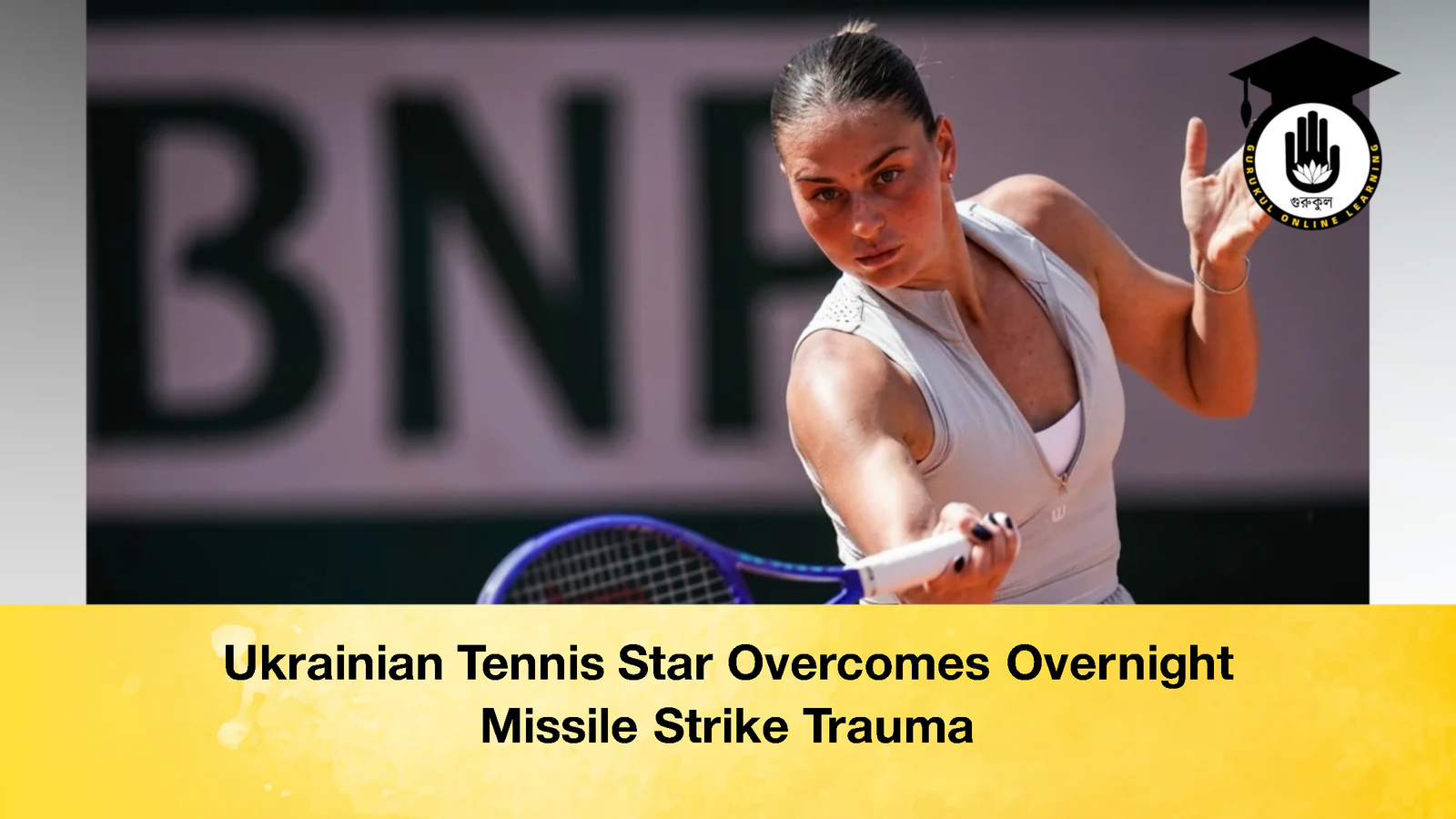

The 15th-seeded Ukrainian tennis player, Marta Kostyuk, successfully commenced her French Open singles campaign on Sunday, 24 May 2026, by defeating Oksana Selekhmeteva in the opening round at Roland Garros. The sporting achievement was delivered on the clay courts of Paris under acute psychological distress. Only hours prior to her scheduled arrival at Court Simonne-Mathieu, the 23-year-old athlete received photographic confirmation that a Russian missile strike had impacted within 100 metres of her family residence in the Ukrainian capital of Kyiv.
The targeted property was occupied by her mother, her sister, and her great-aunt at the time of the nocturnal bombardment. According to verified field reports, the specific wave of drone and missile strikes directed at Kyiv overnight resulted in four documented fatalities and approximately 100 civilian injuries across the nation. Although the immediate family members of the athlete survived the offensive without physical injury, Kostyuk experienced profound emotional trauma preceding her competitive entry onto the Parisian court.
Severe Emotional Distress Prior to the Match
Kostyuk received graphic transmission updates depicting the localized devastation at approximately 8:00 am on the morning of her match. The visual evidence of the nearby explosion generated intense immediate anxiety and physiological distress for the player during her baseline pre-match preparations.
During her formal post-match media briefings, an emotional Kostyuk openly displayed the photograph of the destroyed building from her mobile device to assembled journalists. She clarified the immense mental difficulty of compartmentalising the structural violence affecting her hometown while attempting to sustain elite athletic concentration.
“I think it was one of the most difficult matches of my career,” Kostyuk stated during her emotional post-match interview. “This morning, 100 metres away from my parents’ house, the missile destroyed the building and it was a very difficult morning for me. I didn’t know how I would handle it, I’ve been crying part of the morning.”
The athlete further elucidated the precise nature of her psychological struggle during the contest, noting that thoughts of the potentially fatal impact periodically disrupted her performance focus. “I felt sick,” she remarked to reporters. “If it was 100 metres closer, I probably wouldn’t have a mom and a sister today. Tennis is a mental game, but today’s struggle was entirely different. I did not know how I would be able to control my emotions or my thoughts.”
On-Court Performance and Tactical Decisions
Despite the severe domestic anxiety, Kostyuk maintained her competitive sequence on clay, extending her current unbeaten streak on the surface to 13 consecutive matches following her recent title victories at Rouen and the WTA 1000 Madrid Open. Facing Selekhmeteva, a Russian-born competitor who had changed her sporting nationality to Spain immediately prior to the tournament, Kostyuk demonstrated notable technical precision.
The mechanical breakdown of the first-round baseline statistics reflects her complete tactical control over the 1-hour and 14-minute encounter:
| Performance Metric | Marta Kostyuk (UKR) | Oksana Selekhmeteva (ESP) |
| Final Match Score | 6-2, 6-3 | 2-2, 3-6 |
| Total Winners Placed | 20 (12 Forehand) | 9 |
| Break Points Converted | 6 of 13 | 3 of 7 |
| Double Faults Committed | 5 | 12 |
| Total Points Secured | 68 | 47 |
Kostyuk secured the opening set in 36 minutes, utilising an aggressive baseline strategy. In the second set, while leading 5-1, she failed to serve out the match on her first attempt, allowing Selekhmeteva a brief structural break. However, Kostyuk recovered her composure in the subsequent service game to close out the definitive victory. During the course of the match, she executed an unexpected underarm serve that altered the rhythm of the play.
“When I have sufficient space in a match, I love to employ it,” Kostyuk commented with a smile regarding the tactical variation. “Opponents are invariably taken by surprise when it occurs.”
Commitment to the International Tournament
The world number 15 explicitly noted that she at no stage entertained the prospect of formal withdrawal from the clay-court Grand Slam, despite the direct vulnerability of her family members in Ukraine. She attributed her continued participation to the resilience demonstrated by the broader Ukrainian populace under prolonged conditions of international conflict.
The structural perspective of her determination is defined by several core factors:
Sustained Family Survival: The athlete confirmed that because her immediate relatives survived the strike intact, her primary professional obligation was to represent her nation on the international circuit.
National Resiliency Models: Kostyuk drew direct motivation from citizens in Kyiv who continue their daily civilian and humanitarian routines despite regular overnight disruptions.
Sovereign Public Support: The presence of displaced Ukrainian citizens and national flags within the upper tiers of Court Simonne-Mathieu provided crucial psychological reinforcement during the match.
Following the conclusion of the match, Kostyuk received a sustained standing ovation from the spectators in attendance as she gestured towards the Ukrainian flags displayed in the upper deck. In adherence to her established ethical policy regarding the ongoing invasion of her homeland, she maintained her practice of refusing to engage in a post-match handshake with a Russian-born opponent. Moving forward into the second round of the tournament, Kostyuk is scheduled to face unseeded American player Katie Volynets, who advanced after defeating French wildcard Clara Burel.