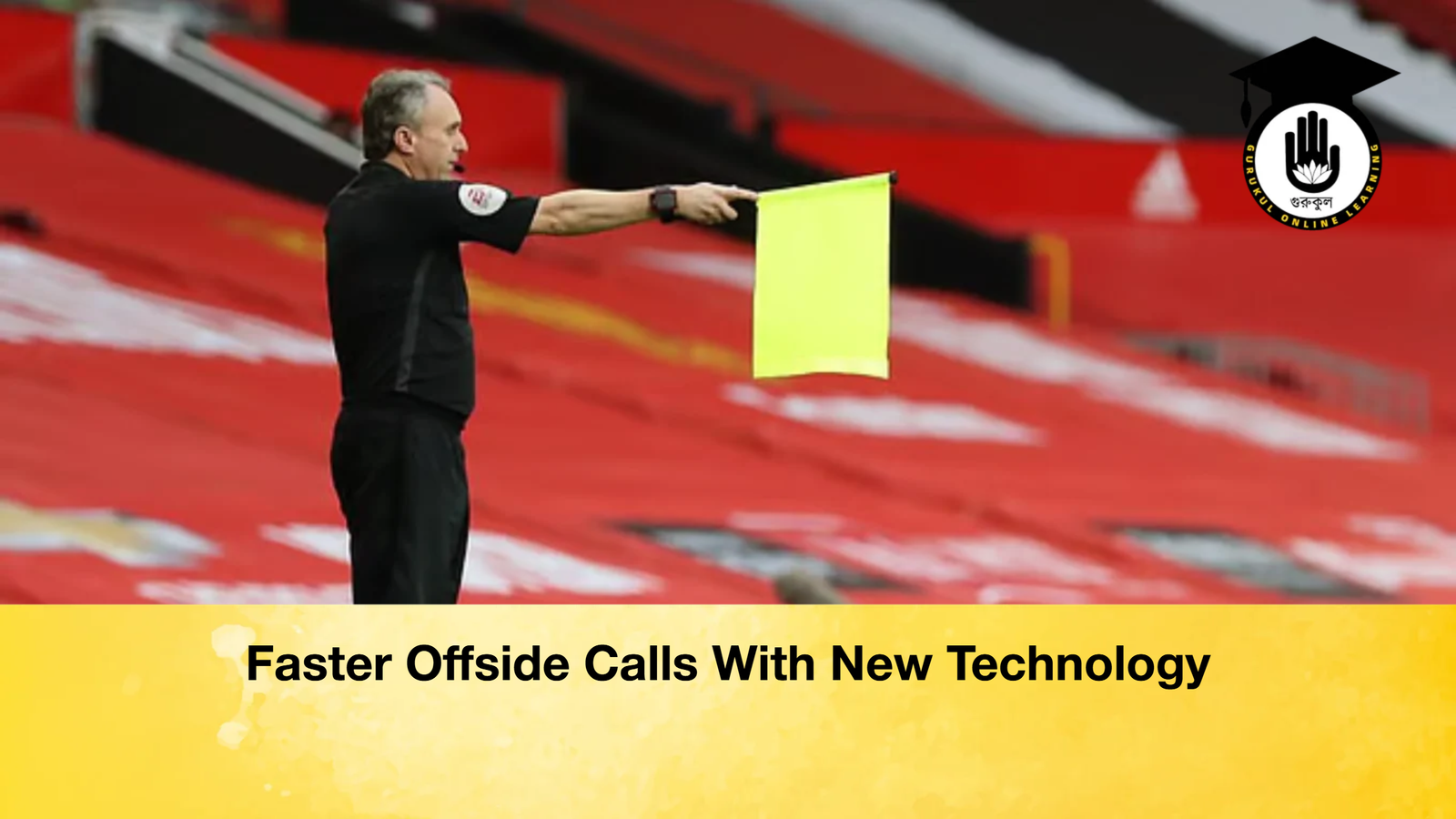
Delays in raising the offside flag have long been a feature of modern football, particularly with the instruction for assistant referees to allow attacking phases to continue before making a decision. However, this practice is set to change significantly following FIFA’s confirmation that new technology will be introduced at the upcoming World Cup.
FIFA has announced the deployment of an enhanced semi-automated offside system designed to support Video Assistant Referees (VAR). The primary objective is to accelerate decision-making and enable assistant referees to raise the flag more promptly when an offside offence occurs.
Under the updated system, if a player is positioned more than 10 centimetres offside, an audio alert will be transmitted instantly to the assistant referee. This real-time signal is intended to reduce unnecessary delays and allow immediate action on clear offside situations. In earlier trials conducted during the FIFA Club World Cup and the Intercontinental Cup, alerts were only triggered when the offside distance exceeded 50 centimetres.
Key Features of the New Offside Technology
| Feature | Description |
|---|---|
| Offside detection threshold | More than 10 centimetres |
| Alert mechanism | Real-time audio signal to assistant referee |
| Previous trial threshold | More than 50 centimetres |
| Final decision authority | On-field referee |
| Technology type | Enhanced semi-automated system |
Despite the introduction of automation, FIFA has clarified that the final authority to stop play or raise the flag will remain with the on-field officials. Referees and assistant referees may choose not to act on the alert if there is any suspicion of a technical malfunction. FIFA has incorporated multiple safeguards within the system to minimise the risk of error.
According to reports, the technology is not capable of detecting the most marginal or borderline offside decisions. Limitations also exist in scenarios where players are on the ground or positioned very close together, which may affect the accuracy of positional data.
The system is designed to determine offside purely on positional data. Interpretative aspects of the law—such as whether a player interferes with an opponent without touching the ball—will continue to be assessed by the referee.
FIFA expects the introduction of this system to reduce frustration among players and spectators. It may also lower the risk of injury caused by prolonged play after an offside situation has already developed. A notable incident occurred in May 2025 when Nottingham Forest striker Taiwo Awoniyi collided with the goalpost and fell into a coma after a delayed offside decision by the assistant referee.
To further enhance accuracy, FIFA will create artificial intelligence-generated 3D avatars of every player participating in the tournament. A total of 1,248 players—representing 48 teams with 26 players each—will undergo digital scanning. Each scan will take approximately one second and will be conducted once during the official pre-tournament photoshoot in a designated chamber.
These digital models will allow offside decisions to be visualised more clearly through precise animations on television broadcasts and stadium screens. In addition, FIFA has approved the use of technology to determine whether the ball has fully crossed the field boundary prior to a goal-scoring action.
A recent controversy in February, involving a disallowed goal by Aston Villa against Brentford, highlighted the difficulty of judging whether the ball had gone out of play. Under the new system, a 3D animation—similar to goal-line technology—will illustrate the exact position of the ball.
Furthermore, a sensor embedded within the ball will identify the last player to make contact. This feature will assist VAR officials in reviewing decisions such as corner kicks, ensuring greater accuracy in officiating.