
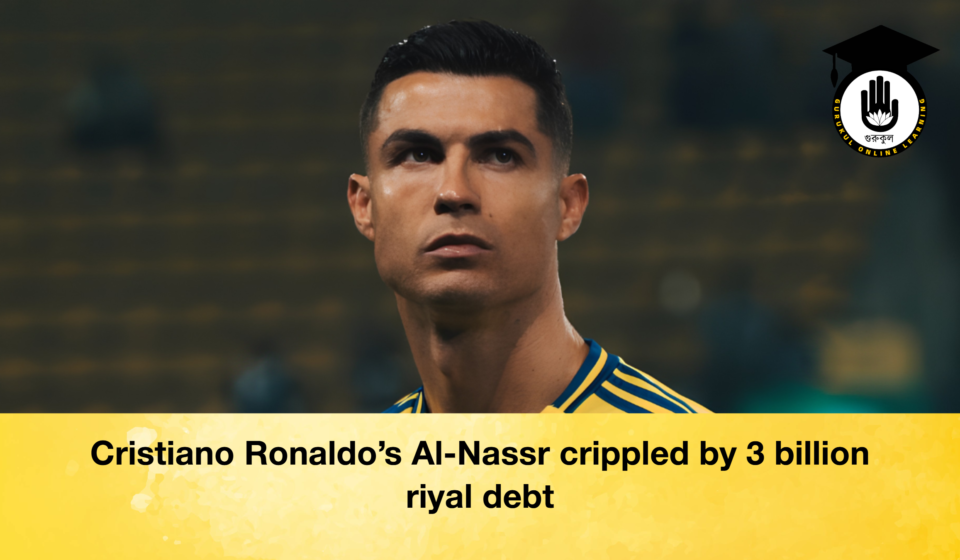

Cristiano Ronaldo’s club Al-Nassr find themselves plunged into a severe financial crisis, weighed down by debts exceeding 800 million Saudi riyals, which translates to roughly 3 billion Bangladeshi taka. With the new football season looming just a month away, this crippling fiscal deficit is already casting a heavy shadow over the club’s operations, particularly as the summer transfer window gathers pace.
The repercussions of the shortfall are instantly visible. Al-Nassr have thus far failed to finalise a single signing ahead of the upcoming campaign. Although a verbal agreement was reportedly reached to secure Portuguese midfielder Samu Costa from Spanish side Real Mallorca, financial constraints have effectively stalled the transfer. Even routine administrative tasks, such as renewing the contract of winger Abdulrahman Ghareeb, remain frozen.
Prominent Saudi sports daily Al-Riyadiah has shed light on the core drivers behind the crisis, reporting that the astronomical liabilities stem from costly financial decisions made over the previous season.
To steer the club away from insolvency, the club’s majority owner, the Saudi Public Investment Fund, has deployed a rigid three-pronged rescue strategy. The overarching objective is to stabilise the balance sheet, safeguard the brand’s market value, appease the passionate fan base, and prevent the debt burden from spirouring completely out of control.
Under the first measure, the executive management’s financial autonomy has been sharply restricted. Consequently, the board is barred from registering any new players unless management independently generates sufficient liquidity and internal revenue streams this summer.
The second phase involves appointing specialized financial, commercial, and legal advisory firms. These consultants have been tasked with identifying new revenue channels, enforcing strict cost-control measures, and delivering time-bound solutions to pull the club back from the brink.
The third and final approach centres on evaluating external acquisition offers. The Public Investment Fund currently has two serious bids on the table, though authorities prefer a partial rather than a total ownership handover.
Frustrated supporters are desperately hoping for a swift corporate buyout mirroring the path taken by their fierce local rivals, Al-Hilal. Back in April, Prince Alwaleed bin Talal’s Kingdom Holding Company successfully acquired Al-Hilal, setting a benchmark that Al-Nassr’s anxious faithful are eager for their own club to emulate.


