
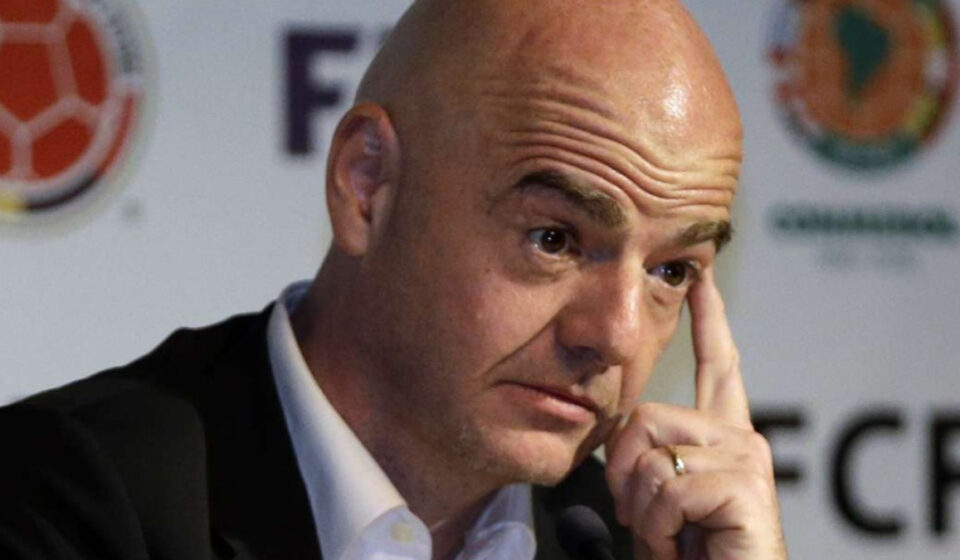

UEFA is considering pursuing criminal proceedings against FIFA president Gianni Infantino over alleged financial mismanagement linked to a proposed sale of part of FIFA’s commercial business, according to people familiar with the matter.
The dispute centres on plans to sell a 20 per cent stake in FIFA Forward Enterprise (FFE), the company responsible for managing commercial activities connected with FIFA, for $4.2 billion. The proposed transaction attracted opposition from several major football governing bodies and has now developed into a potential legal confrontation between UEFA and FIFA’s leadership.
According to sources cited by ESPN, UEFA believes the process behind the proposed sale may not have followed the appropriate procedures. The European governing body also alleges that relevant FIFA authorities were not adequately consulted while the plan was being developed.
UEFA has raised a further concern over the valuation placed on the 20 per cent stake. The organisation believes there may have been a personal interest involving Infantino in determining the proposed $4.2 billion price, although such allegations have not been established in court.
On Thursday, UEFA applied to a Manhattan court in New York for assistance in obtaining potentially relevant evidence from Thrive Capital Management, an investment firm founded by Joshua Kushner. Thrive was among the investors linked to the proposed investment in FFE.
A 60-page document submitted by UEFA to the court seeks records and communications concerning the proposed transaction. The request extends beyond Thrive Capital. UEFA is also seeking relevant documents from FIFA’s North American headquarters, JPMorgan and Greg Maffei, chief executive of Ban Ventures.
In the court filing, UEFA’s lawyers said the organisation and its legal advisers were considering whether to bring proceedings in Switzerland under Article 158 of the Swiss Criminal Code, which concerns criminal mismanagement. The filing refers to potential proceedings against Infantino and possibly other FIFA officials.
The proposed transaction had been designed around the sale of a 20 per cent interest in FFE for $4.2 billion. The company’s commercial activities include arrangements associated with FIFA’s major competitions and events, making the proposed deal particularly significant in terms of the organisation’s future commercial structure.
The plan faced resistance from the outset. UEFA, the Asian Football Confederation and Concacaf were among the major football bodies that objected to the proposal. Their concerns focused on the way the transaction was being pursued and its possible implications for FIFA’s commercial assets.
The disagreement subsequently escalated into a broader dispute between UEFA and FIFA. UEFA had threatened to boycott FIFA competitions if its concerns were not addressed. Faced with mounting pressure, Infantino cancelled the proposed transaction on 1 August.
The cancellation, however, did not immediately end the dispute. UEFA later agreed to suspend temporarily its threat to withdraw European teams from FIFA competitions after receiving assurances that FIFA would not pursue similar partnership sales involving its commercial assets in the future.
UEFA said in a statement that its decision to withdraw European teams from FIFA competitions during the next season had been temporarily put on hold. The competitions affected include the Women’s Under-20 World Cup, the Under-17 World Cup and the Women’s Under-17 World Cup.
The organisation also made clear that the suspension is not necessarily permanent. UEFA said it would continue to review the situation and could reconsider its position immediately if circumstances warranted such a move.
The latest court filing adds a new legal dimension to the dispute. While UEFA has not confirmed that criminal charges will definitely be brought, its request for evidence in the United States indicates that the organisation is examining the proposed transaction in considerable detail.
Any eventual proceedings in Switzerland would depend on the evidence gathered and on subsequent legal decisions. For now, the dispute remains centred on the handling of FIFA’s proposed commercial deal, the valuation of the stake and whether proper governance procedures were followed.