
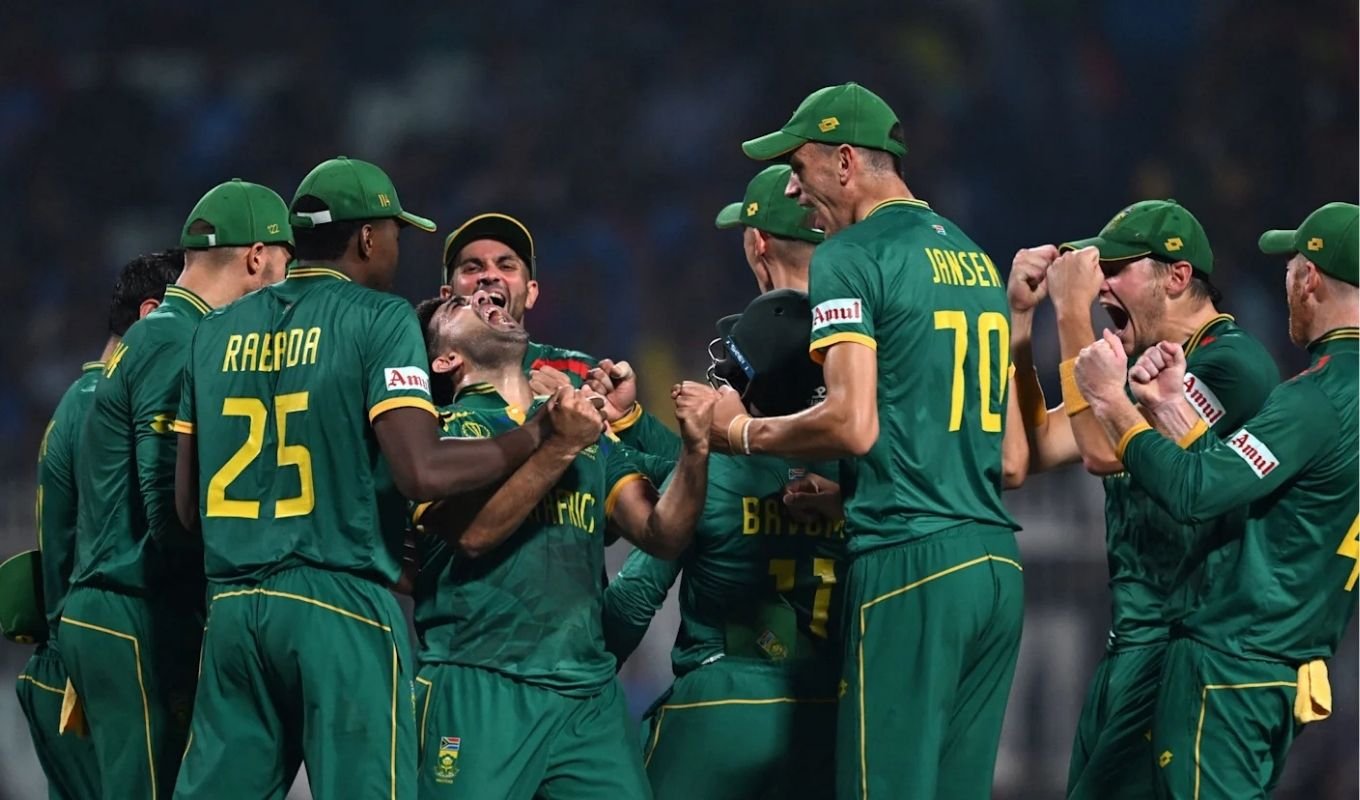

The question on every cricket fan’s mind is simple: can South Africa truly challenge India on home soil? Recent performances suggest that the Proteas are building resilience, yet the task ahead remains daunting.
In Rawalpindi, during the second Test against Pakistan, South Africa were staring at defeat. Chasing a formidable total of 333, they stumbled to 235 for 8. However, a determined partnership between Senuran Muthusamy, Keshav Maharaj, and Kagiso Rabada completely altered the game’s trajectory. Their lower-order heroics propelled South Africa beyond Pakistan’s score and eventually secured a series-levelling victory. That innings was a testament to their grit, patience, and refusal to capitulate under pressure.
Just a few weeks later, South Africa ‘A’ completed an astonishing chase of 417 against India ‘A’. While the pitch offered minimal assistance to bowlers and several key performers—such as Marques Ackerman and Jordan Hermann—will not feature in the full Test series, the win is invaluable for morale. It demonstrates that the Proteas can construct substantial partnerships even in unfamiliar conditions.
Spin: South Africa’s Ace in the Hole
South Africa’s spin duo—Keshav Maharaj and Simon Harmer—could prove pivotal in India. Harmer, a cunning off-spinner, combines sharp turn with subtle variations that can baffle even the best batsmen. Maharaj, having learnt from his difficult 2019 tour, has evolved into a confident, intelligent bowler capable of exploiting any weakness in opposition batting line-ups. His contributions with the bat also provide South Africa with crucial depth in pressure situations.
| Bowler | Wickets in Asia | Average | Wickets in India |
|---|---|---|---|
| Simon Harmer | 26 | 27.38 | 10 |
| Keshav Maharaj | 19 | 45.6 | 8 |
Batting Challenges Ahead
The real test lies in South Africa’s batting against India’s elite spinners—Kuldeep Yadav, Ravindra Jadeja, Washington Sundar, and Axar Patel. Senior batters Aiden Markram and Temba Bavuma have modest records in Asia, averaging 24.1 and 28.4 respectively. Emerging talents like Dewald Brevis and Tristan Stubbs must shoulder the responsibility of navigating conditions hostile to foreign batsmen. Brevis has demonstrated aggressive counter-attacking prowess, while Hamza showed glimpses of comfort against spin during the recent ‘A’ series, albeit on flat pitches.
Pace in Unfriendly Conditions
Although Indian tracks generally favour slow bowlers, South Africa’s pace attack—led by Rabada, Marco Jansen, and Corbin Bosch—can still strike through reverse swing with the older ball. Discipline and patience will be essential as they seek to exploit the smallest imperfections in the pitch.
Conclusion
India, with their home advantage and spin mastery, remain clear favourites. Yet, South Africa boasts a lower order that can frustrate and a spin partnership capable of producing breakthroughs. Should the Proteas bat with composure and their bowlers exploit even minimal assistance, this series promises to be far more competitive than many anticipate.