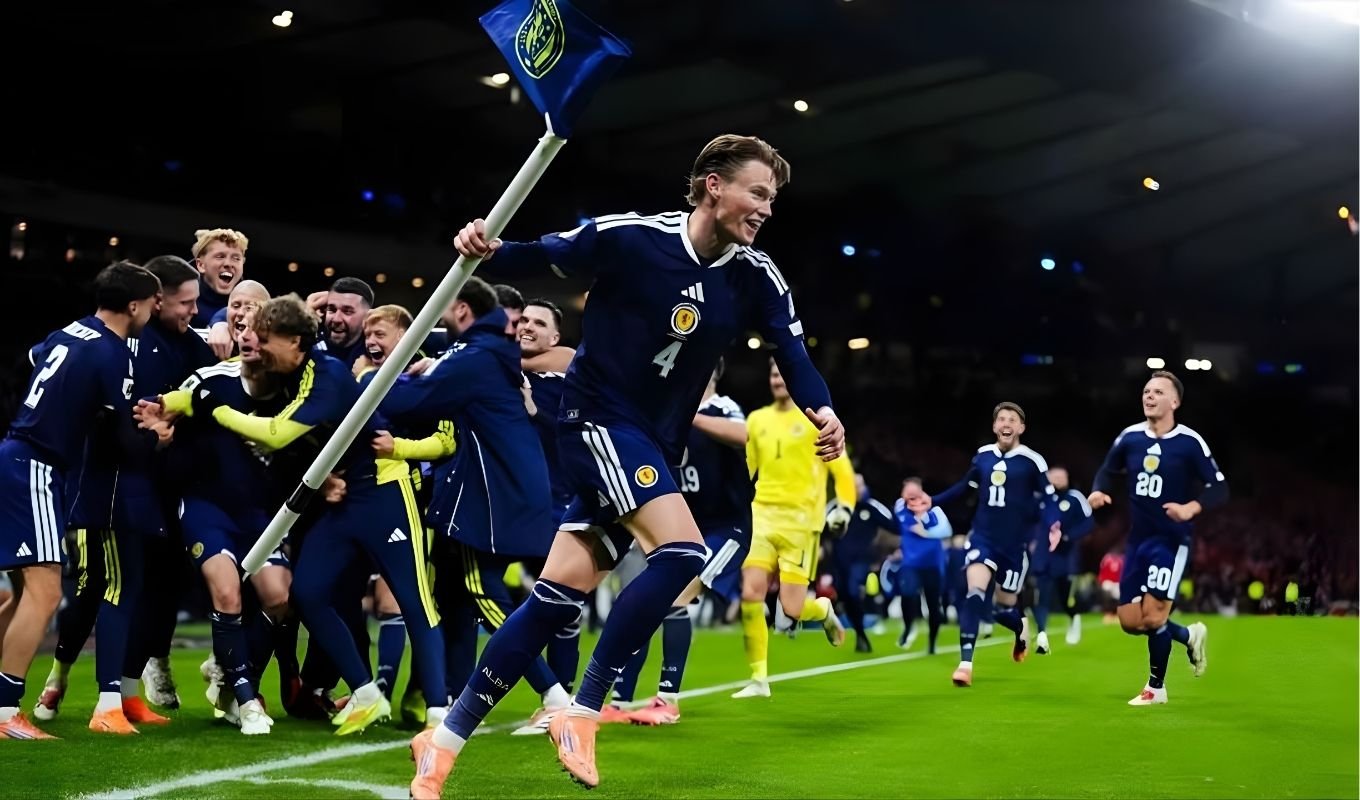
It’s been 28 long years, but Scotland have finally secured their place at the World Cup again. The last time they competed on the global stage, most of their current players hadn’t even been born. After a dramatic and unforgettable evening, the Scots triumphed over Denmark in a 4-2 victory to clinch a coveted spot in the 2026 World Cup.
The match, held at Hampden Park in Glasgow, was a true rollercoaster of emotions. With a draw being enough for Denmark to qualify directly, the game remained finely balanced at 2-2 after the regular 90 minutes. However, in added time, Scotland sealed their comeback with two stunning goals, sending their supporters into wild celebration.
Scotland’s Stellar Group Stage Performance
Scotland finished top of Group C in the World Cup qualifying campaign, with 13 points from six matches. They achieved 4 wins, 1 draw, and 1 loss. Meanwhile, Denmark secured second place in the group with 11 points, which means they will enter the World Cup play-offs.
The Scots’ journey back to the World Cup is a momentous one. Their last appearance came in the 1998 France World Cup, where they were eliminated at the group stage after losing to Brazil and Morocco and drawing with Norway. Since then, Scotland had endured two decades of missing out on major tournaments, including failing to qualify for six consecutive World Cups and five European Championships.
Steve Clarke’s Revival of Scottish Football
Under the leadership of manager Steve Clarke, Scotland have had a resurgence. They made their return to international tournaments at Euro 2020, and qualified for the most recent European Championship. In the current World Cup qualifying campaign, Scotland defeated Belarus twice, drew with Denmark, and secured a crucial win over Greece. Despite a 3-2 loss to Greece last week, Scotland’s hopes were still alive. Victory over Denmark was all they needed to secure direct qualification, and they achieved just that.
Match Stats: Denmark Dominated Possession, But Scotland Took Their Chances
Although Denmark dominated much of the match statistically, Scotland were ruthless in front of goal. Denmark enjoyed 63% possession and registered 20 shots, with 4 on target. However, the Scots made the most of their chances, converting 4 of their 5 shots on target.
| Statistic | Denmark | Scotland |
|---|---|---|
| Possession (%) | 63% | 37% |
| Total Shots | 20 | 8 |
| Shots on Target | 4 | 5 |
| Goals | 2 | 4 |
A Dramatic Victory: Scotland’s Unbelievable Comeback
The match started with an explosive moment in the 3rd minute, as Scott McTominay, playing for Napoli, scored a stunning bicycle kick to give Scotland an early lead. Denmark responded with 10 shots in the first half but failed to find the net.
After the break, Denmark equalised through a penalty by Rasmus Højlund in the 57th minute. However, Scotland regained the lead in the 78th minute, thanks to a goal from substitute Lawrence Shankland. Denmark quickly levelled the score again, with Patrick Dorgu scoring the equaliser. But in the dying minutes of the match, Kieran Tierney fired a powerful shot from outside the box to put Scotland back in the lead in the 93rd minute. Moments later, a beautiful strike by McLean sealed the win, and Scotland’s place in the World Cup.
Scotland’s Celebrations and Reactions
After the final whistle, an ecstatic Scotland captain Andy Robertson told BBC, “This will be one of the best nights of my life. We kept the nation on edge, but it was all worth it. We’re going to the World Cup.”
Outside Hampden Park, the celebrations were equally wild, with fans in disbelief. One supporter, who had been just seven years old the last time Scotland played in a World Cup, said, “This is everything to me. I predicted the second and third goals, but the fourth one? That was unbelievable!”
Other Teams Qualifying Directly for the World Cup
Alongside Scotland, four other teams secured direct qualification for the 2026 World Cup by finishing top of their respective groups: Spain, Belgium, Austria, and Switzerland. Spain finished first in Group E with 16 points after a 2-2 draw against Turkey, while Belgium dominated Group J with an impressive 18 points after a 7-0 victory over Liechtenstein. Austria clinched the top spot in Group H with 19 points, and Switzerland topped Group B with 14 points, despite a 1-1 draw against Kosovo.
In total, the top team from each European qualifying group will advance directly to the World Cup, while the second-placed teams will enter the play-offs.
Conclusion: A New Era for Scottish Football
Scotland’s return to the World Cup is not just a personal triumph for the team, but also a moment of national pride. It marks the end of a long wait and sets the stage for what could be a thrilling journey at the global tournament. With a mix of youthful energy and experienced leadership, Scotland will be hoping to make their mark on the world stage once again in 2026.