
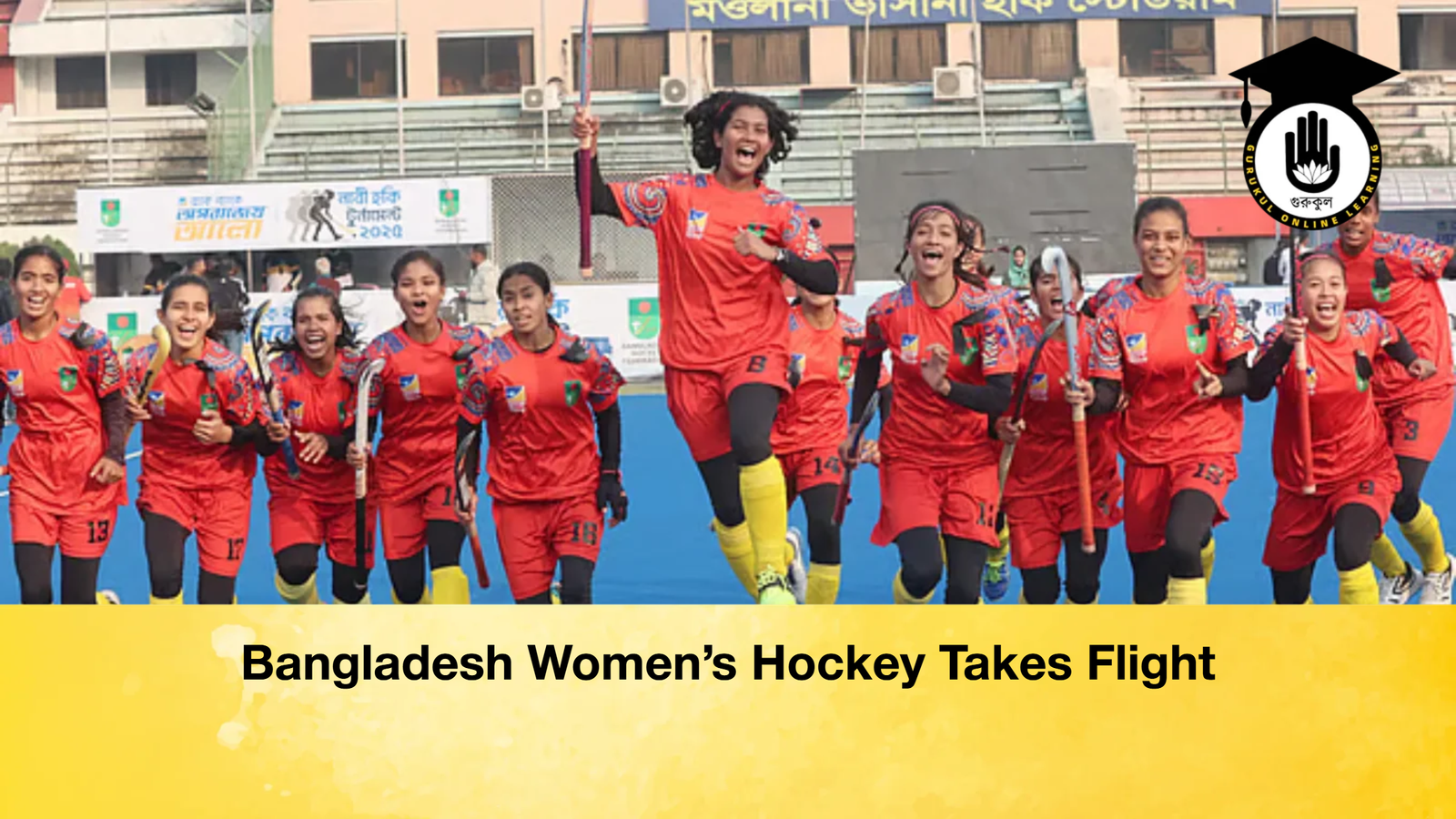

For several days, the Maulana Bhasani Hockey Stadium resonated with the sharp, rhythmic sound of sticks striking balls. Teenage girls and young women sprinted across the turf with determination, chasing every pass and loose ball. The scene was both stirring and symbolic. After cricket and football, women’s hockey in Bangladesh is finally spreading its wings, moving beyond sporadic domestic events into a broader, more organised national platform.
That momentum was on full display as the Brac Bank “Oporajeyo Alo” Women’s Hockey Tournament concluded on Friday. Eighteen districts were divided into four regional zones, culminating in a final round held in Dhaka. Joining the four regional champions was BKSP (Bangladesh Krira Shikkha Protishtan), the country’s only full-fledged sports institute and widely regarded as the powerhouse—or “factory”—of Bangladeshi hockey.
In the final, Zone 5 (BKSP) delivered a commanding performance, defeating Zone 4 (Mymensingh region) by an emphatic 8–0 margin. BKSP’s Kôna Akter starred in the decider, scoring four goals single-handedly and underlining the gulf in preparation and resources between institutional and district-level teams.
Tournament at a Glance :
| Category | Details |
|---|---|
| Tournament Name | Brac Bank “Oporajeyo Alo” Women’s Hockey Tournament |
| Participating Districts | 18 |
| Total Players | 352 |
| Champion | BKSP (Zone 5) |
| Final Score | BKSP 8–0 Zone 4 |
| Matches Played by BKSP | 5 |
| Goals Scored by BKSP | 65 |
| Goals Conceded by BKSP | 0 |
The tournament featured 352 players, many of whom were introduced to hockey sticks and balls for the very first time through this competition. For several participants, it was also their maiden visit to Dhaka and their first experience playing on a modern artificial turf. Compared to February’s Development Cup—where 14 districts competed—this edition expanded to 18 districts with the inclusion of Cox’s Bazar, Narail, Joypurhat and Sylhet, making it the largest domestic women’s hockey event in Bangladesh to date.
BKSP’s dominance was absolute. Averaging 13 goals per match, they conceded none throughout the tournament. The disparity reflects deeper structural issues: BKSP athletes train regularly on turf, enjoy structured coaching, and compete year-round, while most district teams practise sporadically on grass fields and assemble squads hastily whenever tournaments arise.
Yet, despite the imbalance, the broader picture is encouraging. Women’s participation is rising, recognition is growing, and incentives are improving. Rajshahi’s Mahua won Best Goalkeeper, Apurba Akter Jannatul was named Emerging Player, and Irene Akter of BKSP claimed the Best Player award. Irene, also an HSC candidate, previously shone in the 2023 World Cup qualifying five-a-side tournament in Oman. “I started out playing football,” she said. “But after joining BKSP, I fell in love with hockey. We are the future of women’s hockey, and we will take it forward.”
BKSP captain Arpita Pal, who netted 22 goals to finish as top scorer, echoed that optimism but voiced a concern. “We train hard under multiple coaches and follow strict routines, but we need stronger opponents. More competitive matches will help us grow.”
Coaches Zahid Hossain and Mowdudur Rahman believe tournaments like this can form the backbone of a future national women’s team. While Bangladesh has age-group squads, a full senior women’s national team is yet to be established. However, with the Asian Hockey Federation Cup scheduled for March, that reality may soon change.
At the prize-giving ceremony, Brac Bank Managing Director and CEO Refaet Ullah Khan assured stakeholders that the tournament would return on an even larger scale, reinforcing hope that Bangladesh women’s hockey is finally on an upward trajectory.