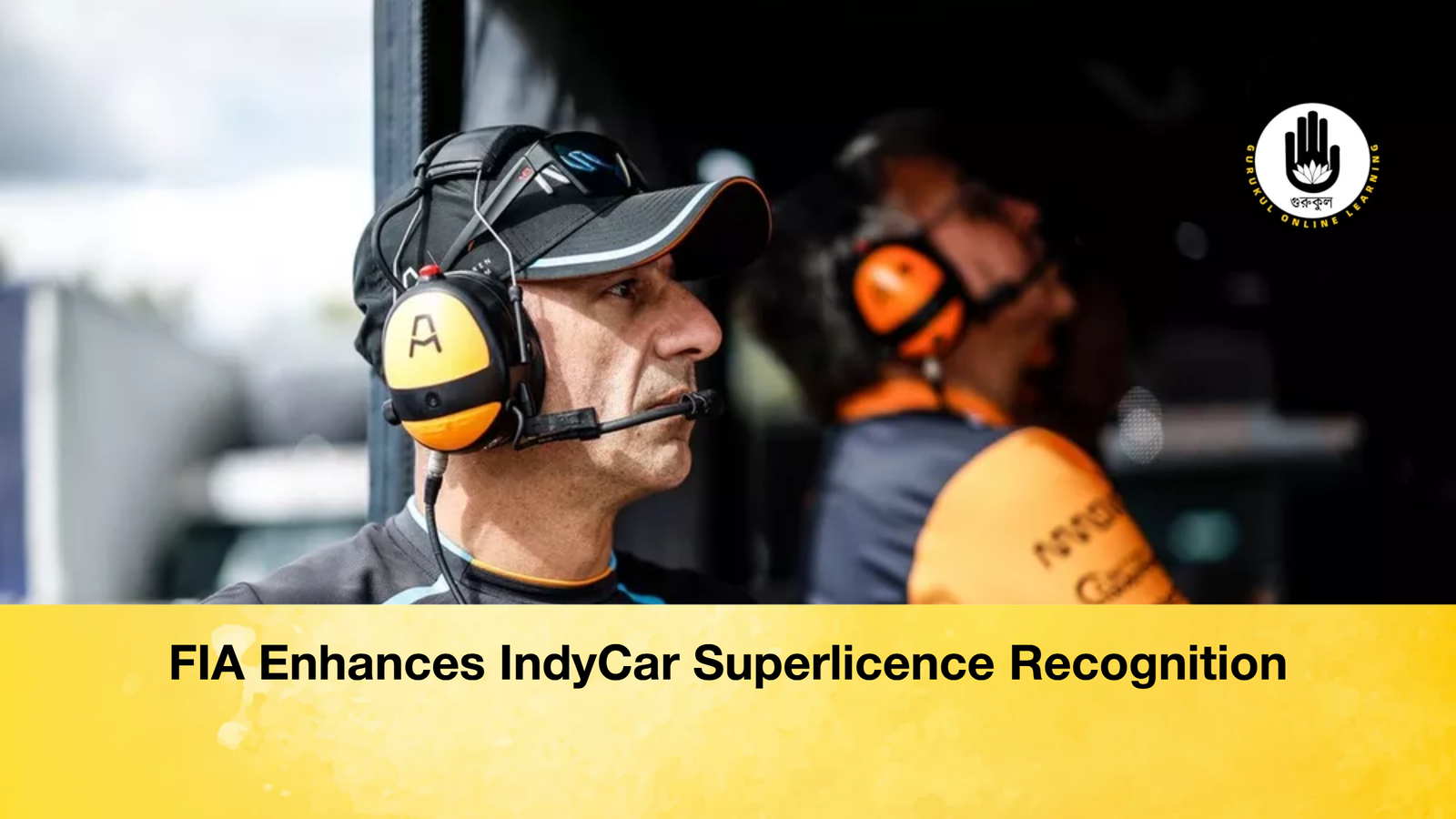

The FIA’s decision to revise the allocation of Formula 1 superlicence points for the IndyCar Series from the 2026 season has been warmly welcomed throughout the paddock, with Arrow McLaren team principal Tony Kanaan among the most vocal supporters. The change, approved at the FIA World Motor Sport Council’s final meeting of 2025, is widely regarded as a long-overdue acknowledgement of IndyCar’s competitive standard and global relevance.
Under the previous framework, only the top ten finishers in the IndyCar championship earned superlicence points, with a steeply tapered scale that heavily favoured the champion and runner-up. While a title-winning campaign comfortably met the FIA’s requirement of 40 points across three seasons, drivers who consistently performed at a high level often found themselves falling short, despite racing in one of the most demanding open-wheel championships in the world.
From 2026, the revised points structure will distribute points more evenly across the top ten, significantly boosting the totals available to drivers finishing between third and eighth. In doing so, IndyCar moves closer to Formula 2 in FIA recognition, while retaining a clear advantage over Formula 3.
Superlicence points comparison (top 10)
| Position | IndyCar (old) | IndyCar (from 2026) | Formula 2 | Formula 3 |
|---|---|---|---|---|
| 1st | 40 | 40 | 40 | 30 |
| 2nd | 30 | 30 | 40 | 25 |
| 3rd | 20 | 25 | 40 | 20 |
| 4th | 10 | 20 | 30 | 15 |
| 5th | 8 | 15 | 20 | 12 |
| 6th | 6 | 10 | 10 | 9 |
| 7th | 4 | 8 | 8 | 7 |
| 8th | 3 | 6 | 6 | 5 |
| 9th | 2 | 3 | 4 | 3 |
| 10th | 1 | 1 | 3 | 2 |
Kanaan praised the FIA for recognising what many within the sport have long argued. “No one doubts that IndyCar is one of the most competitive racing series in the world,” he said in a statement. “I’m glad the FIA is acknowledging that by increasing the points to be more comparable to Formula 2. It’s good news for IndyCar and good for the drivers who may want to race in Formula 1.”
While Arrow McLaren’s Pato O’Ward already satisfies the superlicence criteria and serves as a McLaren F1 reserve driver, Kanaan’s comments inevitably bring to mind the case of Colton Herta. Regarded as one of IndyCar’s standout talents since his debut in 2018, Herta became the series’ youngest-ever race winner in 2019. Yet despite multiple top-seven championship finishes, his path to a superlicence proved tortuous under the old system.
A prospective Formula 1 move with AlphaTauri in 2023 collapsed when Herta was found to have only 32 superlicence points, despite finishing seventh, third and fifth in the championship between 2019 and 2021. Entering the 2025 season with 31 points, he required a top-four finish to qualify outright — a target he ultimately missed by finishing seventh.
Although Herta subsequently joined Cadillac’s Formula 1 project as a test driver and moved to Formula 2 with Hitech to bolster his points tally, his situation highlighted the disconnect between IndyCar performance and FIA recognition.
At present, only Alex Palou, Scott Dixon, Pato O’Ward and Scott McLaughlin meet the superlicence threshold based on results from the past three seasons. Crucially, the revised points system will apply only to results earned from 2026 onwards, meaning its full impact will be felt gradually.
Even so, the changes represent a meaningful shift. While IndyCar is unlikely ever to be branded a conventional “feeder series”, the FIA’s revised allocation acknowledges its calibre and ensures that elite performances in North America are no longer undervalued on the road to Formula 1.