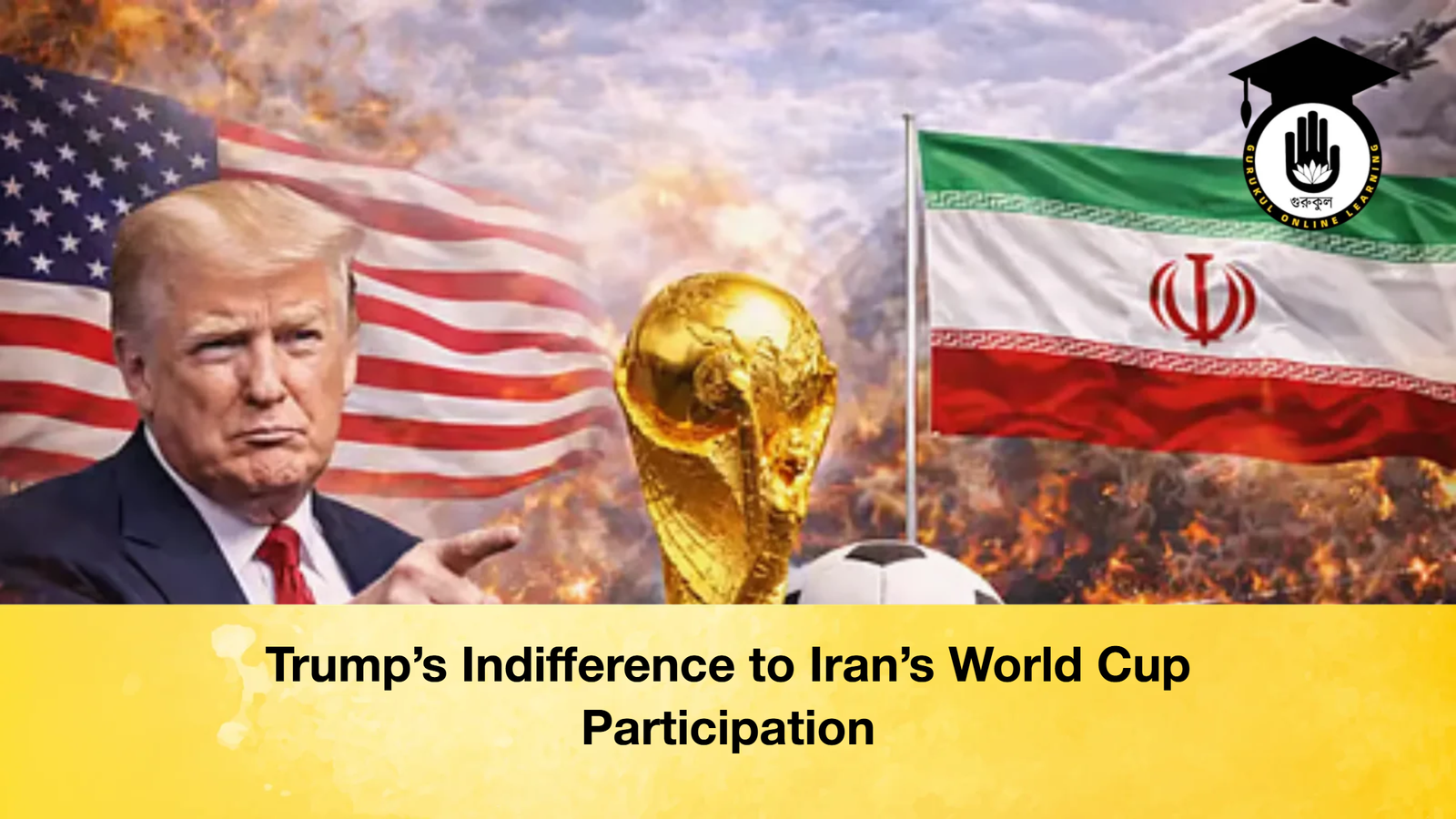

United States President Donald Trump has stated that he is unconcerned about whether Iran will participate in the upcoming FIFA World Cup, scheduled to begin in June. His remarks come at a time of heightened geopolitical tension, as the United States and Israel have launched attacks on Iran, prompting retaliatory strikes by Iran against US-aligned nations in the Gulf region. These developments have escalated international anxiety and cast a shadow over Iran’s sporting plans.
The 2026 World Cup will be jointly hosted by the United States, Canada, and Mexico from 11 June to 19 July. When asked about Iran’s participation in this tournament, Trump told Politico, “I really don’t care whether Iran gets to play! In my view, Iran is a defeated nation. They are almost powerless now.”
Despite these challenges, Iran has qualified for the World Cup for the fourth consecutive time, securing a spot in Group G. Their campaign is set to begin on 15 June against New Zealand in California. They will then face Belgium on 21 June at the same venue, before concluding the group stage against Egypt in Seattle on 26 June.
| Date | Opponent | Venue | City |
|---|---|---|---|
| 15 June | New Zealand | Levi’s Stadium | California |
| 21 June | Belgium | Levi’s Stadium | California |
| 26 June | Egypt | Lumen Field | Seattle |
Last year, despite a US strike on three Iranian nuclear facilities, Iran did not withdraw from international competition. However, the current situation has intensified concerns. Mehdi Taj, President of the Iranian Football Federation, has expressed doubts about Iran’s ability to participate safely. Speaking to the sports portal Varzesh3, Taj stated, “Following these attacks, it is unrealistic to expect optimism from us regarding the World Cup. The US administration has inflicted direct harm on our homeland. Such actions cannot go unanswered.”
In a subsequent interview on Iranian state television, Taj elaborated, “After these attacks, the likelihood of us focusing on the World Cup is low. Those responsible for sporting decisions will ultimately determine our participation.”
Meanwhile, FIFA Secretary General Matthias Grafström emphasised the organisation’s commitment to a secure tournament, stating on Saturday, “Our objective is to ensure a World Cup where everyone can participate safely.”
With just three months remaining before the tournament kicks off, Iran faces the dual challenge of navigating escalating geopolitical tensions while preparing its national team for what promises to be a highly competitive World Cup. Analysts warn that political instability could undermine both the players’ preparation and their mental readiness, potentially affecting their performance on the global stage.
The international football community now watches closely, as the intersection of sport and geopolitics may determine whether Iran ultimately takes the field this summer.