
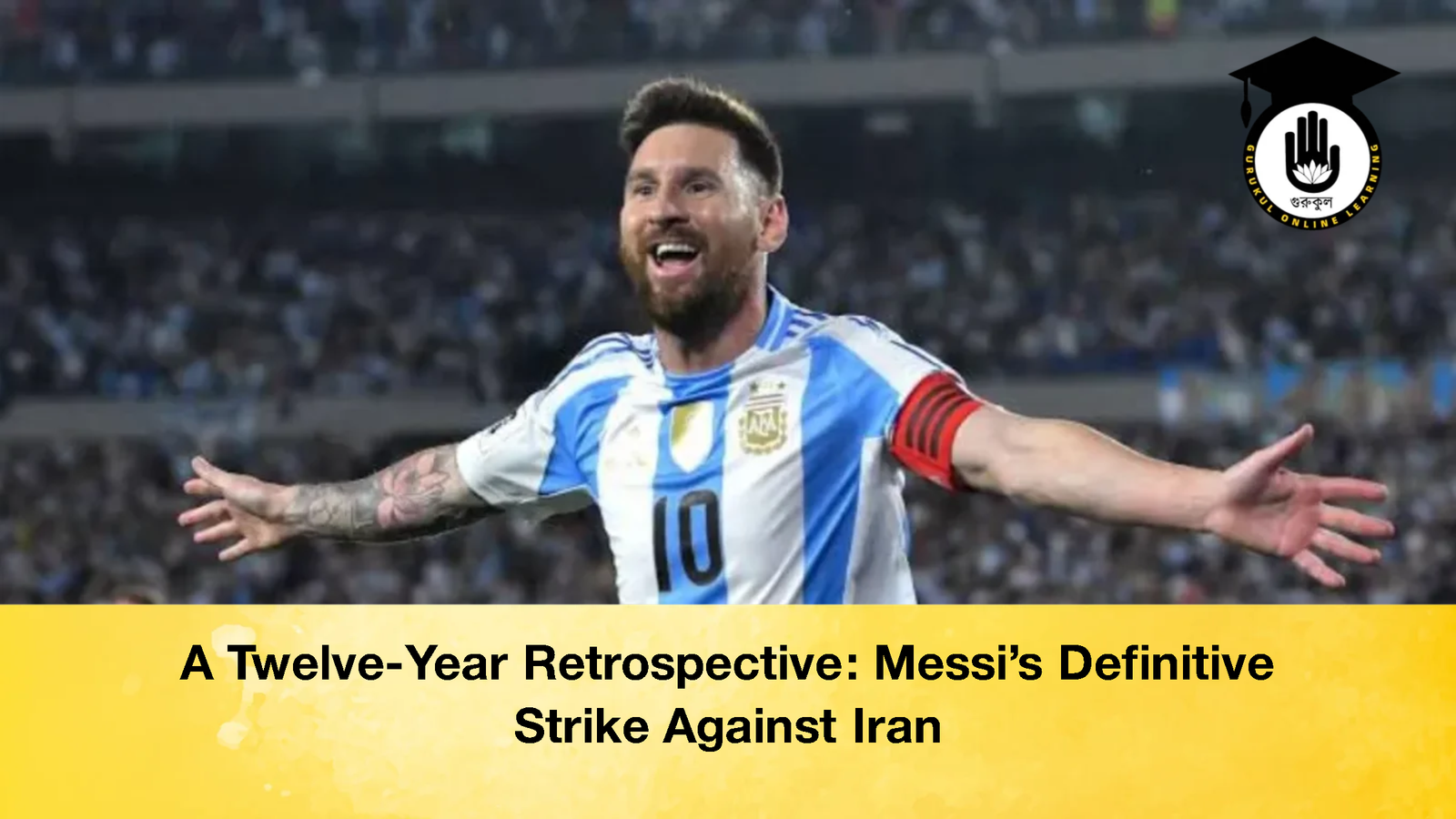

In the extensive history of international association football, certain goals transcend their immediate impact on a tournament’s standings, evolving instead into enduring symbols of individual mastery. Amongst the most celebrated of these is the definitive strike by Lionel Messi during the 2014 FIFA World Cup in Brazil. On a dramatic afternoon at the Estádio Mineirão in Belo Horizonte, the Argentine captain produced a moment of technical perfection that remains a significant point of discussion and admiration twelve years later.
The Tactical Standoff in Belo Horizonte
The Group F encounter, contested on 21 June 2014, was defined by a remarkably disciplined and resolute defensive display from Iran. Under the tactical stewardship of Carlos Queiroz, “Team Melli” employed a sophisticated low-block defensive system that successfully nullified the Argentine offensive for the vast majority of the fixture. Despite Argentina’s overwhelming possession and a star-studded lineup featuring the likes of Sergio Agüero and Gonzalo Higuaín, the Iranian side restricted space with such efficacy that many observers believed a goalless draw was inevitable.
Throughout the ninety minutes of regulation time, Iran proved they were not merely there to defend; they created several dangerous counter-attacking opportunities that severely tested the Argentine backline. The Argentine goalkeeper, Sergio Romero, was forced into a series of crucial saves to maintain parity, most notably tipping a powerful header over the crossbar. As the match entered stoppage time, the tension within the stadium was palpable, with Argentina facing the prospect of dropped points and a potential blow to their momentum.
A Moment of Individual Brilliance
The deadlock was finally broken in the first minute of added time (90+1′). Lionel Messi, receiving the ball on the right flank just outside the penalty area, performed his trademark manoeuvre: cutting inside onto his preferred left foot. Despite being closely shadowed by Iranian forward Reza Ghoochannejhad and several other defenders who had maintained their concentration for over ninety minutes, Messi identified a marginal opening in the defensive perimeter.
From approximately 25 yards out, he unleashed a precision-curled shot towards the far corner of the goal. The Iranian goalkeeper, Alireza Haghighi, executed a full-stretch dive, but the velocity and trajectory of the ball directed it precisely into the side netting. The goal instantly transformed the atmosphere of the Estádio Mineirão, sparking jubilant celebrations amongst the Argentine supporters and leaving the Iranian players in a state of visible disbelief, having come so close to a historic result.
This single moment of technical mastery secured a 1-0 victory for Argentina. Crucially, the result guaranteed the “Albiceleste” a place in the knockout stages of the competition with a game to spare, following their hard-fought opening victory over Bosnia and Herzegovina at the Maracanã.
Post-Match Analysis and Tributes
Following the final whistle, the late Argentine manager, Alejandro Sabella, was quick to acknowledge the exceptional performance of the opposition. He admitted that the Iranian side had presented a formidable challenge that nearly derailed their campaign:
“Iran played an extraordinary match and proved that they are a fantastic team. They made life extremely difficult for us throughout the afternoon.”
However, Sabella was equally forthright regarding the singular factor that ultimately separated the two sides. Reflecting on his captain’s contribution, the manager famously remarked:
“They lacked one thing, and that was Messi. He is a genius, and fortunately, he is Argentine. That specific shot could not have been stopped even if there were two goalkeepers in the net. When Messi is on the pitch, everything is possible.”
Historical Context and Lasting Legacy
Lionel Messi’s goal against Iran was his second match-winning strike in as many games during the 2014 campaign. It served as a pivotal moment in Argentina’s journey to the final, establishing a psychological momentum that the team carried through subsequent knockout rounds against Switzerland, Belgium, and the Netherlands.
Despite Iran’s tactical “double-marking” of the man often called the “Atomic Flea,” the narrowest of opportunities proved sufficient for the forward to alter the course of the match. Twelve years on, the strike at the Mineirão is frequently cited in retrospectives of World Cup history as a quintessential “Messi moment.”
It serves as a stark illustration of his technical capability and his temperament—the ability to remain composed and clinical in the dying moments of a high-pressure international fixture. For Iran, the match remains a proud testament to their defensive organisation and spirit, while for Argentina, it remains a definitive chapter in the legendary career of their iconic number ten, reminding the world why he is often regarded as a player of a different calibre entirely.