
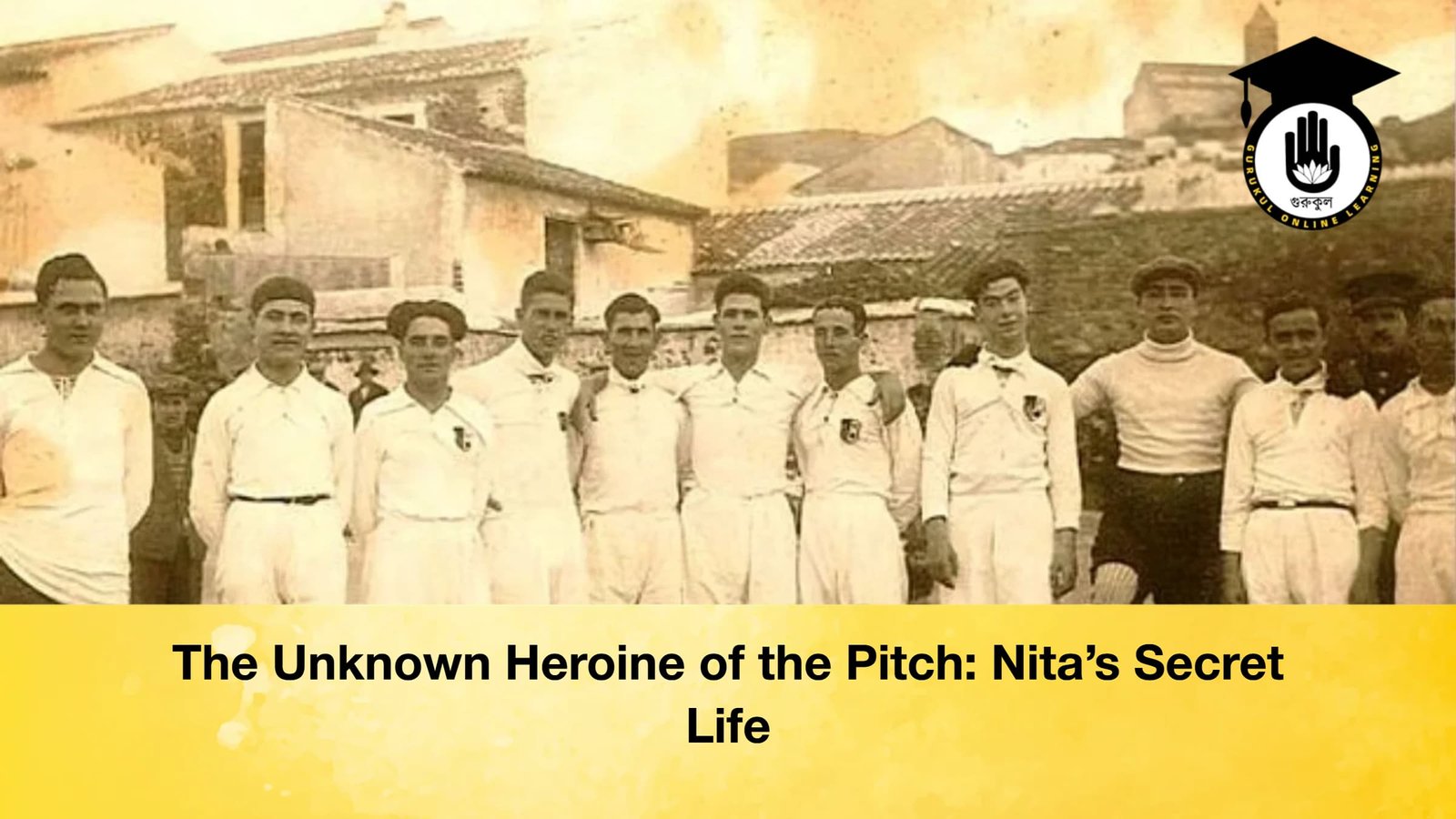

In his cinematic masterpiece Meghe Dhaka Tara, the legendary auteur Ritwik Ghatak discovered ‘Nita’—a woman whose face bore the subtle scars of history and whose spirit was framed by a halo of exhaustion and resilience. Halfway across the world, amidst the sun-drenched landscapes and dusty pitches of Spain, another Nita was born. For over half a century after her death, her story remained shrouded in the clouds of oblivion until Jesus Hurtado, a sports journalist and collector from Malaga, “resurrected” her while researching the centenary of the football club Vélez CF.
The Mystery of ‘Veleta’
While combing through early 20th-century archives, Hurtado encountered a persistent enigma. Records from that era often used only nicknames, and one name appeared frequently without a formal identity: Veleta.
When Hurtado questioned elderly locals and former players, he met a wall of silence. Some patted him on the back, cryptically remarking that “Veleta was a different kind of footballer.” Hurtado initially suspected the player might have been a war refugee or perhaps a member of the LGBT community, explaining the community’s protective secrecy. However, the truth was far more transgressive for the time: Veleta was a woman.
The revelation came through a “gentleman’s agreement” among her teammates. They confessed, “She played better than us, so we never revealed her identity.” Her peers had protected her secret for decades out of pure respect for her talent.
From Ana to Nita
Born on 16 March 1908, her real name was Ana Carmona Ruiz. Her father, a docker at the Port of Malaga, affectionately called her ‘Nita’. Growing up near the docks, she watched English sailors play football—a sight that ignited a lifelong passion. In a patriarchal society where football was strictly a male preserve, her ambition was met with domestic violence and social ostracisation.
Her journey into organized football began under the protection of Father Francisco Miguez, a Galician priest. He allowed her to practice at Sporting Club de Malaga after the boys had finished their sessions. To play in matches, Nita devised a meticulous disguise: she cropped her hair, hid it under a woollen beret, and used bandages to flatten her chest, concealing her femininity beneath baggy jerseys and oversized trousers.
The Double Life of a Pioneer
Nita’s career was a constant cycle of transformation. She would enter the dressing room as a “cleaner” or “masseuse,” emerge onto the pitch as a male playmaker, and return to her life as a woman after the final whistle.
| Feature | Details of Nita’s Sporting Life |
| Full Name | Ana Carmona Ruiz |
| Pseudonym | Veleta (The Weather Vane) |
| Position | Midfielder / Number 10 |
| Active Years | Roughly 1921–1929 |
| Clubs | Sporting Club de Malaga, Vélez CF |
| Technical Style | Highly skilled playmaker, renowned for assists |
The Price of Passion
Nita’s success eventually bred jealousy. When spectators and rival players realised a woman was outperforming men, she was subjected to public humiliation, including being pelted with stones and spat upon. Her own family, prompted by a conservative uncle who claimed football would ruin her “feminine physique,” punished her severely. She was even arrested and held in barracks for her “misbehaviour.”
Eventually, she fled to the town of Vélez-Málaga, where she joined Vélez CF. With the support of her cousin and the club captain’s sister, she continued her clandestine career. She even played in the inaugural match of the region’s first official football pitch—first appearing as a lady-in-waiting to a local dignitary, then slipping away to reappear in kit as the team’s star midfielder.
A Legacy Interrupted
By 1929, the regional football board tightened restrictions, specifically ordering guards to prevent women from entering male dressing rooms to catch Nita. Her playing days were over. Tragically, she died of typhus in 1940 at the age of only 32.
In a final act of defiance and love, her teammates and family buried her in the jersey of Sporting Club de Malaga. While she was not the first woman to play football, she remains the first known woman to have successfully infiltrated the professional male game through sheer talent and disguise. Today’s female athletes stand on the shoulders of pioneers like Nita, who chose to live a double life rather than a life without football.