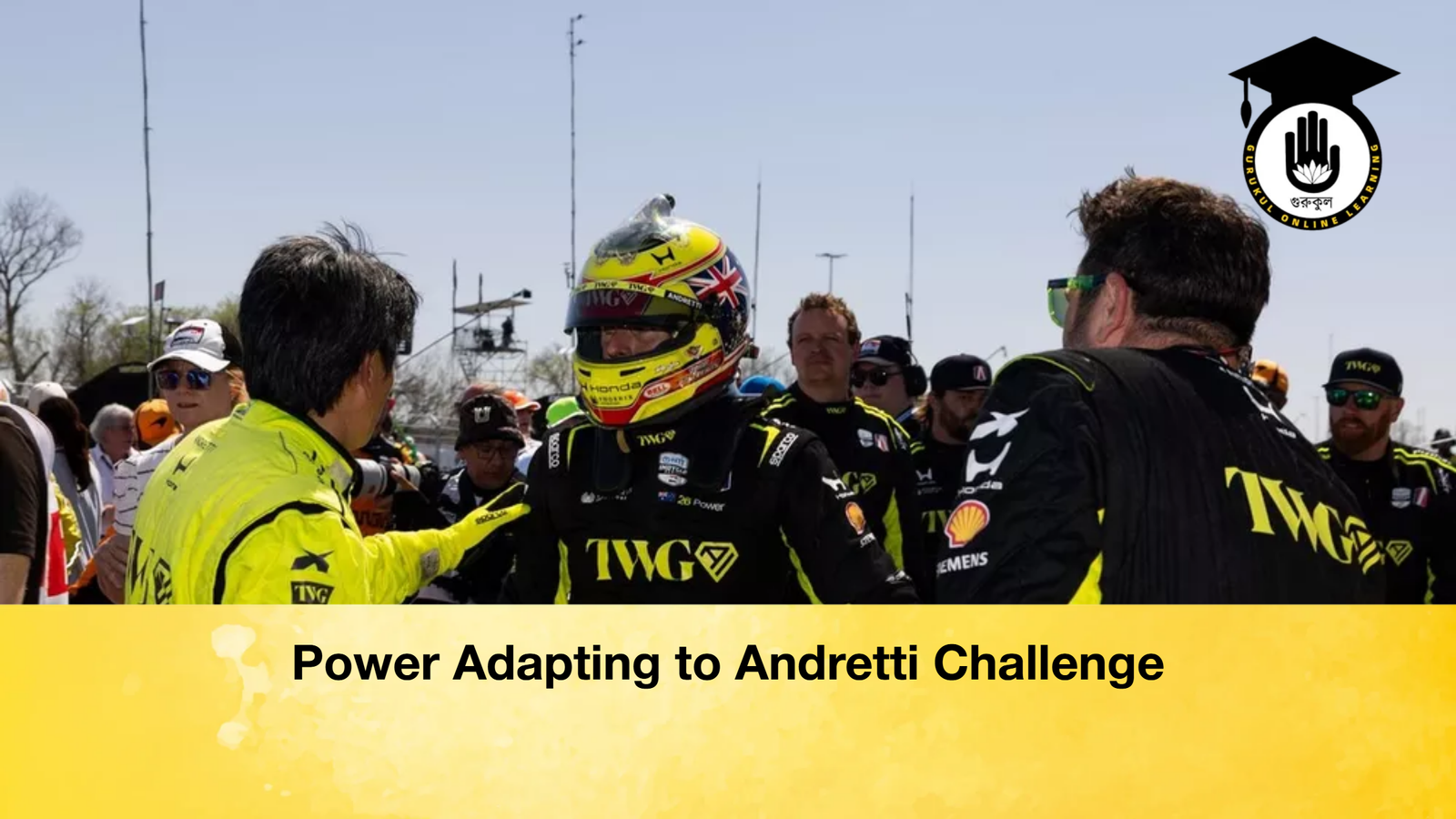

Will Power’s early tenure with Andretti Global has been anything but uneventful. After nearly two decades of continuity with Team Penske, the Australian veteran finds himself navigating a steep learning curve—one that has already produced a blend of promising pace, costly errors, and cautious optimism.
At 45, Power remains one of the most decorated drivers in the IndyCar Series, boasting two championships and victory in the Indianapolis 500. Yet his opening three races with Andretti have underscored just how nuanced even a “spec” series can be. While he has already secured a podium finish—third place at the Arlington Grand Prix—his campaign has also included multiple incidents, notably a crash from the lead at Phoenix.
A Transition Beyond the Surface
On paper, the switch may appear straightforward. However, Power’s move from Chevrolet to Honda power represents a fundamental shift in driving feel and performance characteristics. According to team principal Ron Ruzewski, the differences run far deeper than engine branding.
“Each car has its own philosophy,” Ruzewski explained. “Even in a tightly controlled series, the way teams approach setup can vary significantly.”
One of the most critical areas of divergence lies in suspension and damper development—arguably the last major frontier of technical differentiation in IndyCar. These components dictate how forces from the tyres are transmitted through the chassis, influencing how the car responds under braking, cornering, and acceleration.
Key Differences in Power’s Transition
| Aspect | Previous Setup (Penske) | Current Setup (Andretti) | Impact on Driver |
|---|---|---|---|
| Engine | Chevrolet | Honda | Different power delivery and throttle response |
| Dampers | Penske philosophy | Andretti philosophy | Altered feedback and handling characteristics |
| Car Feel | Familiar (17 years) | New and evolving | Requires adaptation period |
| Setup Approach | Established baseline | New engineering direction | Learning curve for optimisation |
Ruzewski likened the adjustment to switching from a pickup truck to a high-performance sports car: both capable, but fundamentally different in feel. For Power, whose instincts have been honed over 17 years in one environment, recalibrating those sensory cues is no trivial task.
Signs of Progress
Despite the challenges, there are clear indications that progress is being made. His podium in Arlington marked his most complete performance yet with Andretti, suggesting that both driver and team are beginning to align.
Power himself remains pragmatic. With the championship heading to Barber Motorsports Park—a circuit where he has historically excelled—he views the upcoming race as a crucial benchmark.
“It’s a flowing track, very different to what we’ve had so far,” he noted. “I’m curious to see where we stand with this car in that environment.”
A Work in Progress
Ultimately, Power’s transition is a reminder that even the most experienced drivers must adapt when circumstances change. The raw speed is still evident; the challenge lies in unlocking it consistently.
If Arlington was a sign of things to come, Andretti Global may yet reap the rewards of pairing one of IndyCar’s most accomplished drivers with a fresh technical philosophy.