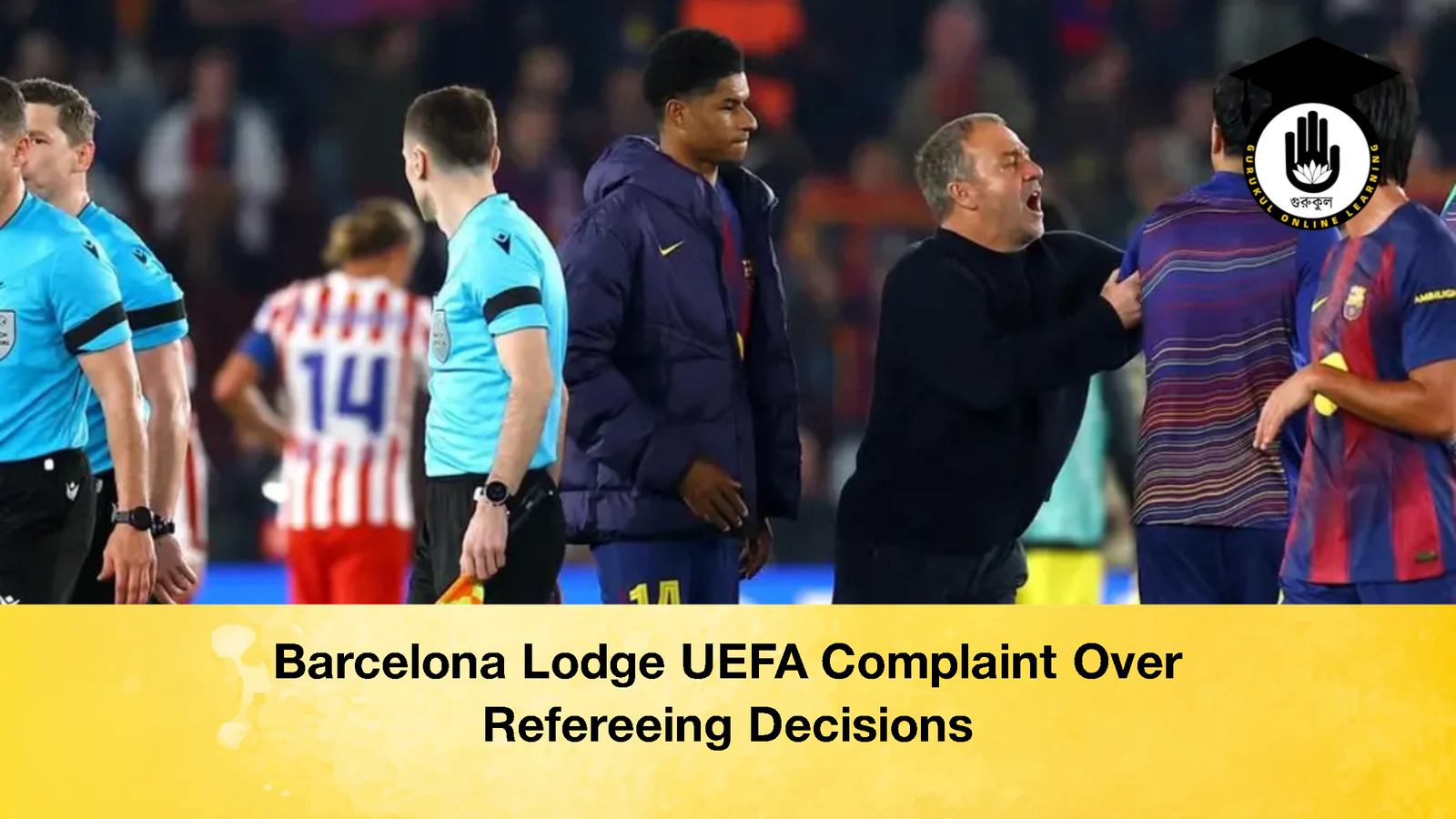
Barcelona have formally submitted a complaint to UEFA following a contentious refereeing performance during their UEFA Champions League quarter-final first-leg defeat to Atlético Madrid, a match that has since generated widespread debate across European football circles.
The Catalan club were beaten 2–0 at home, but the result has been overshadowed by allegations of critical officiating errors involving referee István Kovács and the VAR team. Barcelona argue that key decisions during the match materially influenced the outcome and have called for a formal review of the officiating process.
Match Overview
| Category | Details |
|---|---|
| Fixture | Barcelona vs Atlético Madrid |
| Competition | UEFA Champions League Quarter-Final (First Leg) |
| Venue | Camp Nou (Barcelona) |
| Final Score | Barcelona 0–2 Atlético Madrid |
| Atlético Madrid Goals | Julián Álvarez (45’), Alexander Sørloth (70’) |
| Referee | István Kovács |
| VAR Involvement | No intervention on key penalty incident |
| Disciplinary Context | Barcelona reduced to ten men during match |
The pivotal flashpoint occurred in the 54th minute when Atlético Madrid goalkeeper Juan Musso attempted to clear the ball under pressure inside a crowded penalty area. In the ensuing phase of play, defender Marc Pubill was involved in an incident that Barcelona players immediately appealed as a handball offence, also arguing that it should have resulted in a second yellow card.
Despite strong protests from Barcelona players and staff, referee Kovács allowed play to continue without awarding a penalty or issuing further disciplinary action. More significantly, the Video Assistant Referee (VAR) did not recommend an on-field review of the incident, a decision that has become central to Barcelona’s formal complaint.
In the aftermath, Barcelona released a statement expressing “deep dissatisfaction” with what they described as a “major officiating error”, insisting that both the on-field judgement and the absence of VAR intervention had a decisive impact on the match’s competitive balance.
The club further argued that such inconsistencies undermine confidence in elite European competition, particularly in knockout-stage fixtures where fine margins frequently determine progression.
Barcelona’s Formal Demands to UEFA
In their submission to European football’s governing body, Barcelona have outlined three primary requests:
- The launch of an official investigation into the refereeing performance during the match
- The disclosure and review of communications between the on-field referee and the VAR officials during the disputed incident
- A formal assessment of whether procedural errors or misapplication of VAR protocol affected the integrity of the result
The club is also seeking clarification on why VAR did not intervene, particularly given the nature of the incident and the standard protocols governing clear and obvious errors in penalty-area decisions.
Flick Voices Strong Objections
Barcelona head coach Hansi Flick also expressed strong criticism following the match, arguing that the incident warranted both a penalty and potentially a second yellow card for the Atlético defender involved.
Speaking after the final whistle, Flick described the decision as “clear” in his view and questioned the absence of VAR intervention, suggesting that the officiating team should provide an explanation for the non-review.
His comments reflect broader frustration within the Barcelona camp over what they perceive as inconsistency in refereeing standards across high-profile European fixtures this season.
Match Context and Competitive Dynamics
Despite the controversy, Atlético Madrid delivered a disciplined and tactically organised performance. Goals from Julián Álvarez just before half-time and Alexander Sørloth in the 70th minute gave the Spanish side a commanding advantage heading into the second leg.
Sørloth’s strike, assisted by Matteo Ruggeri, highlighted Atlético’s efficiency in transition and their ability to capitalise on Barcelona’s numerical disadvantage, as the home side were reduced to ten men during the encounter.
Barcelona, meanwhile, struggled to recover momentum after conceding the opening goal and were unable to convert possession into decisive attacking opportunities.
UEFA Review Under Scrutiny
The complaint now places UEFA under renewed scrutiny regarding its officiating standards and VAR implementation protocols in high-stakes knockout matches. While UEFA routinely reviews match incidents internally, formal complaints from participating clubs often trigger detailed assessments of referee performance and communication logs.
Second Leg Anticipation
Attention now turns to the second leg at the Wanda Metropolitano on 14 April, where Atlético Madrid will defend their two-goal advantage. Barcelona face a significant challenge not only in overturning the deficit but also in managing the psychological and tactical pressure following a controversial first-leg defeat.
The developing dispute adds further intensity to an already highly charged European tie, with UEFA’s response to Barcelona’s complaint likely to be closely watched across the footballing world.