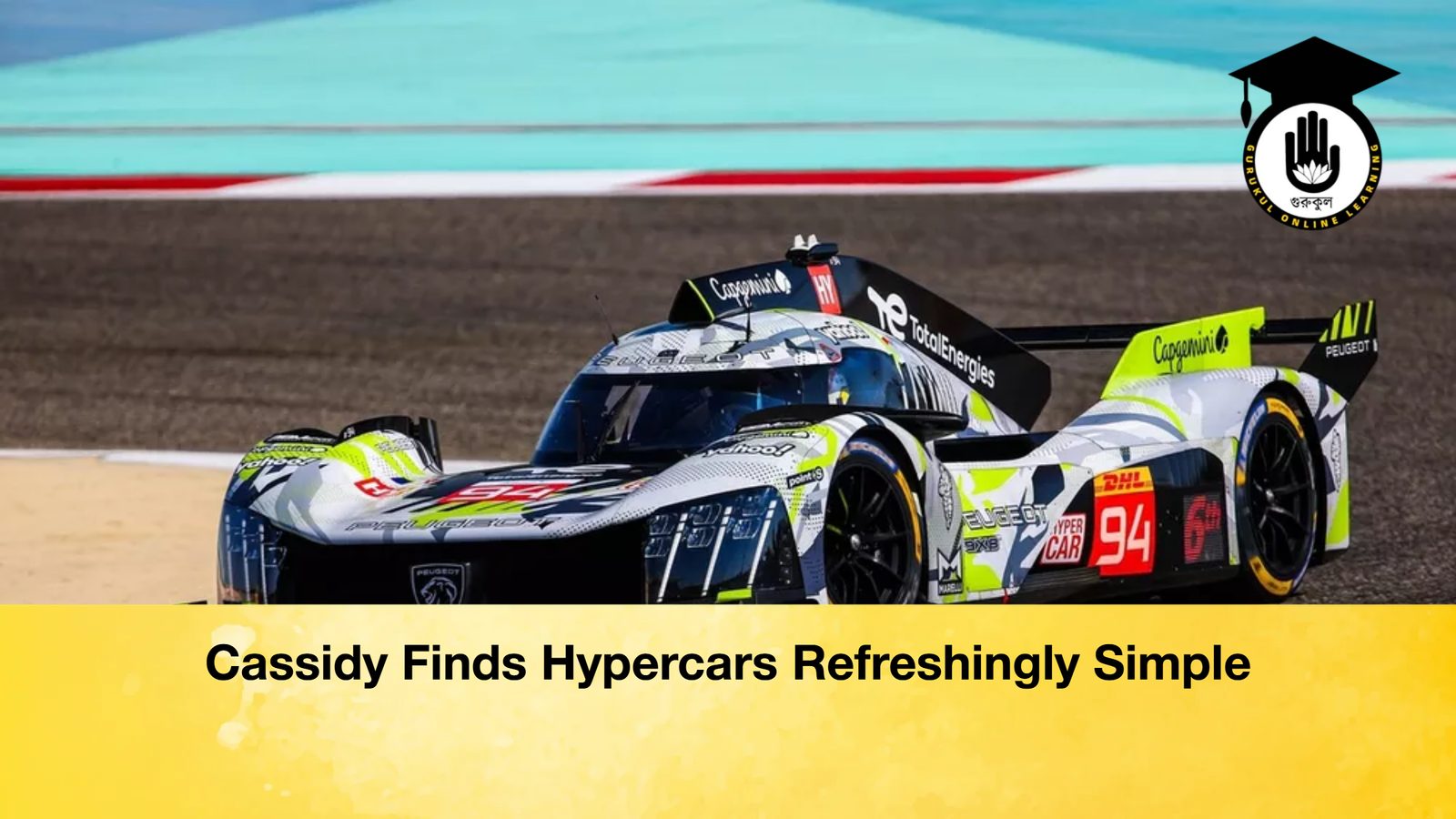
Nick Cassidy has offered a candid and revealing insight into his transition to endurance racing’s top tier, admitting that the systems complexity of World Endurance Championship hypercars feels “like a bit of a holiday” when compared with the relentless technical demands of Formula E.
The New Zealander is preparing for one of the most demanding seasons of his career in 2026, combining a full factory programme with Peugeot in the WEC Hypercar class alongside his ongoing commitments in Formula E, where he now races for Citroën. For Cassidy, it will mark only his second year in the WEC, having previously competed in the GTE Am category with AF Corse in 2022 during the final season of GT-based cars at Le Mans.
Modern LMH and LMDh prototypes are undeniably sophisticated machines, blending internal combustion engines with hybrid systems and operating within tightly regulated performance windows. Yet Cassidy believes his background in Formula E — where drivers constantly juggle energy usage, regeneration modes, torque delivery and software settings — has left him unusually well prepared.
Speaking after his second test with the Peugeot 9X8 in Bahrain, Cassidy explained that the learning curve has been gentler than anticipated. In his estimation, the number of systems a hypercar driver must actively manage is a fraction of those encountered in Formula E, allowing him to focus more on driving and less on operating the car’s electronics. That simplicity, he suggests, breeds confidence and accelerates adaptation.
Cassidy’s versatility is rooted in a career that spans some of the world’s most competitive championships. Before moving to Formula E in 2021, he enjoyed tremendous success in Japan, claiming titles in both Super Formula and Super GT’s premier GT500 class. That experience has proven invaluable as he adjusts once again, this time to the nuances of multi-class endurance racing.
One aspect that has surprised him, however, is the relative lack of grip in today’s hypercars. Compared with the LMP1 machines they replaced, or even the GT500 cars he once raced, current-generation prototypes deliver less downforce and mechanical grip. Cassidy describes driving them as a delicate exercise, requiring restraint rather than aggression — a style he finds closer to Formula E than to his previous high-downforce experiences.
That similarity may prove advantageous as he balances two categories that now share more traits than many might expect. Nevertheless, the logistical challenge of competing at the highest level in both series is immense. Cassidy is also acclimatising to a new Formula E environment after leaving Jaguar to join Citroën, at a time when manufacturers are already diverting significant resources towards the upcoming Gen4 era.
Time, by his own admission, is the one commodity in shortest supply. Yet Cassidy has been fulsome in his praise for Peugeot, citing the team’s flexibility and understanding as crucial in helping him manage an overloaded schedule. With simulator sessions, technical meetings and testing spread across two continents and two championships, he has been operating at full capacity simply to stay ahead of the curve.
Nick Cassidy: series comparison
| Category | Formula E | WEC Hypercar |
|---|---|---|
| System complexity | Very high | Moderate |
| Energy management | Constant and critical | Limited |
| Downforce level | Low | Moderate |
| Driving style | Precision, efficiency | Caution, consistency |
| Multi-class traffic | No | Yes |
As Cassidy looks ahead to 2026, his task is formidable. Yet if early impressions are anything to go by, his ability to translate Formula E’s complexity into hypercar composure may prove a decisive advantage in one of motorsport’s most competitive arenas.