
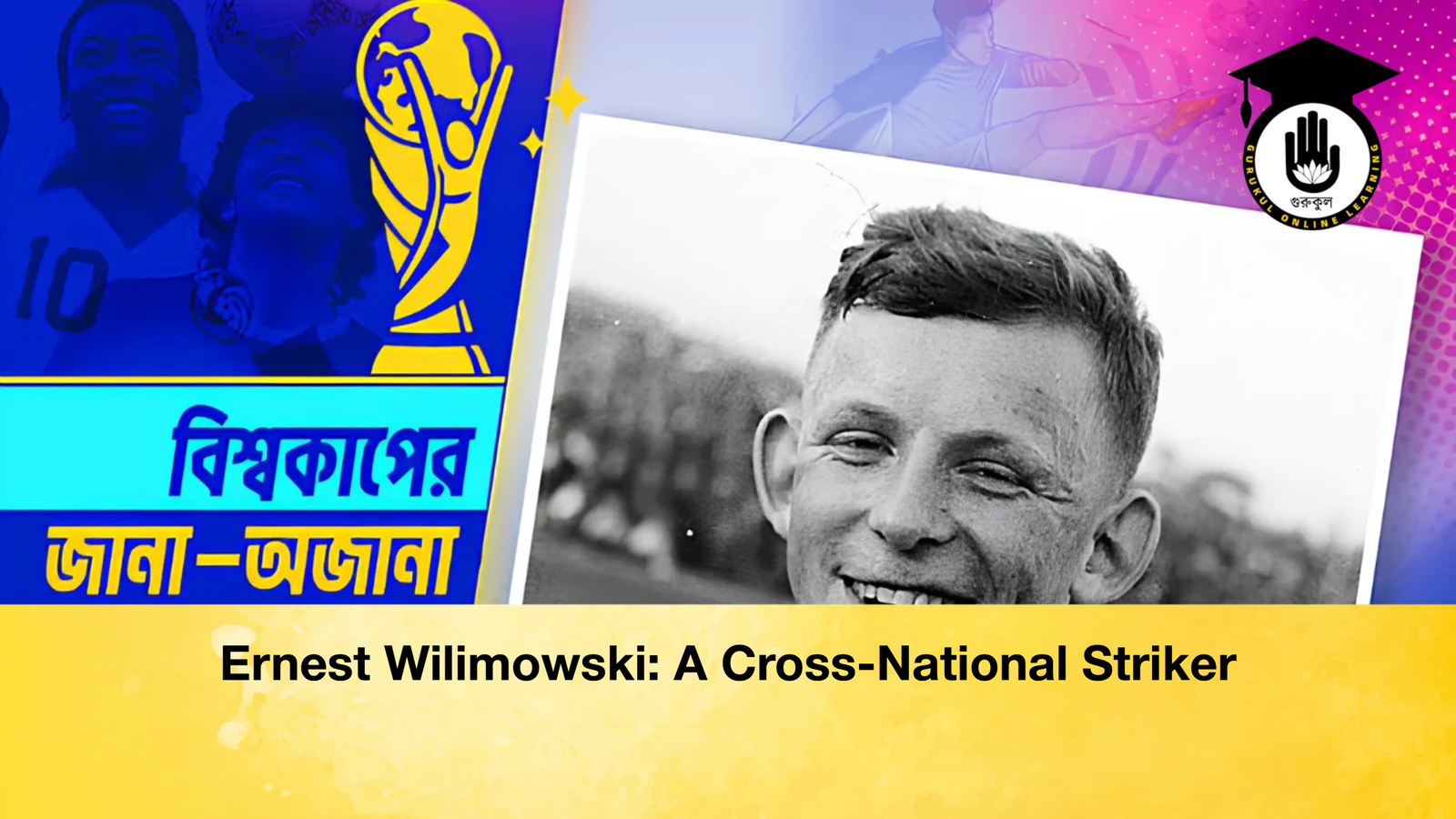

Ernest Wilimowski was a prolific forward whose career spanned both Polish and German international football, yet his legacy remains deeply complex due to the political and historical context in which he played. Despite exceptional goal-scoring records, he is a figure whose recognition in football history has been uneven.
Born in 1916 in Katowice, then part of the German Empire, he was originally named Ernest Otto Pradella. Following changes in family circumstances, he later adopted the surname Wilimowski. He was notable for a distinctive physical characteristic: six toes on his right foot, a feature frequently recorded in accounts of his early life.
Wilimowski’s early life was shaped by the First World War, during which his father died while serving in the German military. After the war, Katowice became part of Poland, resulting in a shift in national identity for residents of the region, including Wilimowski.
At club level, he played for Ruch Chorzów, where he achieved significant domestic success in the 1930s. He helped the club win four consecutive league titles and was the top scorer in the Polish league in both 1934 and 1936. His reputation as a forward of exceptional efficiency was established during this period.
A brief disciplinary suspension in 1935, following an incident involving alcohol consumption linked to bonus payments, led to his absence from competition and consequently from the 1936 Olympic Games.
His international prominence peaked at the 1938 FIFA World Cup in France. In a first-round match against Brazil in Strasbourg, Wilimowski scored four goals in a match that ended 6–5 in Brazil’s favour after extra time. Despite Poland’s elimination, his performance remains one of the most remarkable individual displays in World Cup history.
Key Career Statistics
| Category | Team | Appearances | Goals |
|---|---|---|---|
| International | Poland | 22 | 21 |
| International | Germany | 8 | 13 |
| World Cup 1938 | Poland vs Brazil | 1 match | 4 goals |
In 1939, he scored a hat-trick for Poland in a 4–2 victory over Hungary, a match often referred to as “The Last Game” due to the outbreak of the Second World War shortly afterwards, when Germany invaded Poland.
During the war period, Wilimowski obtained German citizenship and went on to represent the German national team. He scored 13 goals in 8 appearances for Germany. His international career ended in 1942, as wartime conditions severely limited international fixtures and many teams refused to play Germany.
After the war, he attempted to return to Poland but was denied entry by the post-war communist authorities, who classified him as a traitor. As a result, he remained in Germany for the rest of his life and did not return to Poland again.
In 1974, when Poland competed in the World Cup in West Germany, Wilimowski reportedly wished to meet members of the Polish squad but was not granted permission. He lived the remainder of his life in West Germany and died in 1997.