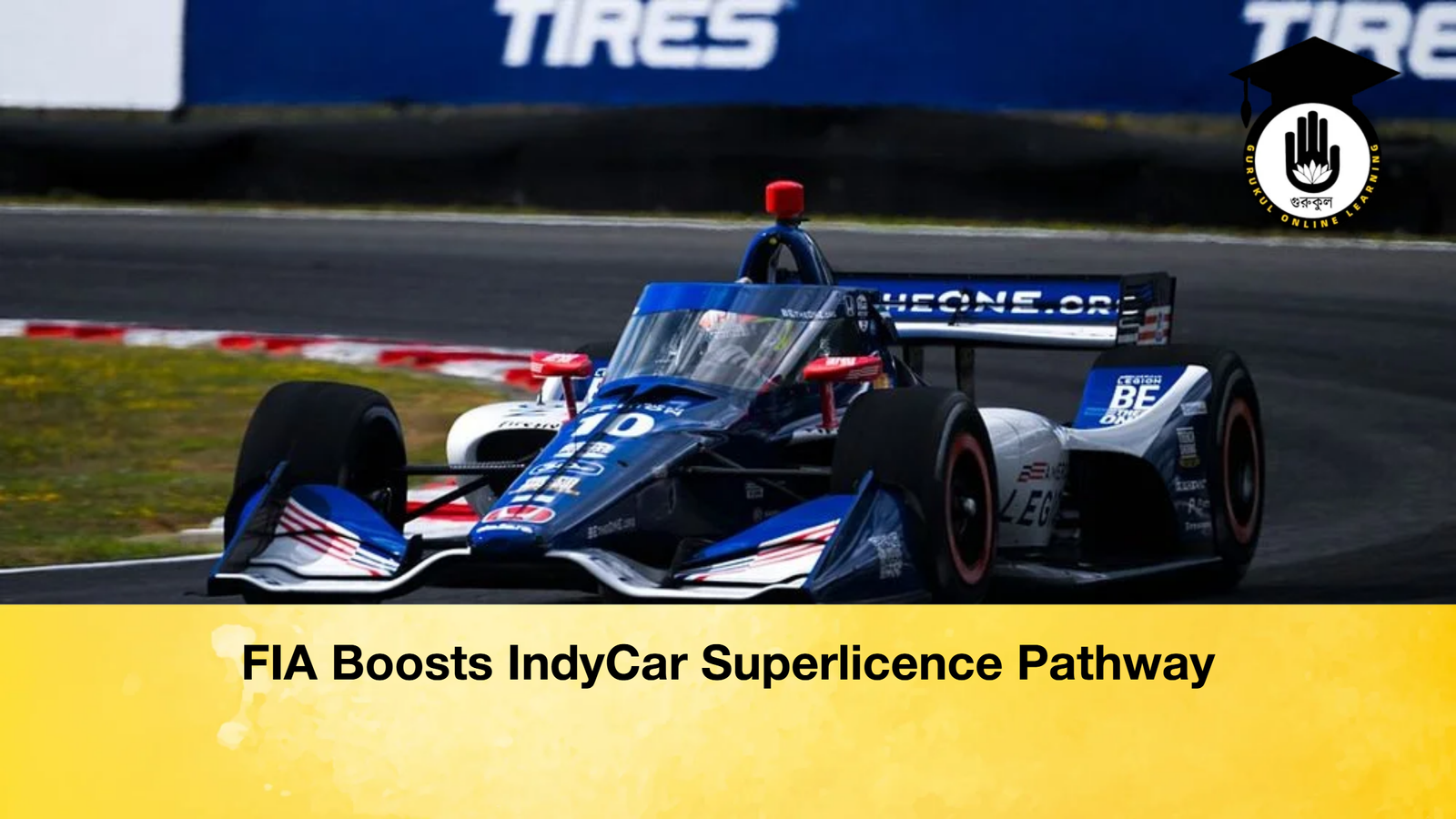
The FIA’s decision to revise the allocation of superlicence points for the IndyCar Series ahead of the 2026 season has been warmly received across the paddock, with Arrow McLaren Team Principal Tony Kanaan among those applauding the move. The changes, ratified at the FIA World Motor Sport Council’s final meeting of 2025, represent a significant step in recognising IndyCar’s competitive depth and its relevance within the global single-seater ladder.
Under the previous system, only the top ten finishers in the IndyCar championship earned superlicence points, distributed on a sharply tapered scale of 40-30-20-10-8-6-4-3-2-1. While this structure a llowed champions to meet Formula 1’s minimum requirement of 40 points over three seasons, it made qualification considerably more difficult for consistently competitive drivers who fell just short of the very top positions.
From 2026 onwards, that imbalance will be partially addressed. The revised points structure offers a more graduated distribution, rewarding sustained performance deeper into the top ten and bringing IndyCar closer to recognised F1 feeder series in FIA terms.
Superlicence points comparison (top 10)
| Championship position | Old IndyCar points | New IndyCar points | Formula 2 points | Formula 3 points |
|---|---|---|---|---|
| 1st | 40 | 40 | 40 | 30 |
| 2nd | 30 | 30 | 40 | 25 |
| 3rd | 20 | 25 | 40 | 20 |
| 4th | 10 | 20 | 30 | 15 |
| 5th | 8 | 15 | 20 | 12 |
| 6th | 6 | 10 | 10 | 9 |
| 7th | 4 | 8 | 8 | 7 |
| 8th | 3 | 6 | 6 | 5 |
| 9th | 2 | 3 | 4 | 3 |
| 10th | 1 | 1 | 3 | 2 |
Although IndyCar remains behind Formula 2 in terms of outright points potential, it now sits ahead of Formula 3 and far closer to the FIA’s preferred developmental pipeline than before.
Kanaan was unequivocal in his support of the decision. “No one doubts that IndyCar is one of the most competitive racing series in the world,” he said in a statement. “I’m glad the FIA is acknowledging that by increasing the points to be more comparable to Formula 2. It’s good for the series and good for the drivers who may want to pursue Formula 1.”
The change also addresses a long-standing frustration within the IndyCar community: that drivers competing successfully at the highest level of North American open-wheel racing were often compelled to move into junior categories overseas to bolster their superlicence tally. “An IndyCar driver shouldn’t need to go to a feeder series to prove they belong at the top,” Kanaan added.
While Arrow McLaren’s Pato O’Ward already meets the superlicence threshold and serves as a McLaren F1 reserve, the revised structure is particularly relevant to drivers such as Colton Herta. Despite being one of IndyCar’s brightest talents since his teenage breakthrough, Herta repeatedly fell short under the old system, even after multiple top-seven championship finishes. His move to Formula 2 for 2026 underscores the limitations IndyCar drivers have faced when attempting to transition to Formula 1.
Notably, the updated allocation will only apply to points earned from the 2026 season onwards, meaning its full impact will be felt over the next several years rather than immediately. As of now, only a handful of IndyCar drivers – including Alex Palou, Scott Dixon, O’Ward and Scott McLaughlin – are eligible for a superlicence based on results from the past three seasons.
Even so, the FIA’s revision is widely seen as an overdue acknowledgment of IndyCar’s quality and consistency. While it may not fully level the playing field with Europe’s established feeder series, it represents meaningful progress and a clearer, fairer pathway for IndyCar drivers with Formula 1 ambitions.