
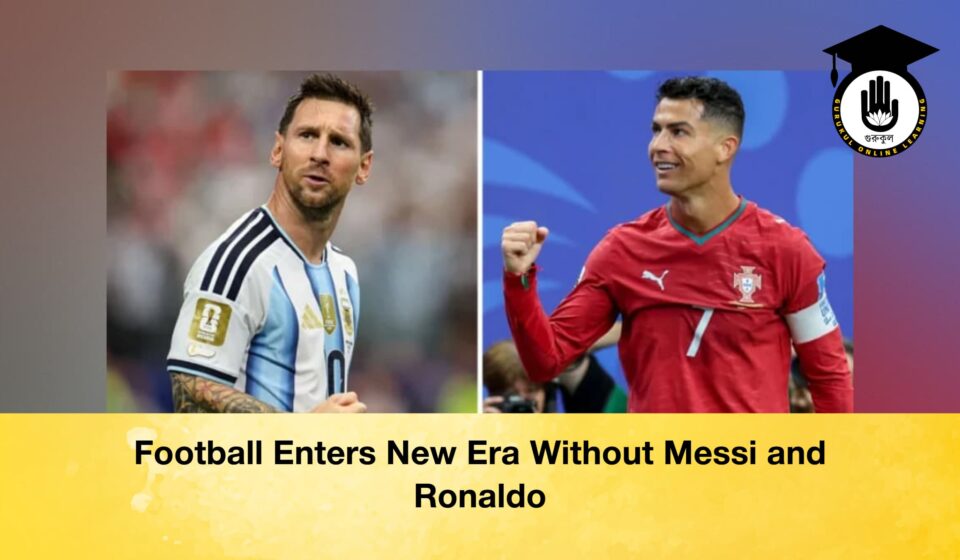

World football is preparing to turn a significant page as the international careers of Lionel Messi and Cristiano Ronaldo come to an end. For nearly two decades, the two legendary forwards dominated the sport, captivating supporters with their extraordinary skills, remarkable consistency and fierce individual rivalry. Their presence shaped an entire generation of football, making almost every major competition an opportunity to witness another chapter in their remarkable contest.
Now, coincidentally, both have stepped away from international football at almost the same time. The latest FIFA international window, therefore, marks the beginning of a new era in which neither of the game’s two most influential modern figures will feature for their respective national teams. Their absence raises an obvious question: can international football retain its appeal without the rivalry that defined much of the past 20 years?
The current international break began on 9 November, with most of the major national teams scheduled to return to action from 12 November. Unlike the previous international window, this one will last approximately a week. Apart from the South Asian Football Federation (SAFF) competition, most countries are expected to play two matches during the period.
However, several prominent players are set to miss at least part of the action through injury or illness. Spain’s Lamine Yamal, France’s Ousmane Dembele, Switzerland’s Granit Xhaka and the Netherlands’ Virgil van Dijk are among the high-profile names whose availability has become a concern.
Messi began his international career in 2005 and went on to become Argentina’s most celebrated footballing figure. His achievements included winning the 2021 Copa America and leading the country to the 2022 FIFA World Cup title in Qatar. After years of carrying the expectations of an entire nation, the forward finally reached the pinnacle of international football by lifting the World Cup.
The 39-year-old announced his retirement from international football on 31 August. He subsequently played his farewell match on 6 October during the previous international break, receiving an elaborate send-off in Buenos Aires. Argentina’s tribute reflected the enormous influence he has had on the national side and the country’s footballing identity. From now on, Messi is expected to concentrate exclusively on club football.
Ronaldo’s departure, by contrast, has been considerably more troubled. The Portuguese forward made his international debut in 2003 and became one of the most influential players in the country’s football history. During his international career, he helped Portugal win the 2016 European Championship and the inaugural UEFA Nations League in 2019, while establishing himself as one of the most prolific goalscorers in international football.
His final days with the national team were overshadowed by tensions involving the coaching staff. During the previous international window, Ronaldo reportedly left the national team camp following a disagreement with the coach. The Portuguese Football Federation subsequently imposed a suspension on him. On 5 November, the 41-year-old announced his international retirement through a video message on social media.
The federation offered Ronaldo the opportunity to play a farewell match, but he declined the proposal. Like Messi, he will now focus solely on his club career. His departure brings an end to an international journey that spanned more than two decades and transformed Portugal’s standing in world football.
Argentina will face Uruguay in Buenos Aires on 14 November, before taking on Costa Rica on 17 November. Both fixtures are friendly matches and will be among the first opportunities for the national side to demonstrate how it intends to move forward without Messi.
Portugal, meanwhile, have two UEFA Nations League fixtures scheduled. They will face Denmark on 15 November, followed by Wales three days later. The matches will offer an early indication of how the team plans to reorganise its attacking responsibilities in Ronaldo’s absence.
With Messi and Ronaldo no longer part of the international landscape, attention is increasingly shifting towards the next generation. Spain’s Lamine Yamal is widely regarded as one of the leading young talents in world football. His performances for Barcelona and the Spanish national team have already established him as a major figure despite his age.
However, Spain will be without the teenager for their UEFA Nations League encounter against the Czech Republic on Thursday night, 13 November. Yamal suffered a knee injury during Barcelona’s 2-1 victory over Atletico Madrid in La Liga.
Spain will also be without forward Mikel Oyarzabal for the fixture, as he is suffering from flu. The reigning world champions are nevertheless hopeful that both players will recover in time for Sunday’s match against England.
Spain have made an impressive start to their Nations League campaign, winning all four of their matches so far to top their group. Maintaining that momentum will be a priority as they continue their preparations for the next stage of the competition.
Meanwhile, Brazil are preparing for another trip to Asia. Having played three friendly matches in Australia and India during the September-October international window, the five-time world champions will return to the region for two more fixtures in Singapore.
Brazil are scheduled to face Japan on 14 November and hosts Singapore on 17 November. The matches will provide the coaching staff with an opportunity to assess players and continue developing the squad ahead of future international competitions.
Barcelona forward Raphinha’s involvement had initially become a subject of disagreement between the Spanish club and Brazil’s national team management. There had been considerable tension over his release for international duty, given the demands of the club’s schedule. However, the Brazilian has ultimately joined the national squad and is expected to feature in both matches.
The departure of Messi and Ronaldo represents more than the retirement of two celebrated footballers. Their rivalry helped define an extraordinary period in the sport, particularly through their years at Barcelona and Real Madrid, when their individual achievements and contrasting styles became a central feature of global football.
Messi’s creativity, close control and vision complemented Ronaldo’s athleticism, goal-scoring instincts and relentless determination. Their competition pushed both players to remarkable standards, while supporters around the world followed their achievements with intense interest.
Football, however, has always evolved through changes in generations. Players such as Yamal and other emerging talents now have an opportunity to establish their own identities and shape the sport’s future.
The Messi-Ronaldo era may be over at international level, but its legacy will remain a defining part of football history. The latest international window could well be remembered as the beginning of a new chapter, one in which the next generation must find its own stars, rivalries and defining moments.