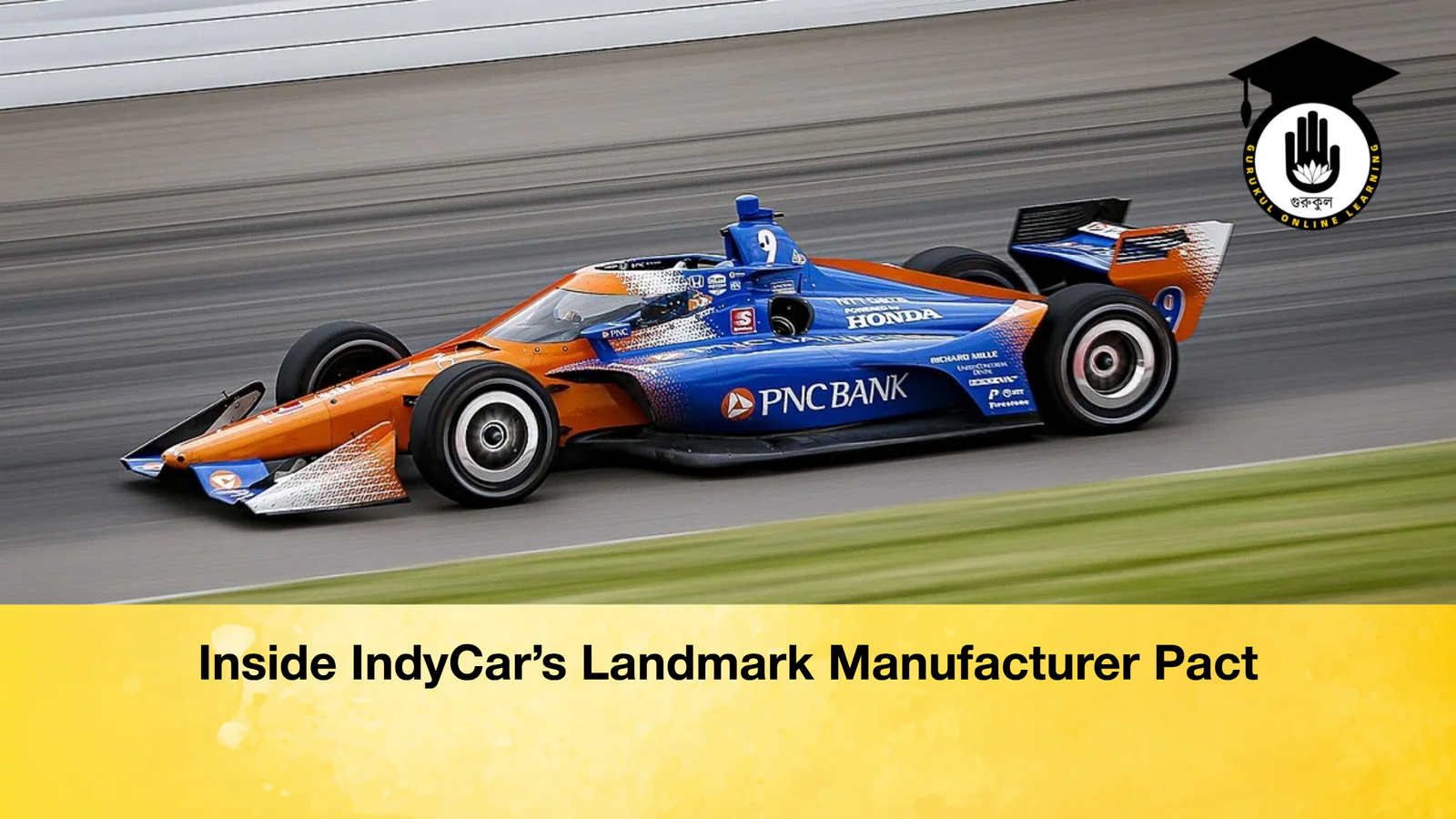
IndyCar’s newly announced multi-year agreement with Chevrolet and Honda Racing Corporation US represents far more than a routine contract renewal. It is a structural reset that will reshape the championship’s commercial and competitive framework from 2028 onwards.
Although the deal formally begins in 2027, the true inflection point arrives a year later. From 2028 — coinciding with the debut of IndyCar’s next-generation chassis and 2.4-litre twin-turbocharged hybrid V6 engine — each manufacturer will hold a charter entry of its own. In practical terms, this grants both brands a tangible equity stake in the series’ long-term growth.
From Supplier to Stakeholder
J. Douglas Boles, President of IndyCar and the Indianapolis Motor Speedway, revealed that discussions began roughly a year ago, shortly after he assumed oversight of the series following the departure of Jay Frye.
At that stage, negotiations were fluid. IndyCar was entering a new broadcast era with FOX, and both manufacturers were evaluating not merely competitive value but boardroom justification. As Boles candidly noted, Chevrolet and Honda are ultimately car companies. Motorsport must translate into measurable brand and business returns.
Granting charter ownership became the solution. It offered what Boles described as “a stake in the ground” — an appreciating asset tied directly to the championship’s expansion.
Key Elements of the Agreement
| Element | Detail |
|---|---|
| Contract Start | 2027 season |
| Charter Allocation | One per manufacturer from 2028 |
| New Engine | 2.4L twin-turbo V6 hybrid (2028 debut) |
| Charter Sale Restriction | Not before 2030 |
| Grid Cap (non-Indy 500) | 27 cars from 2028 |
The charter provision was also pivotal in securing Honda’s continued presence beyond 2026. Over recent seasons, the Japanese marque had publicly expressed concerns regarding governance and sporting controversies — notably the 2024 push-to-pass irregularities and penalties linked to Team Penske machinery at the 2025 Indianapolis 500.
The establishment of an Independent Officiating Board in late 2025 contributed to renewed confidence, though Honda President David Salters indicated it was one factor among many.
Importantly, Honda’s extension does not preclude exploration of other categories, including NASCAR. Salters reiterated that all series are assessed on merit.
Implications for Teams and New Entrants
IndyCar currently fields 25 charter entries. With two additional manufacturer charters arriving in 2028, the grid — excluding the Indianapolis 500 — is expected to stabilise at 27 cars. That ceiling significantly narrows pathways for prospective newcomers.
The Italian outfit PREMA remains the only regular non-chartered entrant at present, though uncertainty surrounds its short-term participation. Beyond 2028, any new team is likely to require purchasing a charter from an existing holder, as manufacturers themselves are not permitted to buy charters directly from teams under current guidelines.
The scenario becomes even more complex should a long-mooted third engine supplier join. Boles acknowledged that any further charter expansion would require consensus among existing stakeholders.
A Controlled Growth Model
The philosophy underpinning the deal is clear: controlled expansion to protect asset value. By limiting grid size and granting manufacturers equity, IndyCar aims to align team owners, OEMs and promoters within a shared growth trajectory.
For Chevrolet and Honda, the agreement ensures technical influence, competitive presence and commercial security in a championship poised for a significant 2028 transformation. For IndyCar, it secures stability in an era when global motorsport competition for manufacturer backing has rarely been fiercer.
The message is unmistakable: this is not merely a renewal — it is a recalibration of the series’ economic architecture for the decade ahead.