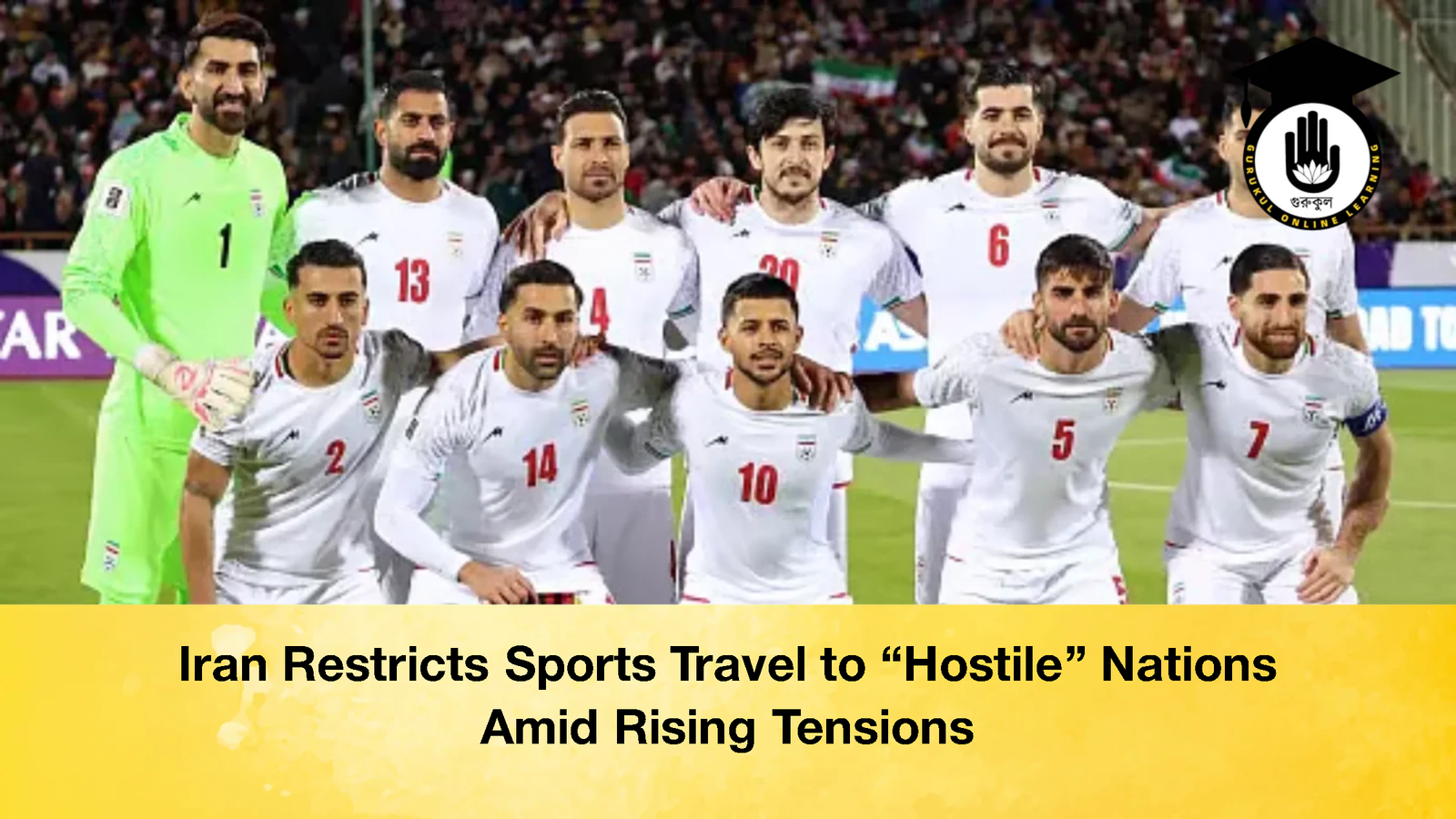
Iran has introduced a far-reaching restriction barring its national and club sports teams from travelling to countries it classifies as “hostile”, in a significant development that further intertwines international sport with rising geopolitical tensions. The announcement, made on Thursday (27 March) by Iran’s Ministry of Sport and Youth, comes amid heightened instability across the Middle East and renewed concerns in Tehran over the safety and treatment of Iranian athletes competing overseas.
According to Iran’s state-affiliated Islamic Republic News Agency (ISNA), the ministry stated that any country deemed unfriendly—or considered unable to guarantee the safety and security of Iranian athletes, coaching staff, and officials—will now be effectively off-limits for sporting participation until further notice. The directive applies comprehensively to both national representative teams and domestic club sides engaged in international competitions across multiple sporting disciplines.
While the government has not published a formal list of affected nations, the language of the policy grants authorities broad discretion to determine eligibility on a case-by-case basis. This allows Iranian sporting bodies to respond dynamically to diplomatic relations and evolving security assessments, rather than adhering to a fixed or publicly defined blacklist. Officials have linked the move to escalating regional tensions, including military developments involving the United States and Israel, which Iranian authorities have described as hostile actions contributing to an increasingly volatile security environment.
Immediate sporting consequences and football disruption
The timing of the announcement has triggered immediate uncertainty within Asian sporting circuits, particularly in football, where Iranian clubs regularly compete in continental competitions. One of the most immediate points of concern is the Asian Champions League, in which Iranian side Tractor FC had been scheduled to face an Emirati opponent in Saudi Arabia. Under the newly issued directive, participation in such fixtures may now be suspended unless alternative arrangements—such as neutral venues—are formally approved.
The Ministry of Sport has instructed the Football Federation Islamic Republic of Iran (FFIRI), alongside all affiliated clubs, to formally notify the Asian Football Confederation (AFC) of the policy change without delay. Iranian officials are expected to request that any fixtures involving Iranian teams be relocated to neutral territory, ensuring compliance with national directives while attempting to preserve participation in continental competitions.
This introduces logistical challenges for governing bodies, which will now need to balance regulatory frameworks, competitive fairness, and political sensitivities in rescheduling or relocating matches involving Iranian sides.
Wider implications for global sport and the World Cup
The decision carries broader implications beyond Asia, particularly in relation to the 2026 FIFA World Cup, which is set to be jointly hosted by the United States, Mexico, and Canada. Iran has already secured qualification for the tournament, and under the current schedule, its group-stage matches are expected to be played in the United States.
Iran has been drawn in Group G alongside New Zealand, Belgium, and Egypt, setting the stage for high-profile fixtures against established international teams. However, the new directive raises questions over whether Iranian participation could be affected if travel restrictions extend to host nations or if diplomatic tensions intensify further in the coming months.
Policy overview
| Category | Details |
|---|---|
| Announcing authority | Iran Ministry of Sport and Youth |
| Date of announcement | 27 March |
| Scope of directive | National teams and domestic club sides |
| Definition of “hostile” states | Countries deemed unfriendly or unable to ensure athlete safety |
| Implementation | Immediate and indefinite, pending further notice |
| Governing coordination | Football Federation Islamic Republic of Iran (FFIRI); Asian Football Confederation (AFC) |
| Competitions potentially affected | Asian Champions League; FIFA World Cup 2026; wider international fixtures |
Strategic and diplomatic interpretation
Observers suggest the move reflects a broader recalibration of Iran’s engagement with international sport, where security considerations and political alignment are increasingly influencing participation decisions. By formalising restrictions on travel to perceived hostile environments, Iranian authorities appear to be elevating national security concerns above long-standing principles of sporting neutrality and open competition.
Although Iranian athletes have previously encountered sporadic limitations linked to diplomatic disputes or bilateral tensions, analysts note that this latest directive is more institutionalised and systematic in scope. It effectively provides a legal and administrative framework for restricting international sporting travel, which could have long-term consequences for Iran’s participation in global competitions across multiple disciplines, not limited to football.
The Asian Football Confederation is expected to hold urgent consultations with Iranian officials and member associations to determine whether fixtures can be rescheduled or moved to neutral venues. Meanwhile, global governing bodies such as FIFA are likely to monitor developments closely, particularly given the proximity of major tournaments and the potential for disruption to qualification and match scheduling.
For now, Iran’s decision introduces a fresh layer of uncertainty into the international sporting calendar. It raises pressing questions about how global sport can maintain operational continuity amid geopolitical fragmentation, and whether increasingly politicised security considerations will reshape the future of international competition.