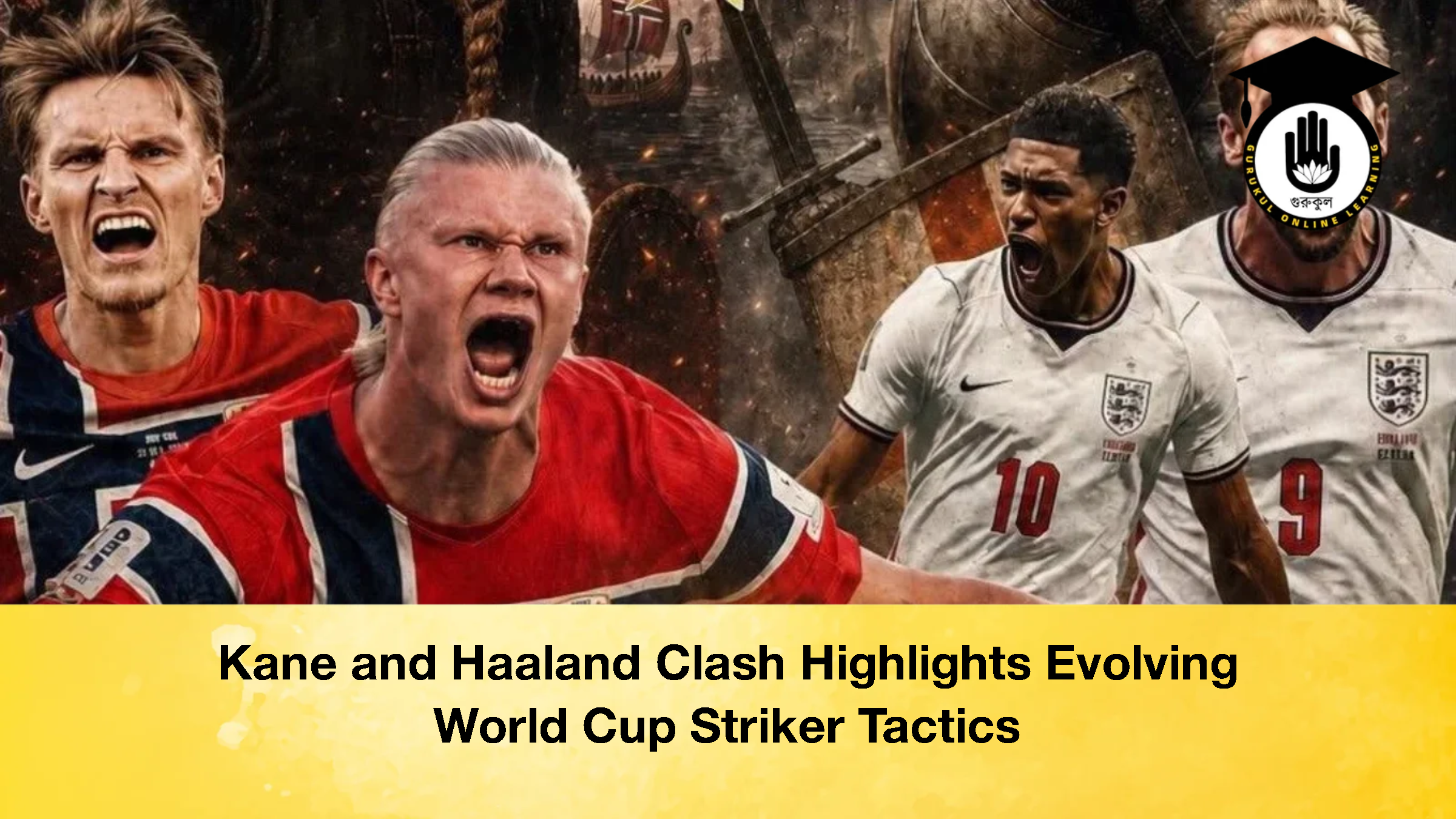

The narrative surrounding the World Cup quarter-final between England and Norway highlights a refreshing level of mutual respect that stands in stark contrast to typical pre-match media posturing. Harry Kane’s public analysis of Erling Haaland provides an insightful look into contemporary football tactics. This analytical approach successfully shifts the public focus away from simplistic tabloid rivalries, anchoring the conversation in structural reality instead.
By rejecting direct statistical comparisons, the England captain has highlighted a crucial reality of modern tactical systems. The traditional definition of a centre-forward has fractured. Today, elite managers no longer look for a one-size-fits-all attacker, choosing instead to deploy highly specialised roles that dictate how an entire team transitions from defence to attack.
Profiling the Elite: A Study in Contrasts
The tactical divergence between Harry Kane and Erling Haaland defines how both managers build their attacking transitions. Their contrasting movements shape the entire geometry of the pitch.
Operating essentially as a hybrid number nine and ten, Kane routinely vacates the opposition’s defensive backline to slide into the half-spaces. He operates fluidly between the opponent’s midfield and defensive blocks. His primary value lies in spatial creation, defensive disruption, and releasing inverted wingers into space, without sacrificing his own high-percentage finishing inside the penalty box. This deep-lying orchestration requires supreme situational awareness and passing range.
Conversely, Haaland represents the absolute pinnacle of hyper-efficient, vertical attacking play. His role prioritises minimal touches, constant manipulation of centre-backs through explosive off-the-ball runs, and sheer physical dominance in transitional phases. He operates almost exclusively within the final third, acting as the ultimate focal point for a high-pressing team. Haaland demands that his team play with directness, exploiting any space left behind an opponent’s high defensive line.
“The modern striker is no longer judged solely by the number on their back, but by the specific zones they occupy to disrupt the opposition structure.”
Golden Boot Metrics and Tactical Realism
While the media remains transfixed by the race for the Golden Boot, the two players view individual rewards merely as a by-product of tactical success. Personal accolades are secondary to collective progression. Because the current scoring leaders index features fewer than ten players at the absolute top tier, a formal table is unnecessary. The tournament’s top individual tallies ahead of the quarter-final whistle show Erling Haaland leading the charts for Norway with seven goals, while Harry Kane follows closely for England with six goals.
The upcoming quarter-final will not be decided by who is the superior individual finisher. Rather, the outcome depends on which tactical system successfully maximises its spearhead’s unique profile. If England’s low block can deny Haaland space to run into, his low touch volume can isolate him from the game entirely. Conversely, if Norway’s midfield screen disrupts Kane’s ability to drop deep and link play, the Three Lions risk becoming entirely static in possession, cutting off the supply line to their creative wide players.