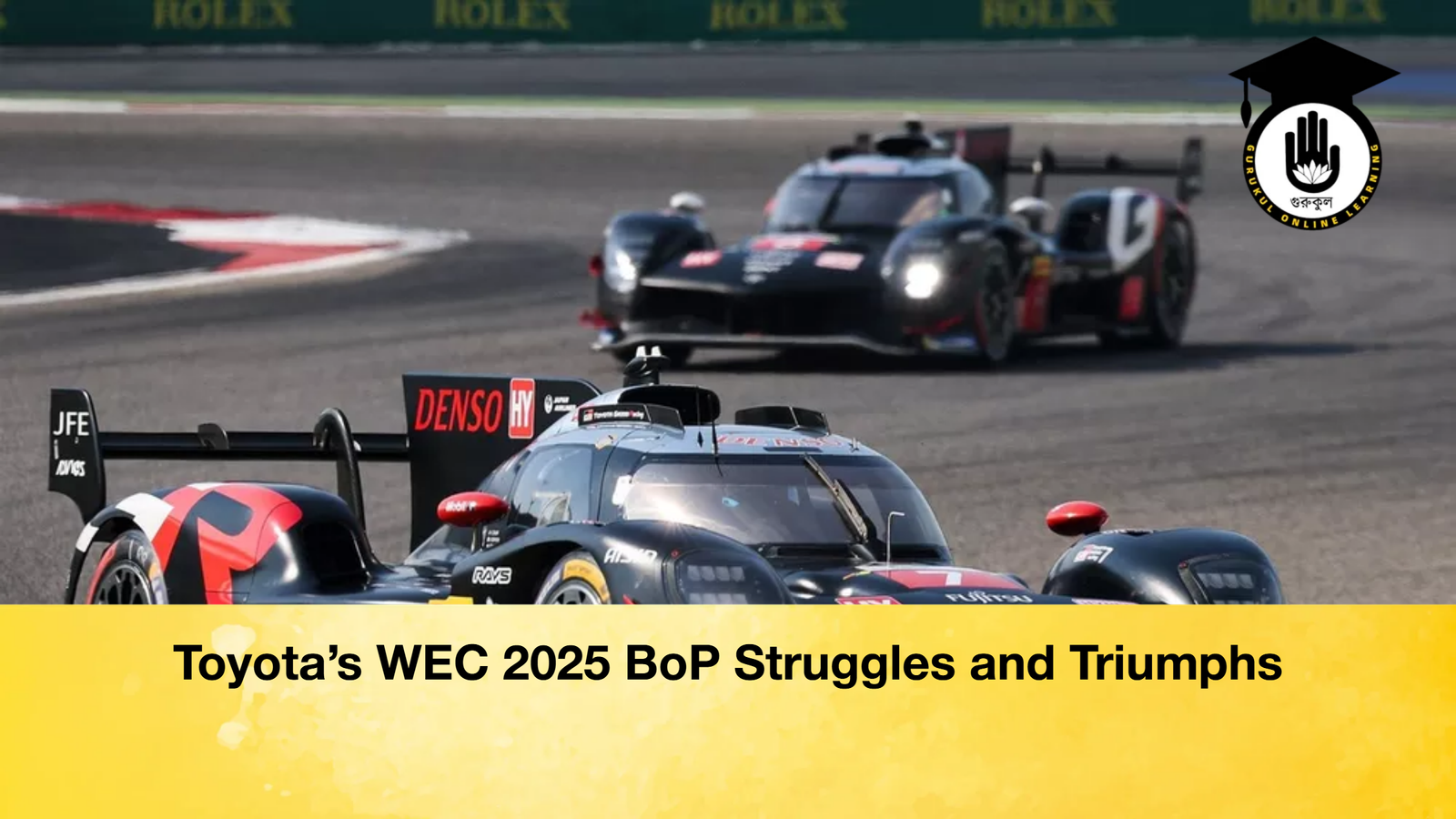
Toyota endured a turbulent 2025 FIA World Endurance Championship season, largely due to a series of uncharacteristically harsh Balance of Performance (BoP) allocations and a few operational missteps. Despite being one of the fastest hypercars on paper, the GR010 Hybrid often found itself at a disadvantage compared with its rivals.
Following Toyota’s dramatic manufacturers’ title win in 2024, it was anticipated that the BoP would not favour the team unduly. However, the GR010 Hybrid’s 2025 allocations were particularly punishing, with the car starting the season with the least favourable power-to-weight ratio among hypercars at both Qatar and Imola. While the Toyotas remained competitive in raw pace, strategy errors prevented them from converting performance into podiums.
The team’s challenges intensified before the 6 Hours of Spa, when the GR010’s power-to-weight ratio below 250 km/h jumped to a record 2.227 kg/kW—the worst rating in WEC history. Paradoxically, the car appeared dominant in performance metrics such as fastest laps, which ironically triggered further BoP penalties.
At the Le Mans 24 Hours, the GR010 faced additional difficulties. While its sub-250 km/h BoP was comparable to Ferrari, its rating above 250 km/h was a mediocre 2.052 kg/kW, the third-worst among hypercars. This significantly reduced top speed, with the #7 car finishing only fifth after the #8 retired due to a lost wheel, a result arguably the best achievable under the circumstances.
Toyota’s fortunes slowly improved in the season’s latter rounds. The team struggled from Sao Paulo to Fuji, scoring only two points in Austin, compounded by operational errors such as a missed pit stop under FCY at Fuji. Finally, at Bahrain, the GR010 benefited from both a marginal BoP improvement (2.172 kg/kW) and a relative slowdown of key rivals, allowing the five-year-old car to secure a strong performance and reassert Toyota’s competitiveness.
Looking ahead to 2026, the rebranded TR010 Hybrid features significant aerodynamic revisions designed to reduce drag and optimise Le Mans performance. Toyota’s technical director, David Floury, emphasises that winning Le Mans remains the team’s primary goal, with the BoP system still a critical factor across the season.
Toyota GR010 Hybrid – 2025 BoP Summary
| Race | Power-to-Weight <250 km/h (kg/kW) | Power-to-Weight >250 km/h (kg/kW) | Result | Notes |
|---|---|---|---|---|
| Qatar | 2.090 | 1.995 | 3rd/4th | Strong pace despite unfavourable BoP |
| Imola | 2.100 | 2.000 | 2nd/3rd | Strategy errors limited podium potential |
| Spa | 2.227 | 2.010 | 4th/5th | Record worst BoP rating in WEC history |
| Le Mans | 2.050 | 2.052 | 5th (#7) | Top speed hampered; #8 retired |
| Sao Paulo | 2.215 | 2.020 | 6th/7th | Competitive pace; no BoP relief |
| Austin | 2.210 | 2.025 | 2 pts | Rain-affected; limited impact of BoP |
| Fuji | 2.218 | 2.030 | 4th/5th | Pit stop error under FCY |
| Bahrain | 2.172 | 2.010 | 2nd | Marginal BoP gain and slower rivals |
Toyota’s 2025 season demonstrated that even with an ageing platform and unfavourable BoP, the GR010 Hybrid remained a capable and resilient competitor. With the TR010 Hybrid, the team aims to convert its proven pace into consistent victories, particularly at Le Mans, where aerodynamics and drag optimisation will be pivotal.