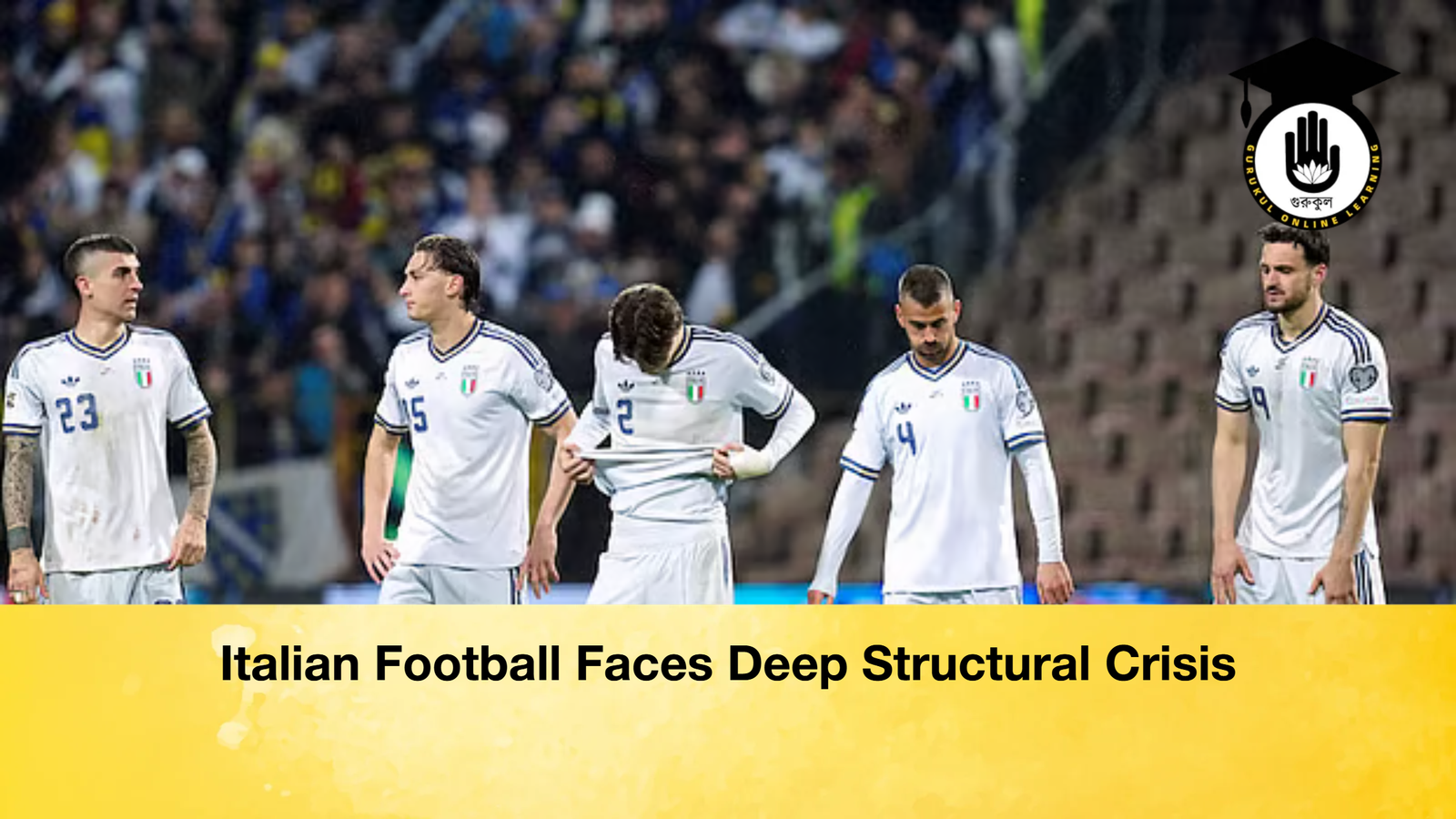

Italian football is currently experiencing a significant downturn, marked by failures at both international and club levels. The four-time FIFA World Cup winners have failed to qualify for the tournament for a third consecutive time, while their clubs have underperformed in European competitions. Taken together, these developments indicate one of the most difficult periods for Italian football in the past four decades, compounded by growing concerns over leadership and structural weaknesses.
In European club competitions this season, Italian teams have been eliminated at the quarter-final or earlier stages. In the UEFA Europa League, Bologna suffered a 4–0 defeat to Aston Villa in the second leg of their quarter-final, resulting in a 7–1 aggregate loss. On the same night, Fiorentina exited the UEFA Europa Conference League despite a 2–1 second-leg victory over Crystal Palace, losing 4–2 on aggregate.
These eliminations ensured that no Italian club remains in any of the three major European competitions—UEFA Champions League, Europa League, and Conference League. Atalanta, Italy’s final representative in the Champions League, had already been eliminated in the round of 16 the previous month. This marks the first time since the 1986–87 season that no Italian club has reached the semi-finals of any major European competition.
Italian Clubs in European Competitions (2025–26 Season)
| Competition | Club | Opponent | Aggregate Result | Stage Eliminated |
|---|---|---|---|---|
| Europa League | Bologna | Aston Villa | Lost 7–1 | Quarter-finals |
| Conference League | Fiorentina | Crystal Palace | Lost 4–2 | Quarter-finals |
| Champions League | Atalanta | Not specified | Eliminated | Round of 16 |
This decline comes shortly after notable successes. Inter Milan reached the UEFA Champions League final in 2025, and Atalanta won the UEFA Europa League in 2024. However, the current the season reflects a sharp reversal in fortunes.
At international level, Italy’s difficulties have been equally pronounced. In March, they were defeated 4–1 on penalties by Bosnia and Herzegovina in the 2026 World Cup qualifying play-off final. The match had ended 1–1 after extra time. This defeat confirmed Italy’s absence from the World Cup finals scheduled to begin on 11 June.
Following this outcome, head coach Gennaro Gattuso resigned from his position. Gabriel Gravina, president of the Italian Football Federation (FIGC), also stepped down, acknowledging the deterioration of the domestic football structure. He described the crisis as “extremely deep” and emphasised the need for comprehensive reform.
Former AC Milan coach Fabio Capello stated during the week that the situation could not realistically worsen, adding that Italian football had reached its lowest point. Carlo Ancelotti, currently managing Brazil, also commented that Italy has lost direction both tactically and financially. He highlighted a shortage of talent in key positions and suggested that excessive focus on tactical systems has undermined traditional playing characteristics.
Ancelotti further noted that financial limitations in Serie A have reduced its attractiveness compared with other leagues, particularly due to disparities in television rights revenue and external investment. As a result, leading foreign players are less inclined to join Italian clubs.
Infrastructure issues have added to these concerns. Although Italy is preparing to co-host the UEFA European Championship in 2032 with Turkey, several stadium projects are reportedly behind schedule, with some yet to begin. UEFA president Aleksander Čeferin recently warned that failure to complete infrastructure preparations on time could jeopardise Italy’s ability to host matches.
Currently, Italian football is undergoing a transitional phase. Key leadership positions remain vacant following recent resignations, and no new appointments are expected before the FIGC elections scheduled for 22 June. Until then, the administration remains in a state of uncertainty, with decisions on structural reform and long-term strategy still pending.