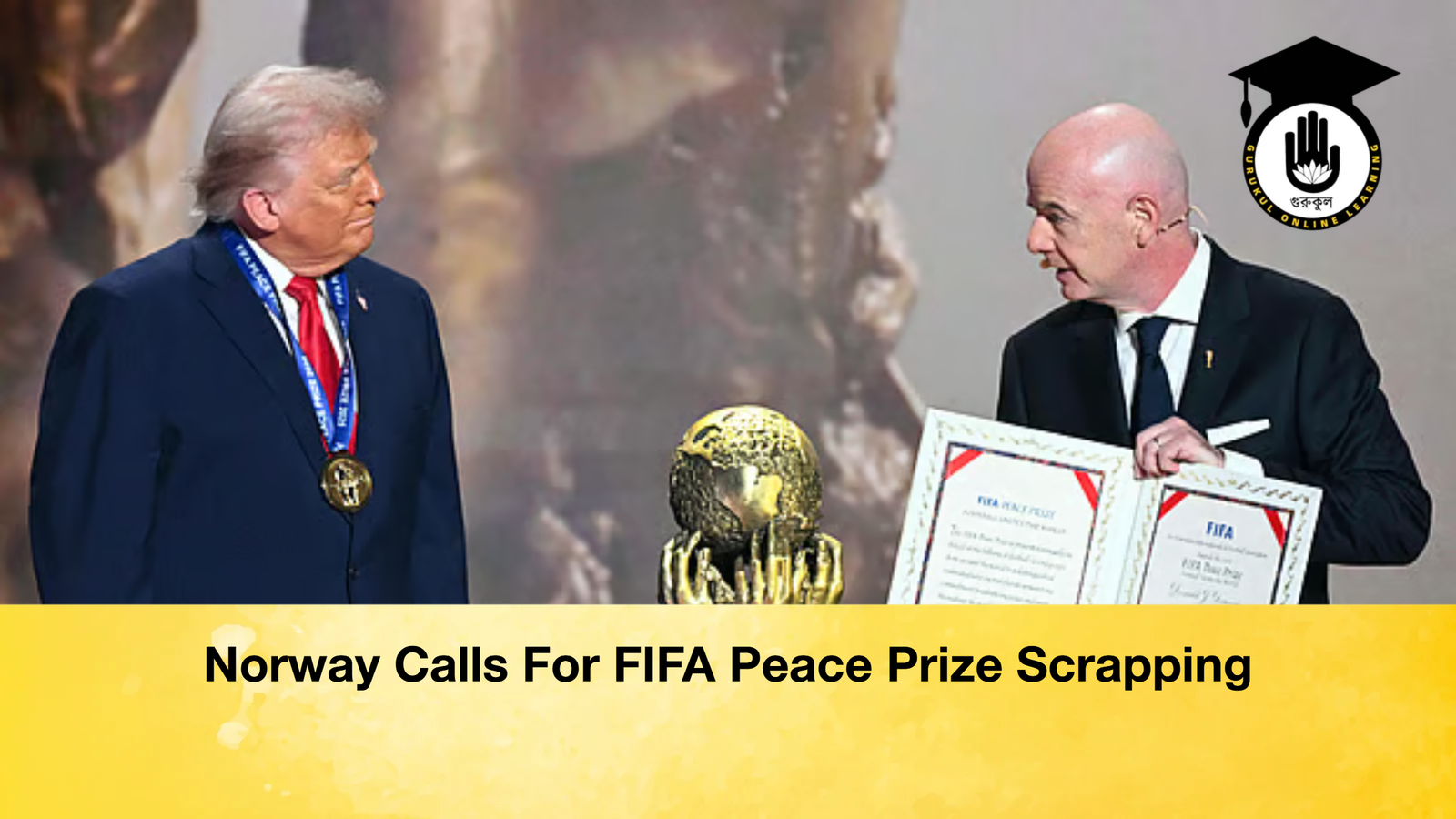

The Norwegian Football Federation (NFF) has called for the abolition of FIFA’s Peace Prize, arguing that the award conflicts with FIFA’s principle of political neutrality. NFF president Lise Klaveness stated that the federation will formally write to FIFA requesting that such an award, which is not related to football, be discontinued.
The NFF has also confirmed its support for a complaint submitted by the advocacy group FairSquare to FIFA’s Ethics Committee regarding the Peace Prize. The complaint raises concerns about the legitimacy and process surrounding the award’s creation and presentation.
The issue dates back to December, when FIFA president Gianni Infantino presented the Peace Prize for the first time during the draw for the 2026 World Cup. The inaugural award was given to United States President Donald Trump. The decision has since attracted scrutiny and debate.
The Norwegian federation has further stated that it will press FIFA to seek assurances from the United States government that Immigration and Customs Enforcement (ICE) officers will not target spectators during World Cup matches. US officials have indicated that ICE personnel will form part of the security framework for the tournament.
Key Positions Raised by NFF
| Issue | NFF Position |
|---|---|
| FIFA Peace Prize | Should be abolished |
| Reason | Considered incompatible with FIFA political neutrality |
| FairSquare complaint | Supported; calls for formal review |
| ICE presence at World Cup | Concerns over potential targeting of spectators |
| FIFA Congress (Vancouver) | Issue to be raised formally |
Klaveness said that awarding such prizes falls outside FIFA’s remit and is instead the responsibility of independent institutions. She noted that the Nobel Institute operates independently in this field and argued that the Peace Prize presentation in Washington during the World Cup draw breached FIFA’s own policy of political neutrality. She also stated that the necessary internal legal procedures were not followed.
She further added that FIFA, its confederations, and member associations should avoid situations where their neutrality could be questioned due to proximity to heads of state. According to Klaveness, awards of this nature risk becoming politicised unless they are governed by independent structures, defined criteria, and impartial judging panels with sufficient expertise and resources. She described such arrangements as a full-time and highly sensitive responsibility, and suggested that initiatives of this kind should be avoided in future.
The NFF has confirmed its backing of FairSquare’s complaint and has urged FIFA’s Ethics Committee to assess the matter thoroughly. Klaveness emphasised that the federation has taken a clear position on the alleged breach of political neutrality. She said the complaint should be properly received, evaluated, and resolved, with a transparent process and clear publication of both reasoning and outcome.
On security matters, Klaveness raised concerns regarding the role of ICE officers during the World Cup. While US authorities have stated that ICE personnel will be part of the tournament’s security arrangements, the NFF has expressed concern that their presence could lead to spectators being targeted. Klaveness said the issue would be raised at the FIFA Congress scheduled to begin in Vancouver on 30 April.
She added that the NFF intends to engage directly with FIFA leadership to understand how operations involving ICE will be managed across stadiums. The federation’s stated objective is to ensure that all spectators can attend matches safely and without barriers, stressing that the tournament should remain inclusive and secure for everyone.