
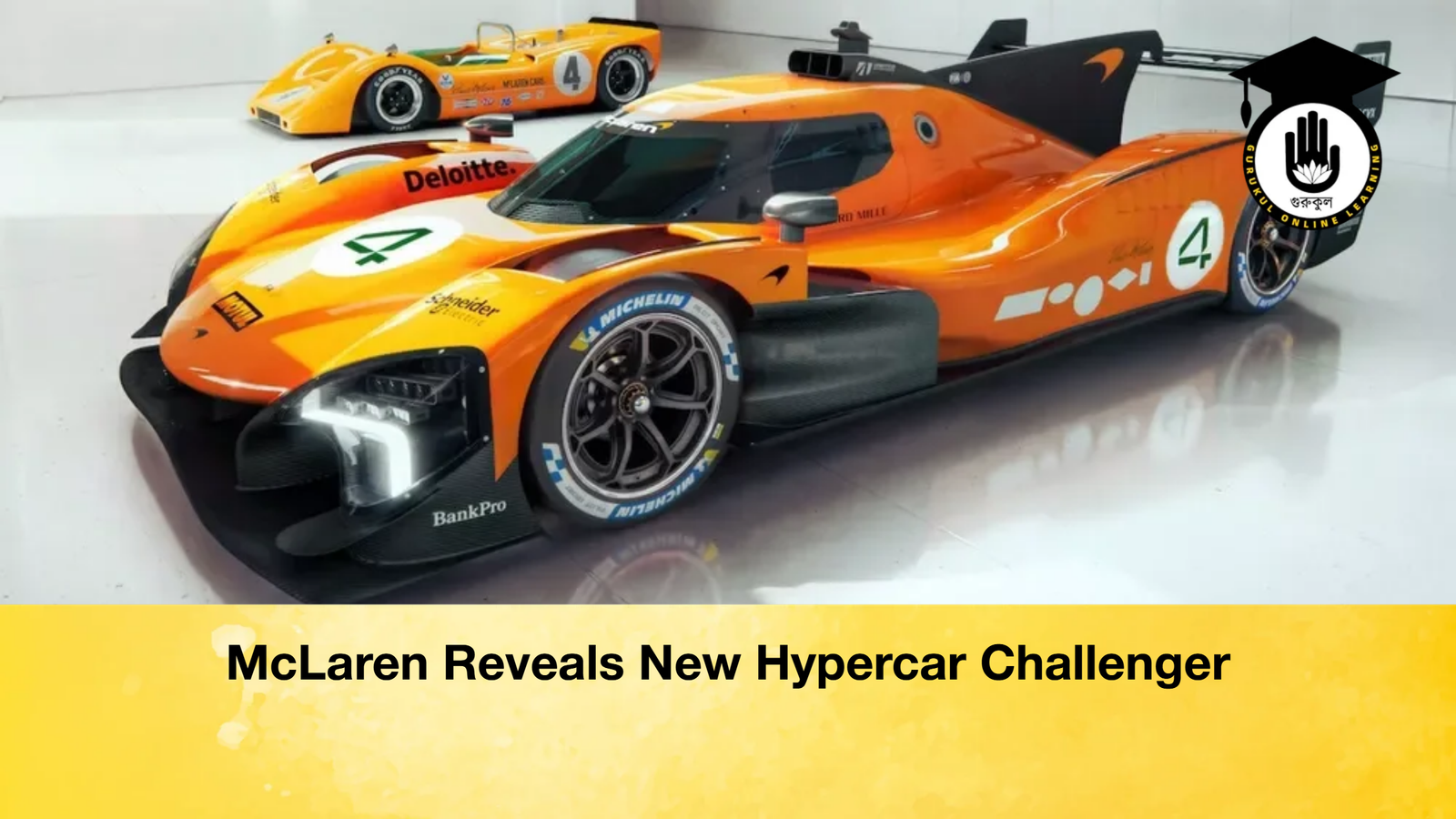

McLaren has taken a significant step towards its return to top-level endurance racing by unveiling the first official images of its LMDh prototype, the MCL-HY. The car, presented in a striking orange-and-black test livery, is poised to begin its on-track development programme later this month ahead of a full campaign in the FIA World Endurance Championship in 2027.
This marks the first time the fully realised prototype has been publicly displayed, following an earlier mock-up shown during the 24 Hours of Le Mans in 2025. The reveal signals the transition from concept to reality as McLaren intensifies its preparations for a long-awaited return to endurance racing’s top class.
Table of Contents
ToggleA Design Rooted in Heritage
The MCL-HY’s livery pays homage to the legendary McLaren M6A, a car designed by Bruce McLaren that dominated the Can-Am series in the late 1960s. By drawing inspiration from this iconic machine, McLaren is consciously linking its future ambitions to its historic successes—particularly its overall victory at Le Mans in 1995 with the F1 GTR.
Technical Foundations and Development Plan
Built on a chassis supplied by Dallara, the MCL-HY conforms to the LMDh regulations, combining a bespoke internal combustion engine with a standardised hybrid system. Power will come from a 3.0-litre twin-turbocharged V6, paired with a spec hybrid unit, producing up to 520kW (subject to Balance of Performance adjustments).
The development programme will be spearheaded by Mikkel Jensen, previously associated with Peugeot’s Hypercar effort. He will be joined by a cadre of test and development drivers, including Grégoire Saucy, Richard Verschoor, and Ben Hanley. Race operations will be managed by United Autosports, McLaren’s long-standing partner.
The key technical specifications are summarised below:
| Component | Specification |
|---|---|
| Chassis | Dallara LMP2-based |
| Engine | 3.0L twin-turbo V6 |
| Hybrid System | Spec LMDh unit |
| Maximum Power | ~520 kW |
| Debut Season | 2027 WEC |
Expanding Motorsport Ambitions
The introduction of the MCL-HY forms part of a broader strategic expansion for McLaren Racing. In recent years, the marque has strengthened its presence across multiple disciplines, including Formula One and the IndyCar Series. Its addition to the WEC grid will place McLaren among a select group of manufacturers competing simultaneously at the highest levels of global motorsport.
Chief Executive Zak Brown highlighted the significance of this milestone, noting that McLaren now fields competitive machinery across three of the world’s premier racing arenas. This alignment, he suggested, enables the team to pursue motorsport’s elusive “Triple Crown”—victories at Monaco, Indianapolis, and Le Mans—within a unified organisational framework.
Road-Car Derivative and Wider Programme
Parallel to the race car’s development, McLaren Automotive is working on a track-only derivative known as the MCL-HY GTR. Unlike its racing counterpart, this version will forgo hybridisation and is expected to produce approximately 720 horsepower, offering an exclusive experience for collectors and enthusiasts.
Meanwhile, McLaren’s GT3 activities continue through partnerships such as Garage 59, although United Autosports has shifted its primary focus to the forthcoming Hypercar programme.
A Return to Le Mans Glory?
McLaren’s re-entry into endurance racing’s top tier carries both symbolic and competitive weight. The brand has not contested an outright victory at Le Mans since its triumphant debut in 1995, making the MCL-HY project a bold attempt to recapture former glory.
While significant development work remains, the unveiling of the MCL-HY represents more than just a new car—it is a statement of intent. McLaren is not merely returning to endurance racing; it is aiming to compete at the very front, rekindling a legacy that has lain dormant for three decades.