
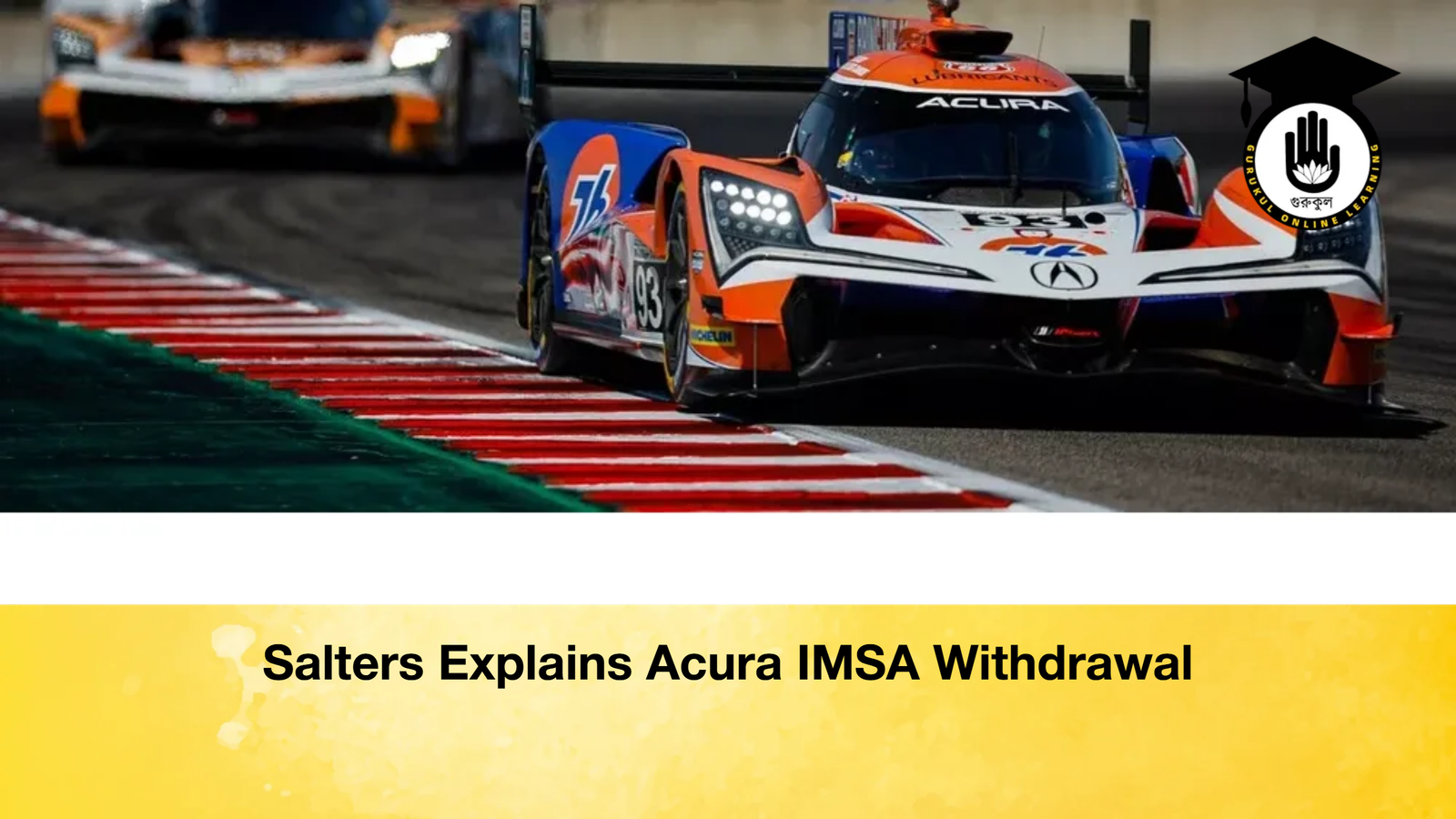

Honda Racing Corporation USA president David Salters has shed further light on Acura’s decision to step away from the IMSA WeatherTech SportsCar Championship at the conclusion of the 2026 season, citing escalating costs and concerns surrounding technical development regulations as major contributing factors.
Earlier this month, HRC US confirmed that its factory-supported Acura ARX-06 programme, currently operated in partnership with Meyer Shank Racing, would be placed on “pause” following the end of the current homologation cycle. The announcement marked a significant moment in the modern GTP era, particularly given Acura’s competitive success since the introduction of the LMDh regulations.
Although Salters stopped short of providing exhaustive detail regarding the decision, he made clear that economics and technical direction played an important role.
“This is not a complete cancellation of our GTP programme, but merely a stop for the time being,” Salters explained. “The Acura GTP programme has delivered strong results and has also been valuable from a technological development perspective for HRC US.
“During this programme, Acura has achieved 11 pole positions and eight race victories. However, we felt this was the right moment to utilise our substantial involvement in IndyCar as the primary platform for promoting the Acura brand.”
Table of Contents
ToggleAcura GTP Record
| Statistic | Total |
|---|---|
| Pole Positions | 11 |
| Race Victories | 8 |
| Factory Partner Team | Meyer Shank Racing |
| Prototype | Acura ARX-06 |
| Planned Exit | End of 2026 Season |
Salters also referenced broader pressures within the automotive industry, suggesting these influenced the company’s strategic reassessment.
“Due to competitive automotive industry reasons, we will not be discussing in detail what specifically led us to pause the Acura GTP programme,” he added.
One of the most revealing aspects of Salters’ comments centred on the increasing financial burden associated with Evo development packages. Under current LMDh regulations, manufacturers are permitted a limited number of homologation “Joker” updates across the lifecycle of the platform, alongside scheduled performance evolutions in future seasons.
While the cost of standardised hybrid systems and chassis components is controlled jointly by IMSA and the Automobile Club de l’Ouest, development expenditure elsewhere has continued to rise as manufacturers chase marginal gains.
Salters argued that the original spirit of the formula risked being undermined by continuous evolution upgrades.
“There appear to be two primary ways to control costs,” he said. “One is Balance of Performance, and the other is a cost cap.
“The difficulty is that cost caps themselves are expensive to administer and police. In our view, eliminating Evo changes entirely — as the regulations were originally intended — would be the most efficient method of controlling expenditure.”
Although Salters deliberately avoided directly criticising Balance of Performance regulations, he hinted at frustration regarding how evolving cars can complicate parity management.
Key Regulatory Topics
| Area | Current Situation | Salters’ Position |
|---|---|---|
| Evo Kits | Permitted under homologation rules | Supports removal |
| Balance of Performance | Used across IMSA and WEC | Believes stability is important |
| Cost Cap | Not currently implemented | Expensive to enforce |
| LMDh Regulations | Current cycle runs to 2029 | Possible return point in 2030 |
“Evo developments and Balance of Performance can work against one another,” Salters continued. “They destabilise the system that was originally designed to maintain close and competitive racing.”
The comments are likely to resonate across the paddock, where concerns over escalating development budgets have become increasingly common despite the current popularity of prototype racing.
Indeed, the present era has frequently been described as a modern golden age for endurance racing, with manufacturers including Porsche, Cadillac, BMW, Ferrari, Lamborghini, Peugeot, Toyota and Alpine all competing at the highest level across IMSA and the FIA World Endurance Championship.
Salters himself acknowledged the remarkable achievement of the current platform.
“We massively applaud IMSA, the ACO and the FIA for conceiving and developing this modern sportscar era,” he said. “The last eight years of sports car racing have been incredibly rewarding for us.
“Developing the hybrid systems, powertrains, vehicle optimisation and race engineering capabilities around the Acura programme has been tremendously valuable for our staff and engineers. Competing against world-class opposition has strengthened our organisation.”
Despite that praise, Salters admitted the decision to withdraw was emotionally difficult.
“We did not arrive at this decision quickly or lightly,” he explained. “There was a great deal of thought involved.”
Acura’s Future Motorsport Direction
| Programme | Status |
|---|---|
| IMSA GTP Factory Effort | Pausing after 2026 |
| IndyCar | Increased focus |
| Privateer GTP Support | No plans currently |
| Asian Le Mans Series | Potential future interest |
For now, Acura has no confirmed plans to continue in IMSA through customer programmes once the factory operation ends. However, Salters did reveal that HRC US has explored potential future involvement in categories such as the Asian Le Mans Series.
Any full-scale return to top-level prototype racing is unlikely before the anticipated next-generation LMDh regulations arrive around 2030, though Salters stopped short of committing to a definitive timeline.
“One potential re-entry point could coincide with the next-generation LMDh cars,” he noted. “But we have not established a firm schedule for any return.”
Acura’s departure nevertheless represents a notable loss for IMSA’s GTP field, particularly given the competitiveness of the ARX-06 programme. Since its debut, the prototype has regularly challenged for victories and helped reinforce the credibility of the LMDh concept.
At the same time, Salters’ remarks highlight a growing debate within endurance racing regarding how best to balance manufacturer freedom, technological relevance and financial sustainability.
As prototype grids continue to expand globally, regulators face increasing pressure to ensure that the category remains commercially viable without sacrificing the engineering innovation and close racing that have helped fuel its resurgence.
For Acura, the current pause may not represent a permanent farewell — but Salters made it clear that future participation will depend heavily on whether the next era of endurance racing can better contain costs while preserving competitive stability.

Sufi Arshan Aziz Faruq | Contributor | sportsgoln.com
Sufi Aarshan Aziz Faruq is a car enthusiast
Follow Me