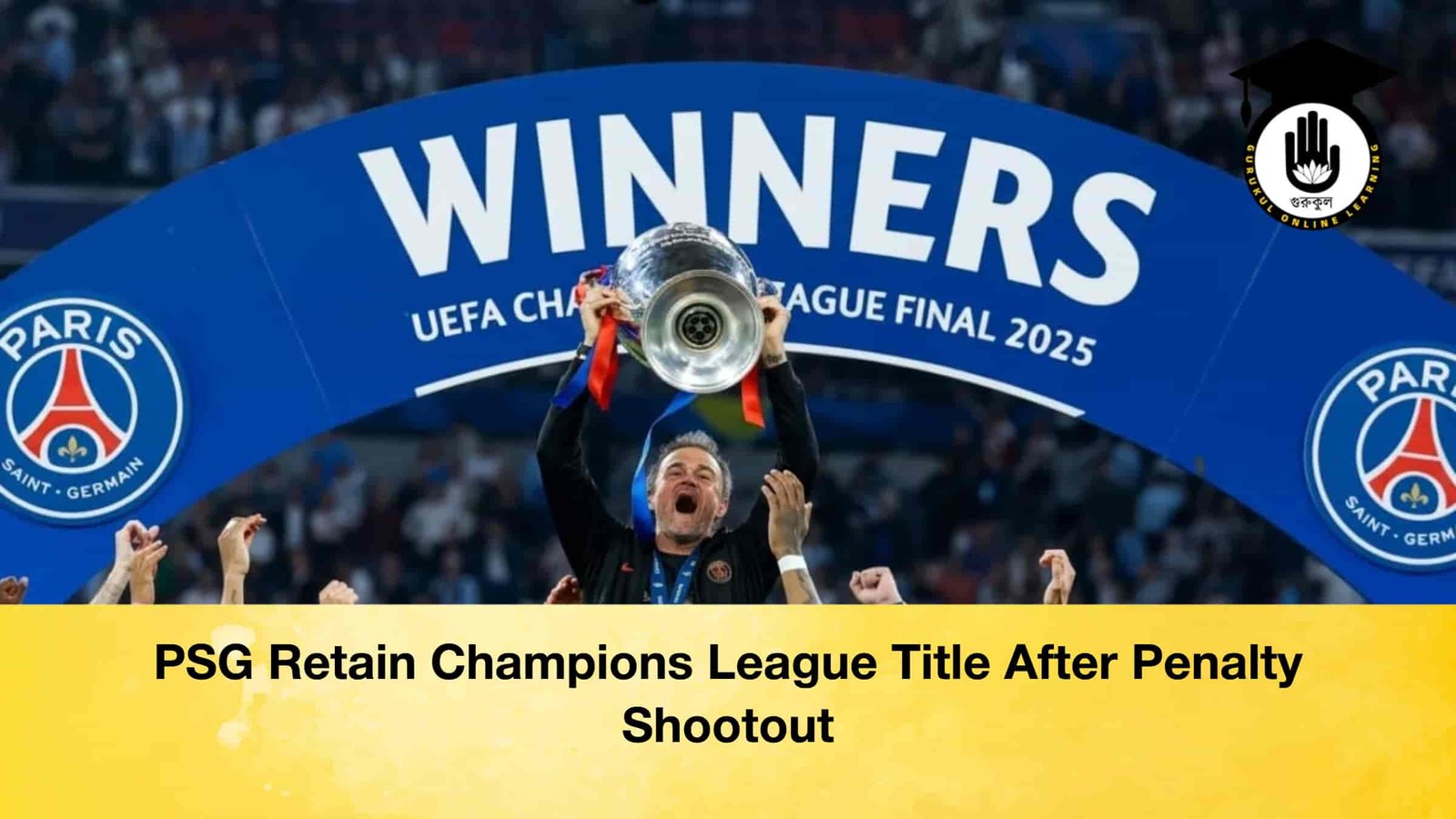
The UEFA Champions League final extended beyond the regulation 90 minutes for the first time in a decade, culminating in a dramatic penalty shootout at the Puskás Aréna in Budapest. Not since the 2016 final in Milan between Real Madrid and Atlético Madrid had Europe’s premier club showpiece required an additional half-hour and penalties to determine the winner. Ultimately, Paris Saint-Germain (PSG) emerged victorious from the mental ordeal, defeating Arsenal 4–3 in the shootout to secure their second consecutive Champions League trophy.
The definitive moments of the shootout occurred during the final round of penalties. Lucas Beraldo successfully converted his spot-kick for the French champions, whereas Arsenal’s Brazilian central defender, Gabriel Magalhães, struck his effort over the crossbar. With this victory, PSG became only the second club in the modern Champions League era, alongside Real Madrid, to retain the continental crown in consecutive seasons.
Early Arsenal Dominance and Tactical Shifts
Paris Saint-Germain had to show immense resilience to retain their title, particularly after a commanding start by Mikel Arteta’s Arsenal. The English side opened the scoring in the sixth minute of play. A clearance from PSG captain Marquinhos deflected off Leandro Trossard and fell directly into the path of Kai Havertz. The German forward capitalised on the opportunity, unleashing a powerful strike over the head of PSG goalkeeper Matvey Safonov, who had no chance of making a save.
PSG entered the showpiece match with notable tactical continuity, fielding ten of the eleven players who had started in the previous year’s victorious final. The solitary alteration was the inclusion of Safonov in goal. This championship experience ensured that the Parisian club remained composed despite conceding early.
As the first half progressed, Arsenal retreated into a deeper defensive block to protect their narrow advantage. This allowed PSG to intensify their offensive pressure, with Ousmane Dembélé, Fabián Ruiz, and Désiré Doué driving forward. Although these attacks initially failed to yield clear-cut opportunities—often resulting in off-target long-range efforts—the French side gradually asserted control. Shortly before the half-time interval, Havertz came close to doubling Arsenal’s lead, but his attempt was thwarted by a crucial defensive intervention from Marquinhos.
Second-Half Attrition and Dembélé’s Equaliser
The second half began with immediate tension, highlighted by Arsenal returning to the pitch two minutes after their opponents. The physical nature of the contest intensified, and Arsenal’s Spanish right-back, Christian Mosquera, received a yellow card for a time-wasting infraction shortly after the restart.
In the 65th minute, Mosquera was involved in the pivotal moment that allowed PSG back into the match. The defender committed a foul inside the penalty area on Khvicha Kvaratskhelia, who had breached the box with a direct run. The referee promptly awarded a penalty, which Ousmane Dembélé converted with composure to restore parity at 1–1.
Following the equaliser, Luis Enrique’s side dictated the tempo of the match. Kvaratskhelia struck the post with a powerful effort, whilst Bradley Barcola failed to convert two clear goalscoring opportunities. Despite sustained pressure from PSG, the Arsenal rearguard held firm, sending the match into a grueling period of extra time.
Extra Time and the Penalty Drama
During the additional 30 minutes, the match remained finely balanced, though Arsenal managed to create several dangerous opportunities of their own. Jurriën Timber and substitute striker Viktor Gyökeres both found themselves in promising positions but were unable to convert their chances. With neither side capable of finding a late winner, the final was decided by a penalty shootout.
The shootout provided immediate shifts in momentum. Arsenal’s second penalty, taken by Eberechi Eze, missed the target entirely. However, the North London side was quickly thrown a lifeline when goalkeeper David Raya saved the subsequent spot-kick from PSG’s Nuno Mendes.
After four rounds of penalties, the scores remained perfectly level at 3–3. Beraldo’s successful conversion under immense pressure piled the weight of expectation onto Arsenal’s final penalty taker. Gabriel Magalhães stepped up but sent his decisive shot over the crossbar, triggering wild celebrations amongst the PSG players and staff. Prior to 2025, PSG had never won the Champions League; by securing consecutive titles, they have firmly established themselves alongside Real Madrid in the record books of modern European football history.
UEFA Champions League Final: Match Summary
| Match Component | Official Statistic / Event Detail |
| Venue | Puskás Aréna, Budapest |
| Full-Time Score | Paris Saint-Germain 1–1 Arsenal |
| Penalty Shootout Score | Paris Saint-Germain 4–3 Arsenal |
| Opening Goal | Kai Havertz (Arsenal) – 6th Minute |
| Equaliser Goal | Ousmane Dembélé (PSG) – 65th Minute (Penalty) |
| Missed Penalties (Shootout) | Eberechi Eze (Arsenal – Off Target), Nuno Mendes (PSG – Saved), Gabriel Magalhães (Arsenal – Off Target) |
| Decisive Penalty | Lucas Beraldo (PSG) – Converted |
| Cautionary Bookings | Christian Mosquera (Arsenal) – Yellow Card |
| Historical Milestone | PSG become the second club to retain the modern Champions League title |