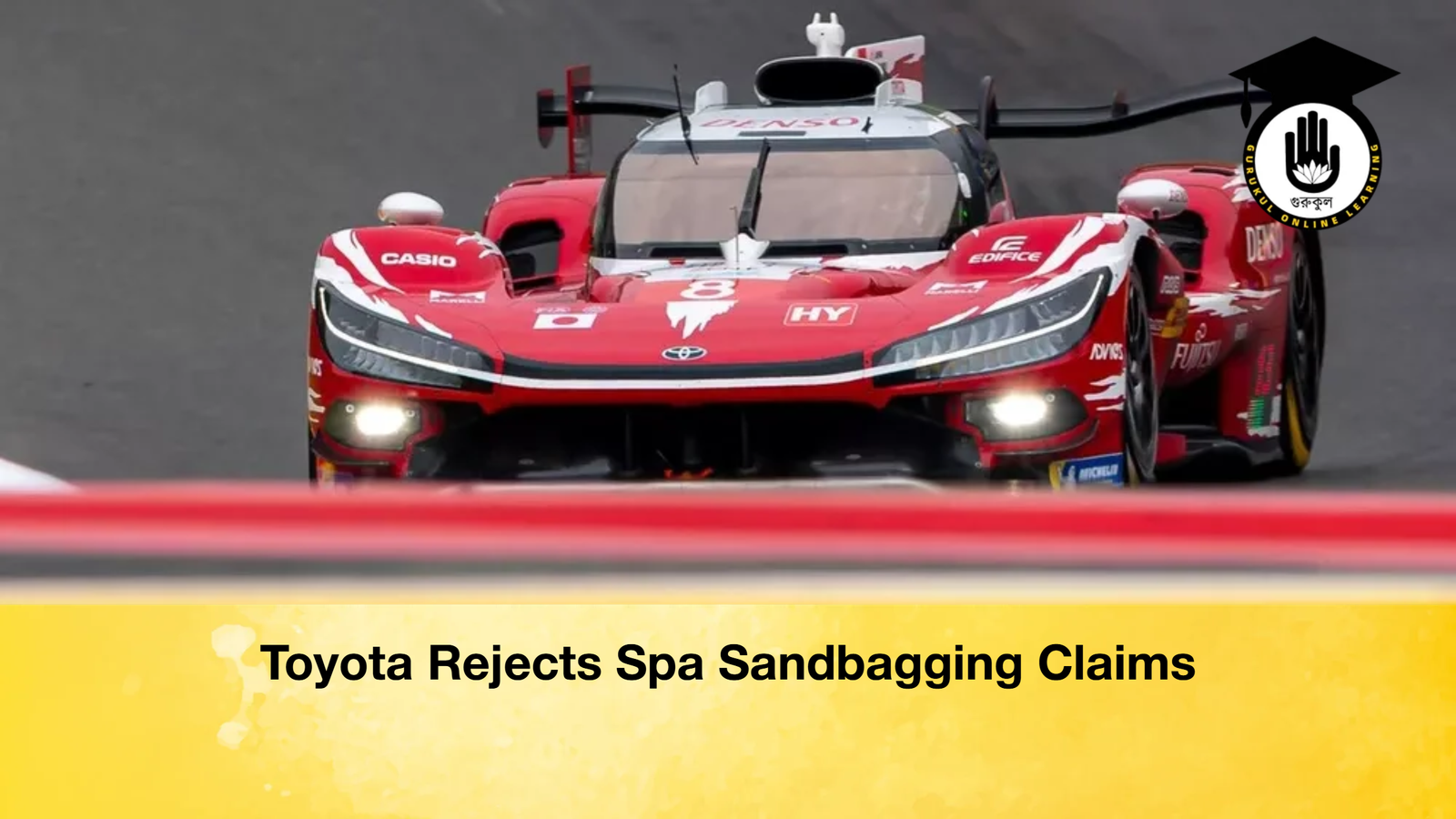
Toyota has firmly dismissed suggestions that it deliberately underperformed during qualifying for the FIA World Endurance Championship round at Spa-Francorchamps, insisting that its apparent lack of pace reflects the characteristics of the circuit rather than any attempt to influence future Balance of Performance calculations ahead of the 24 Hours of Le Mans.
The Japanese manufacturer arrived in Belgium on the back of a landmark victory at the 6 Hours of Imola, where it secured its 50th win in the World Endurance Championship. However, the team endured a far more difficult weekend at Spa, with neither of its Hypercars progressing into the Hyperpole shootout.
That disappointing result inevitably sparked speculation among observers, particularly given Spa’s status as the final WEC race before Le Mans and its reputation as a key indicator of competitiveness at Circuit de la Sarthe.
Yet Toyota Technical Director David Floury was unequivocal in rejecting any notion of “sandbagging”—the practice of intentionally concealing a car’s true performance.
Qualifying Performance Compared
Floury pointed to the raw data as evidence that Toyota had, in fact, improved compared with its performance at Spa one year earlier.
| Year | Toyota Fastest Qualifying Lap | Improvement |
|---|---|---|
| 2025 | 2m 01.908s | — |
| 2026 | 2m 01.592s | +0.316s faster |
According to Floury, Toyota was one of only two manufacturers present in both seasons to record a quicker lap time than it managed in 2025.
“We are faster than last year,” he explained. “While we improved our lap time by around three tenths, the average pace of the field actually became quicker by a similar margin. Relative to our rivals, we are roughly six tenths faster than we were a year ago.”
Those figures, he argued, directly contradict claims that Toyota was intentionally holding back.
Spa Exposes Toyota’s Weaknesses
Rather than focusing on conspiracy theories, Floury believes the answer lies in the differing demands of the circuits.
Imola’s layout rewards cars that perform strongly through slower and medium-speed corners. Spa, by contrast, is defined by sweeping high-speed sections such as Eau Rouge-Raidillon, Blanchimont and Pouhon, placing very different demands on chassis balance and aerodynamic efficiency.
“The characteristics of Spa simply do not suit our car particularly well,” Floury admitted.
More concerning for Toyota is the fact that Le Mans shares several of those traits, particularly its emphasis on high-speed stability and aerodynamic efficiency.
“The nature of the corners and the way our car behaves through them is probably not one of our strongest areas,” he added.
Little More Pace Available
Floury also praised the effort of Kamui Kobayashi in extracting what he described as a near-maximum lap from the No. 7 Toyota.
Asked whether significantly more pace could have been found, his response was blunt.
| Assessment | Estimated Gain |
|---|---|
| Additional performance available | 0.1–0.15 seconds |
| Potential to challenge front-runners | Limited |
“From the car’s potential, I don’t think there is much more we could extract,” Floury said. “Perhaps a tenth or a tenth-and-a-half, but not much beyond that.”
Confidence in the New Package
Despite the disappointing qualifying result, Toyota remains encouraged by the progress made through the evolution of its Hypercar programme. The transition from the GR010 Hybrid specification to the updated TR010 package is viewed internally as a positive step forward.
Floury stressed that the revised package has delivered measurable gains, even if the results at Spa have not reflected the scale of improvement the team had hoped to see.
“We have a better package,” he said. “But we still need to continue working, developing and pushing forward.”
With Le Mans now looming, Toyota finds itself in an unusual position. Long regarded as the benchmark in endurance racing, the manufacturer heads to the biggest race of the year with questions surrounding its outright pace. Nevertheless, the team believes the numbers tell a more encouraging story than the qualifying order suggests—and insists that its focus remains on finding performance rather than hiding it.