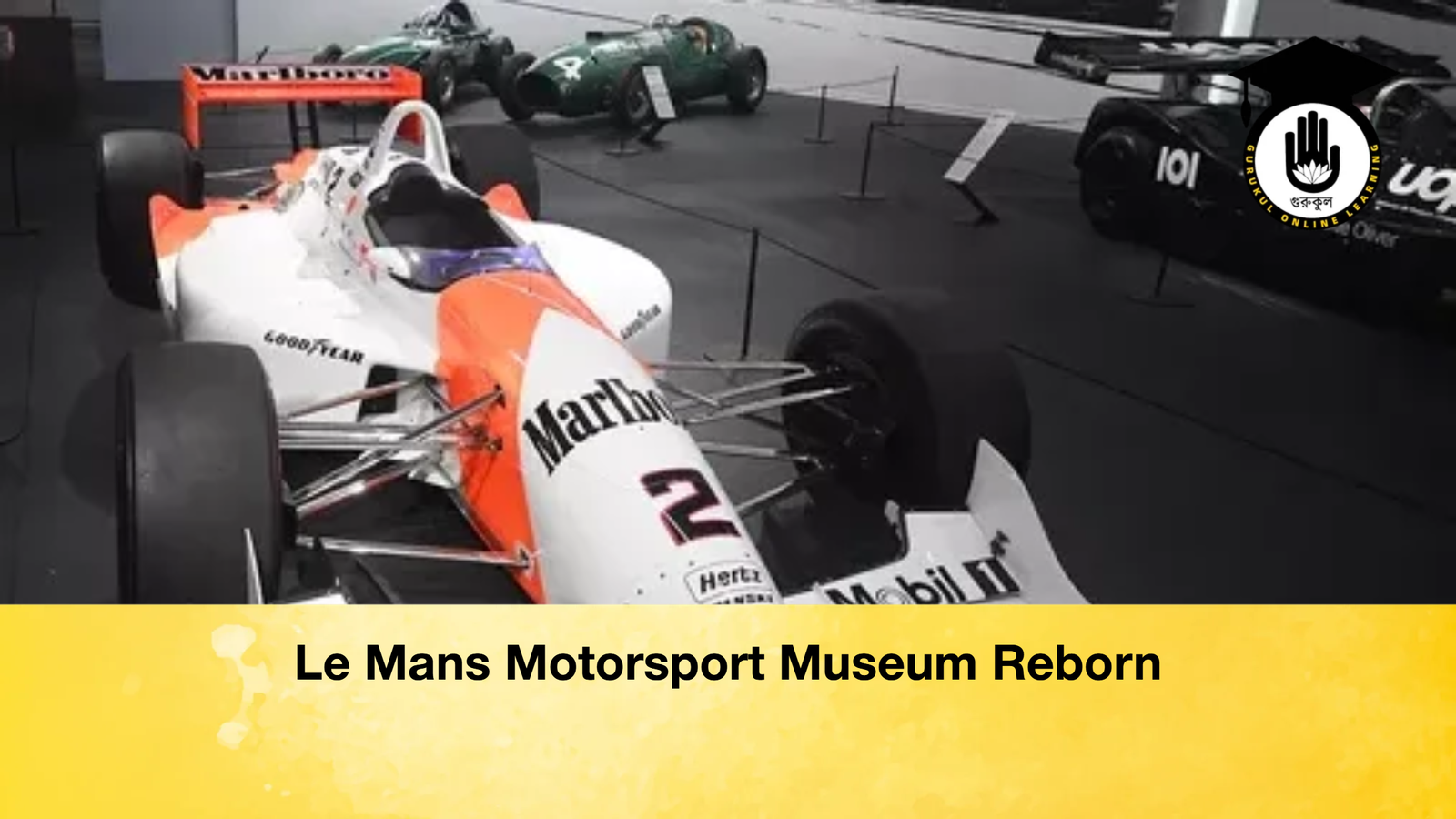
The city of Le Mans has unveiled a radically reimagined home for its racing heritage with the opening of the all-new M24 Motorsport Museum, a sweeping redevelopment project completed in under a year and positioned as a global reference point for motorsport storytelling.
Closed for just under twelve months, the former museum underwent a near-total transformation. Around 45,000 cubic metres of earth were excavated, internal walls were reconfigured, and hundreds of artefacts were relocated or restored as curators rebuilt the experience from the ground up. The result is a doubled footprint and a dramatically expanded narrative scope that extends far beyond the famed 24-hour race.
On 28 May, the museum reopened to the public beside the gates of the Circuit de la Sarthe, just weeks before the 2026 24 Hours of Le Mans. For Automobile Club de l’Ouest president Pierre Fillon, the opening marked the culmination of an intense and tightly compressed construction schedule.
“It was a day-to-day challenge,” Fillon explained. “The Le Mans 24 Hours starts at 16:00 on Saturday; the museum had to open at 10:00 on 28 May.”
From a single race to global motorsport
The most symbolic change is the name itself. The museum is no longer confined to the 24 Hours of Le Mans alone. Instead, it has been reborn as a comprehensive motorsport institution, charting the evolution of global racing from its earliest days to modern prototype competition.
According to museum director Fabrice Bourrigaud, the ambition was clear: to establish Le Mans as the world’s definitive motorsport archive.
Le Mans’ historical significance underpins that ambition. Alongside Indianapolis and Monaco, it is regarded as one of the sport’s “three pillars”, and the site of the world’s first modern motor race in 1906.
A rapid transformation
| Metric | Old Museum | New M24 Museum |
|---|---|---|
| Floor space | 5,000 m² | 10,000 m² |
| Exhibition vehicles | ~100 | ~130 |
| Construction duration | — | ~9 months |
| Earth moved | — | 45,000 m³ |
The scale of the transformation required what Bourrigaud described as “a racing-team mentality”, with every department aligned to a strict deadline.
“In eleven months, we completed a project that could easily have taken two years,” he said.
Immersive storytelling and design
The redesigned museum prioritises immersion over static display. Visitors move through a chronological journey of a Le Mans race weekend—start procedures, night stints, dawn transitions—before branching into wider motorsport disciplines including Formula 1, IndyCar, rallying and motorcycle racing.
The layout was developed with scenographer Raphaël Daguet, with lighting used as a central design language. Vehicles are presented not as static exhibits but as “mechanical works of art”, positioned on asphalt-like flooring replicating the Circuit de la Sarthe surface.
Full-scale dioramas combine cars, pit equipment, transporters and life-size figures, creating scenes that replicate race-day environments with striking fidelity.
Icons under one roof
The collection brings together some of motorsport’s most significant machines, including:
| Exhibit | Significance |
|---|---|
| Michael Schumacher’s Ferrari F2002 | Dominant Formula 1 title-winning car |
| 1924 Bentley 3 Litre | One of Le Mans’ earliest winners |
| Rondeau M379 | Privateer victory over factory Porsche |
| Jacky Ickx Ferrari F1 | Historic Grand Prix machinery |
| Sébastien Loeb rally car | Rallying dominance era |
The museum also features a dedicated “Alley of Heroes”, linking generations of drivers from Henri Pescarolo to Michael Schumacher.
A living archive
Backed by collector Richard Mille and supported by the Automobile Club de l’Ouest’s archive of over one million photographs, the museum is designed as a living institution rather than a fixed exhibition. Up to 400 cars are expected to rotate through future displays, ensuring continual renewal.
Temporary exhibitions are also planned from 2027 onwards, reinforcing the museum’s ambition to evolve alongside the sport it celebrates.
With its doors now open ahead of race week, the M24 Motorsport Museum positions itself not just as an attraction for Le Mans spectators, but as one of the most comprehensive motorsport archives in the world—built at racing speed, but designed to last for generations.