
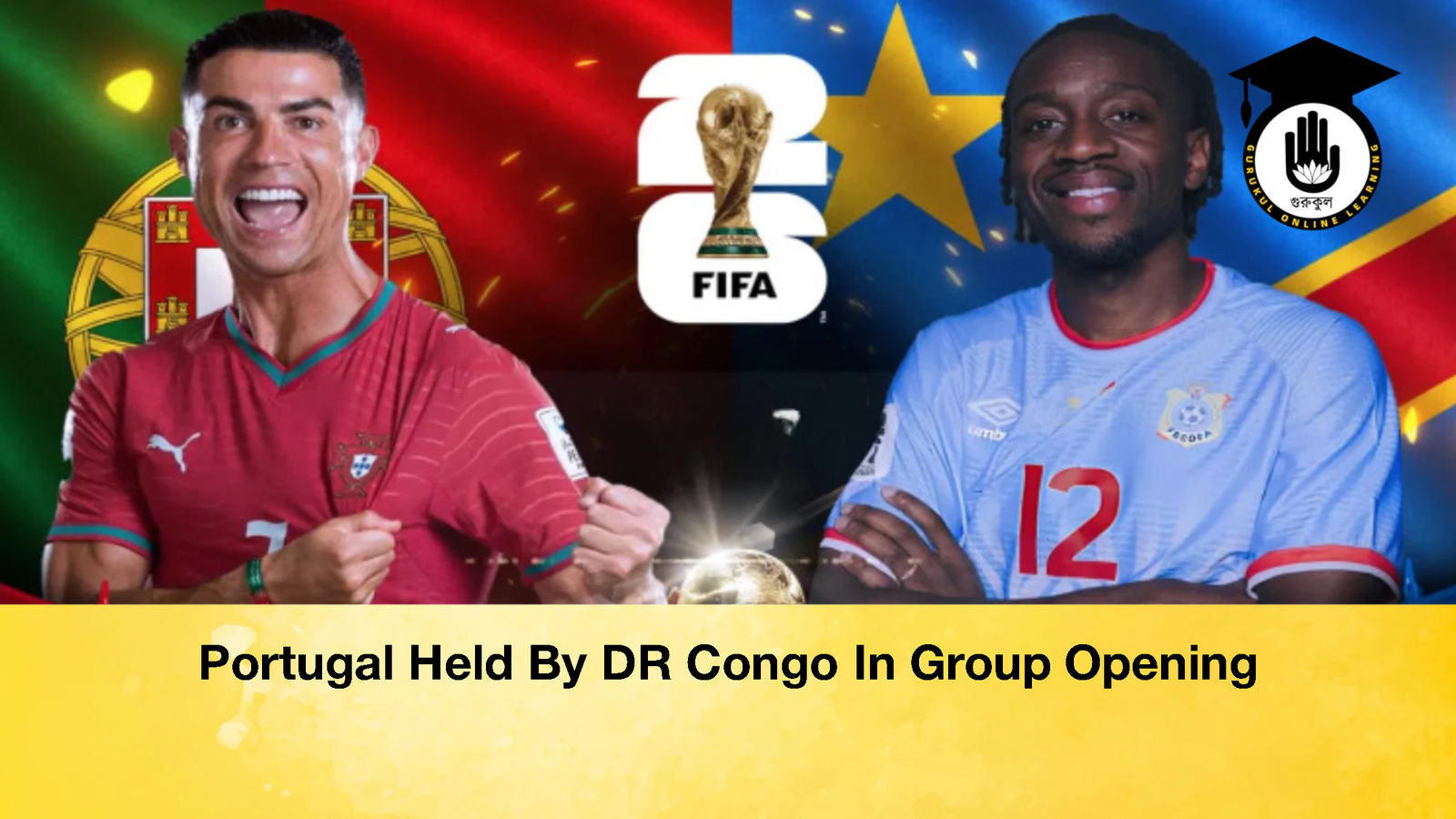

The Portugal national football team officially opened their FIFA World Cup 2026 campaign with a performance that fell short of initial pre-tournament expectations. Facing the Democratic Republic of Congo (DR Congo) in a Group K fixture at the Houston Stadium in Texas, United States, the European representatives were held to a 1-1 draw. Despite entering the stadium as the statistical favourites to win the encounter, Portugal were unable to secure all three points, resulting in a shared spoils outcome that leaves both international teams tied on one point each within the opening group standings.
Tactically, Portugal commenced the match utilising a 4-2-3-1 formation and established an early advantage by finding their passing rhythm quickly. In the 6th minute of play, midfielder João Neves scored the opening goal for Portugal by heading the ball into the net following a cross from winger Pedro Neto. Following the goal, Portugal maintained a significant percentage of ball possession across the field. However, the European side conceded an equaliser in the final stages of the first half. Five minutes into first-half injury time ($45+5’$), DR Congo forward Yoane Wissa struck a shot past the goalkeeper from a pass delivered by teammate Arthur Masuaku. Wissa’s successful strike marked an institutional milestone as the first-ever FIFA World Cup goal scored by the Democratic Republic of Congo in its footballing history. Following a completely goalless second half, the competitive fixture concluded in a formal tie.
Technical Statistics and Performance Metrics
The statistical data from the match highlights a distinct contrast between overall positional dominance and clinical offensive execution. Under their chosen tactical setup, Portugal controlled an estimated 80% of total ball possession throughout the opening 45 minutes and successfully completed 459 out of 488 attempted passes. This specific system enabled the Portuguese squad to document 56 final-third entries and maintain a high passing accuracy rate of 86% within that specific sector of the pitch. Furthermore, the European team executed long-range passes with accuracy, completing 21 out of 30 total attempts, while also registering 11 touches inside the opposition’s penalty box.
In contrast, the technical staff representing DR Congo organised their team into a compact 5-3-2 defensive formation specifically designed to absorb continuous attacking pressure from the opposition. While deliberately conceding territorial position and field control, the Congolese team generated higher-quality scoring opportunities, outshooting Portugal by six attempts to two during the first half. Five of DR Congo’s six total shots originated from outside the penalty box, while their organised defensive structure successfully restricted Portugal to just two shots during the entire match, only one of which was directed on target. Ultimately, the rigid defensive block deployed by DR Congo neutralised Portugal’s attacking transitions, forcing the European squad to move the ball along the outer edge of the penalty area without consistently creating threats for Congolese goalkeeper Lionel Mpasi.
Cristiano Ronaldo Set Milestone Amid Defensive Marking
The Group K fixture was notable for an individual historical milestone achieved by the Portuguese team captain, Cristiano Ronaldo. By leading his national team out onto the playing field and completing the full 90 minutes of the match, the 41-year-old forward featured in his sixth different edition of the FIFA World Cup tournament. This appearance officially established a record-equalling achievement for individual participation in the history of the global football competition.
Throughout the match, the veteran forward was subjected to strict defensive monitoring by the Congolese centre-backs, specifically Chancel Mbemba and Steve Kapuadi, who successfully restricted his operational space inside the final third. Ronaldo was limited to 16 total touches of the ball during the opening 45 minutes of play and did not record a single shot on goal until the 69th minute. This attempt, a right-footed shot taken from the edge of the six-yard box, traveled wide of the goalpost. Shortly after this sequence, Ronaldo missed a second close-range scoring opportunity without forcing a defensive save from Lionel Mpasi. Although manager Roberto Martínez introduced late tactical adjustments—replacing midfielder Vitinha with forward Gonçalo Ramos in the 83rd minute—the Portuguese captain remained on the pitch until the final whistle blew without any further changes made to the scoreline.
Disciplinary Records and Second-Half Substitutions
The competitive nature of the tournament opener resulted in multiple disciplinary cautions issued by the match referee. For the Portuguese team, midfielder Bernardo Silva was shown the first yellow card of the match in the 13th minute. During the second half, substitute defender Nélson Semedo—who had entered the match in the 71st minute alongside Rafael Leão to replace Nuno Mendes—was booked by the referee in the 88th minute for a foul that stopped a transitional run by Yoane Wissa. Portugal’s final caution was issued to Tomás Araújo in the second minute of second-half stoppage time ($90+2’$) for committing a tactical foul on Wissa to halt a potential counter-attack.
DR Congo’s single disciplinary infraction occurred during the first half, when defender Chancel Mbemba was shown a yellow card in the 32nd minute. The Congolese technical staff, under the direction of manager Sébastien Desabre, executed a series of strategic second-half substitutions to maintain the physical freshness of their defensive formation. Noah Sadiki was brought onto the pitch to replace Ngal’ayel Mukau in the 56th minute of play. Later, in the 73rd minute, Joris Kayembe and Charles Pickel entered the game to replace Arthur Masuaku and Edo Kayembe respectively. In the 84th minute, the final tactical changes for DR Congo saw Gédéon Kalulu and Simon Banza replace Aaron Wan-Bissaka and Cédric Bakambu, ensuring the African squad secured the draw.