
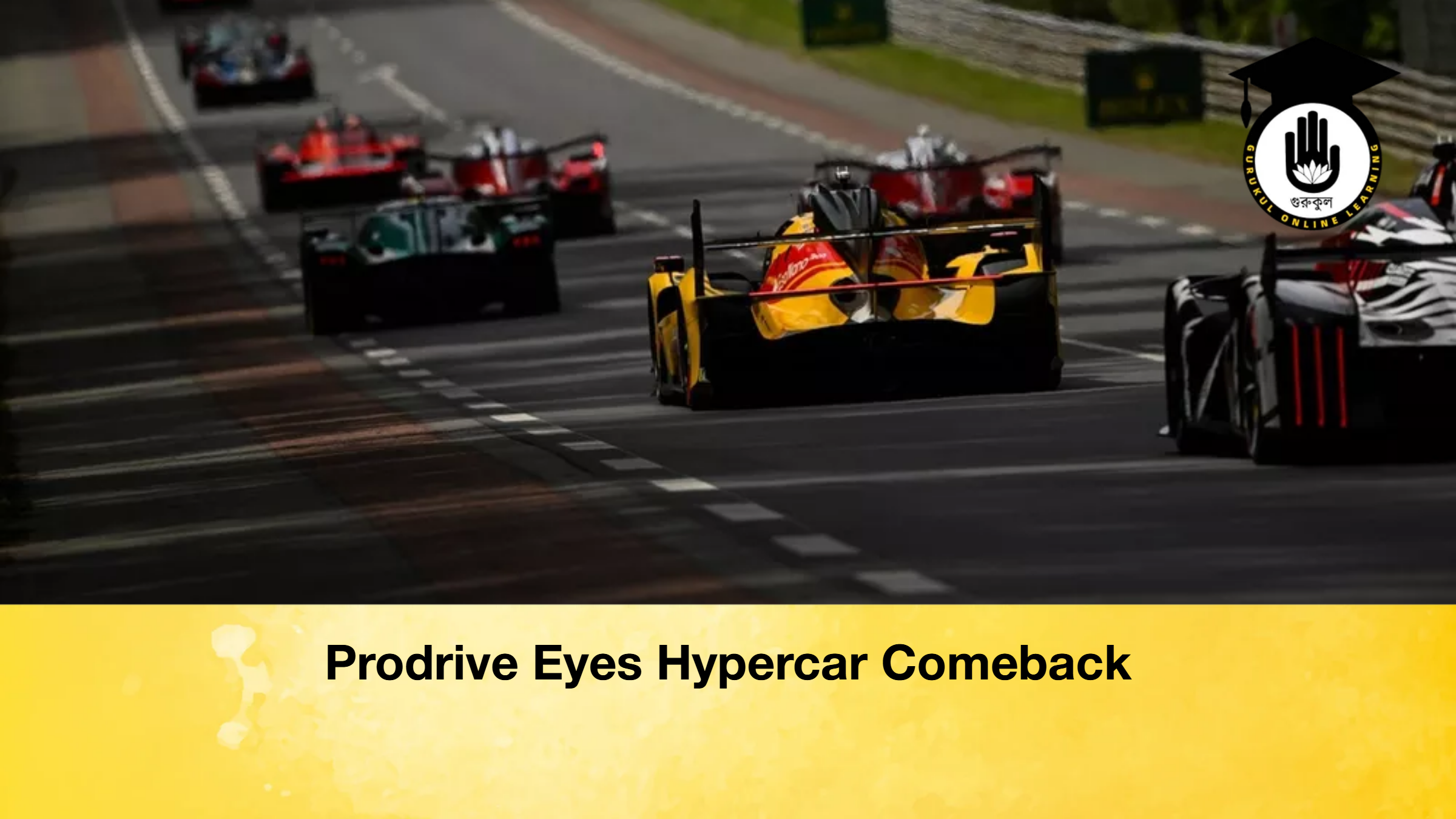
Prodrive Eyes Hypercar Comeback

Prodrive has revealed that a return to top-flight prototype endurance racing is becoming an increasingly attractive prospect, with the British engineering powerhouse exploring opportunities to re-enter the FIA World Endurance Championship (WEC) amid the unprecedented popularity of the Hypercar era.
Best known for creating iconic machines such as the Aston Martin DBR9 and Vantage GTE, Prodrive has remained a respected force in international motorsport despite its absence from the outright category in endurance racing for more than a decade. The company currently maintains a presence in the WEC through the LMGT3 class, but its last prototype project at the pinnacle of sports car racing was the Aston Martin AMR-One in 2011.
Now, with Hypercar grids packed with manufacturers and the 24 Hours of Le Mans enjoying one of its strongest periods in modern history, Prodrive Chief Executive David Richards admits the prospect of returning to the fight for overall victories is becoming increasingly compelling.
Speaking to Motorsport.com, Richards confirmed the company is evaluating potential partnerships with manufacturers, although he stopped short of announcing any formal programme or timeline.
“Obviously, a partner, a manufacturer partner, and we’ve got some ideas around that at the moment, and we’re exploring some ideas there, but it’s certainly very appealing now,” Richards explained.
He credited the Automobile Club de l’Ouest (ACO) and the championship organisers for creating regulations that have revitalised endurance racing.
“The thing I like about it is that it’s such a competitive series now, and so popular. That’s a measure of the success that the ACO have had in putting the regulations together. I think they’ve done a superb job.”
Hypercar boom attracts unprecedented competition
The current Hypercar regulations, encompassing both LMH (Le Mans Hypercar) and LMDh (Le Mans Daytona h), have transformed endurance racing into one of motorsport’s most competitive battlegrounds.
Manufacturers from across the automotive world have committed factory programmes, creating fiercely contested grids in both the WEC and IMSA SportsCar Championship.
For a company with Prodrive’s engineering pedigree, the opportunity to return to prototype competition is an enticing one. However, Richards acknowledged that the financial demands of competing at the highest level have risen significantly.
“What don’t I like about it? Well, inevitably it’s quite expensive, but that’s a consequence of popularity as well.”
He added:
“It’s more expensive than I anticipated. It’s just the competitiveness of the whole series now. With so many competitive manufacturers, everyone’s come into it, and when that happens, costs go up.”
Current Hypercar landscape
| Category | Details |
|---|---|
| Championship | FIA World Endurance Championship (WEC) |
| Top class | Hypercar (LMH & LMDh) |
| Prodrive’s last prototype | Aston Martin AMR-One (2011) |
| Current WEC involvement | LMGT3 category |
| Potential return | Manufacturer-backed Hypercar programme (under evaluation) |
| Primary target | Overall victories, including the 24 Hours of Le Mans |
Success brings rising costs
The Hypercar formula has been widely praised for producing close racing while allowing different technical philosophies to compete under a balanced set of regulations.
Manufacturers have embraced both the bespoke LMH route and the cost-controlled LMDh platform, creating one of the healthiest eras the discipline has enjoyed in decades.
Yet Richards believes that increased popularity inevitably drives up expenditure.
With multiple factory-backed operations fighting for outright victories, every marginal performance gain becomes increasingly valuable—and increasingly expensive.
For engineering companies such as Prodrive, entering the category requires not only technical excellence but also substantial financial backing from an automotive manufacturer.
Boom-and-bust cycle likely to repeat
Despite his enthusiasm for the championship, Richards warned that motorsport history suggests the current level of manufacturer participation is unlikely to last indefinitely.
Sports car racing has traditionally experienced cycles in which new regulations attract numerous manufacturers before rising costs and inconsistent results gradually reduce the field.
Recent developments appear to support that trend. Lamborghini has already ended its factory Hypercar programmes in both the WEC and IMSA, while Acura’s successful ARX-06 campaign is also scheduled to conclude. Porsche has likewise scaled back aspects of its factory endurance racing commitments to concentrate on selected programmes.
Richards believes these fluctuations are simply part of motorsport’s natural rhythm.
“You watch what happens in motorsport at the top level with car manufacturers’ interest.”
He explained that manufacturers often arrive in large numbers when fresh regulations are introduced, only for participation to decline once competitive realities emerge.
“If you actually do a bit of research over the years and find out the average number of manufacturers participating in a championship, it always ends up at about three.”
According to Richards, the reasoning is straightforward.
Manufacturers expect success, and when too many competitors are chasing the same prize, those struggling near the back of the field begin questioning the value of their investment.
“Because you get to six or seven and the people at the back of the grid say, ‘We can’t justify being here and not winning.’ So they drop off.”
Eventually, once participation falls, fresh opportunities emerge for new entrants.
“Then once it gets down to two or three manufacturers, suddenly others say there’s an opportunity to come back again. It’s a cycle that’s inevitable—and car manufacturers don’t like losing.”
No immediate announcement
While Richards offered no indication that a return is imminent, his comments underline that Prodrive is actively assessing its options.
Should the company secure the right manufacturer partnership, one of Britain’s most successful motorsport engineering firms could once again find itself competing for outright honours at Le Mans.
Given Prodrive’s long history of championship-winning programmes across endurance racing, rallying and touring cars, any future Hypercar entry would undoubtedly add another significant name to an already stellar grid—and further strengthen what many regard as a golden era for international sports car racing.