
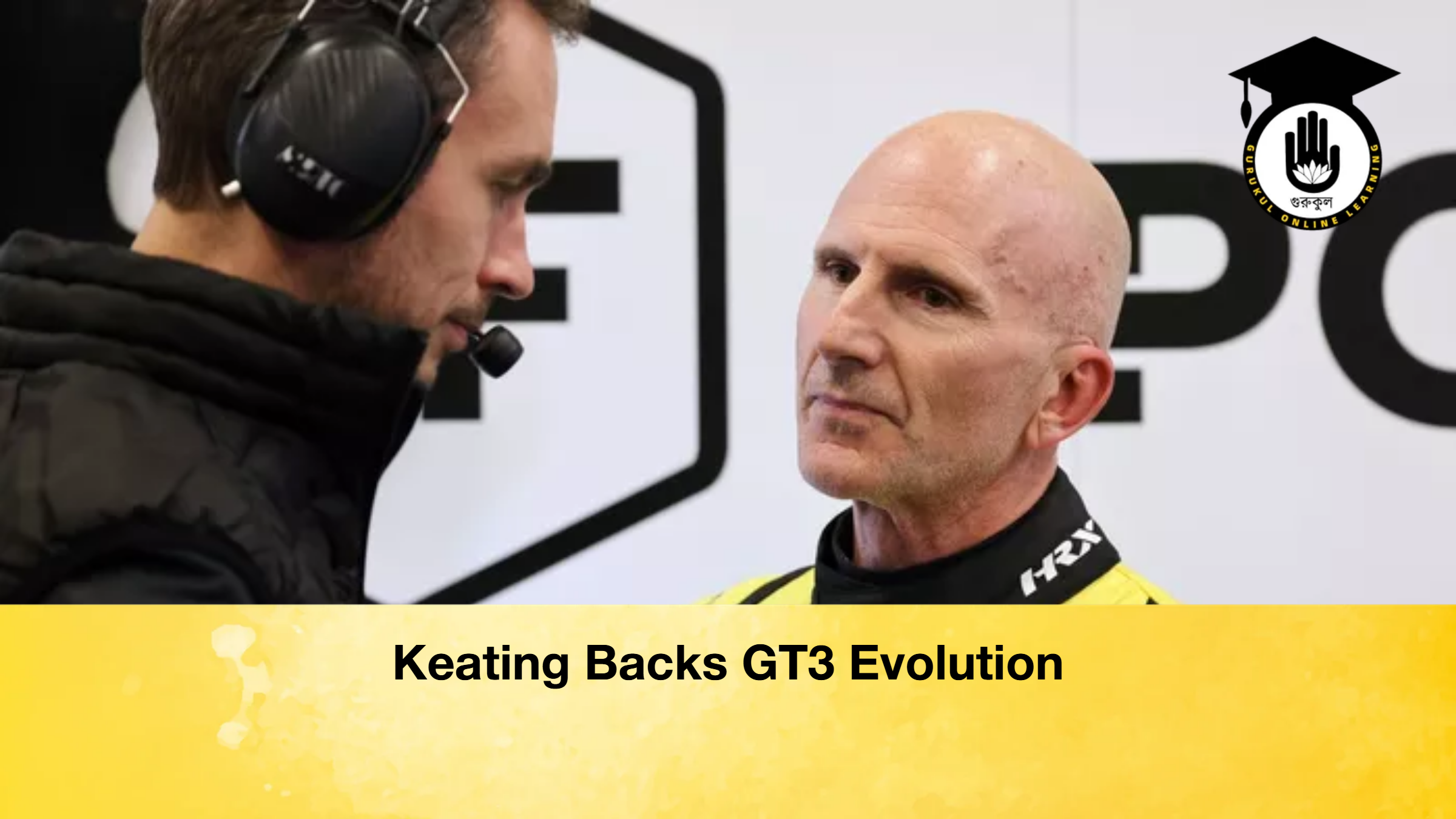

The future direction of GT3 racing has become one of the sport’s most hotly debated topics, with manufacturers increasingly developing race cars first before adapting them into road-going models. While the shift has raised concerns over escalating costs and the long-term identity of GT racing, Le Mans class winner Ben Keating believes the philosophy is a logical step forward.
The experienced American, who has competed in a remarkable variety of GT machinery throughout his endurance racing career, argues that designing a competition car from the outset ultimately produces a stronger package than attempting to transform a road car into a front-running racing machine.
However, fellow Corvette racer Matt Bell is less convinced. Although he accepts that the Balance of Performance (BoP) system should maintain competitive parity, he fears the growing trend risks steering GT3 away from the principles upon which the category was originally founded.
Race-first philosophy gathers momentum
Several manufacturers are embracing a fresh approach to GT3 development. Rather than engineering a production sports car before converting it into a racing machine, companies including Toyota, Mercedes and Genesis are designing dedicated competition cars first, with homologated road versions following later.
The concept represents a significant departure from GT3’s original purpose. Introduced by Stéphane Ratel two decades ago, the category was intended to provide manufacturers and private teams with an affordable platform based upon production-derived sports cars.
As development programmes become increasingly sophisticated, questions have inevitably been raised over whether costs could spiral in a manner similar to previous GT categories.
Keating, however, believes the engineering advantages outweigh those concerns.
“With the Toyota, I agree. I think it’s the right way to do it.
“If you want to design the very, very best GT3 car, you have to start with the race car. Figure out what it needs, what it wants, how to design it, and then fashion a road car after it. It’s easier than the other way around.”
His opinion carries considerable weight given his extensive experience across multiple manufacturers and categories. Keating has contested the 24 Hours of Le Mans in no fewer than ten different cars and remains one of endurance racing’s most respected amateur drivers.
The Texan also admitted he would relish the opportunity to race Toyota’s forthcoming GT3 challenger should the chance arise.
“This is my 12th Le Mans in 10 different cars. I always like trying something different.
“I really like the Toyota team. I’m a big Toyota dealer. Anything is possible.”
A changing GT3 landscape
The increasing number of manufacturers pursuing race-first designs illustrates how the category continues to evolve.
| Manufacturer | GT3 Development Approach | Current Status |
|---|---|---|
| Toyota | Race-first GR GT3 programme | Under development |
| Mercedes | New-generation GT3 project | In development |
| Genesis | Dedicated GT3 programme | In development |
| Chevrolet | Corvette Z06 GT3.R derived from production model | Currently competing |
While supporters argue the approach creates faster, more capable racing cars, critics worry it risks moving GT3 closer to becoming a prototype category in disguise.
Bell urges caution
Matt Bell acknowledges that every manufacturer must operate within the regulations laid down by the FIA and SRO. Nevertheless, he believes the philosophy conflicts with what GT racing has traditionally represented.
Bell recalled similar debate surrounding the Ford GT programme, which was also conceived primarily as a competition car before its limited-production road version was introduced.
“I remember the Ford GT was the same deal and that caused a lot of discord amongst a lot of manufacturers.
“It’s not really what GT racing is supposed to be about, but ultimately, we participate within the regulations that are set out by those that make them, and if it’s allowed by those guys, then we’ve all got to go racing.”
Despite his reservations, Bell remains confident that the Balance of Performance system will continue to ensure close competition regardless of differing design philosophies.
“Ultimately, BoP racing is designed to balance all cars.
“In theory, you can balance a Formula 1 car against a Corvette GT3 car over a fair lap.
“As long as that is generally enforced in the correct manner, which I think it is being done, then it’ll still be a fair competition.”
Learning from history
Bell’s greatest concern centres on the financial trajectory of GT racing.
History offers several cautionary tales. The spectacular GT1 era eventually collapsed beneath unsustainable expenditure during the late 1990s before its brief revival ended in 2012. More recently, GTE—originally introduced as GT2—was phased out after the 2023 season following declining manufacturer participation and the emergence of the Hypercar class.
Bell hopes GT3 can avoid repeating those cycles by maintaining sensible budgets.
“I’m not too concerned, but it’s not a trend that I would like to see become the norm in the long term, because with that, the costs go through the roof.
“There’s always a cycle. GT1 was amazing for a while. It died because it got too expensive. GT2 did the same.
“It would be nice if GT3 is the last solution in terms of GT racing we have for as long as my career lasts.
“So, as long as that’s kept under control, I think it will be fine.”
Debate likely to continue
With Toyota, Mercedes and Genesis all preparing new-generation GT3 machinery, the discussion surrounding race-first design philosophy is unlikely to fade anytime soon.
Supporters believe purpose-built racing platforms offer superior engineering, improved reliability and greater performance potential. Opponents fear the trend could gradually erode the production-based identity that has made GT3 the world’s premier customer racing category.
For now, the Balance of Performance regulations remain the equalising factor, ensuring that regardless of how manufacturers arrive at their final products, competition on track remains as close as ever. Whether GT3’s evolution ultimately strengthens the category or leads it down a more expensive path will only become clear over the coming years, as this new generation of race-first machines begins to populate grids around the world.