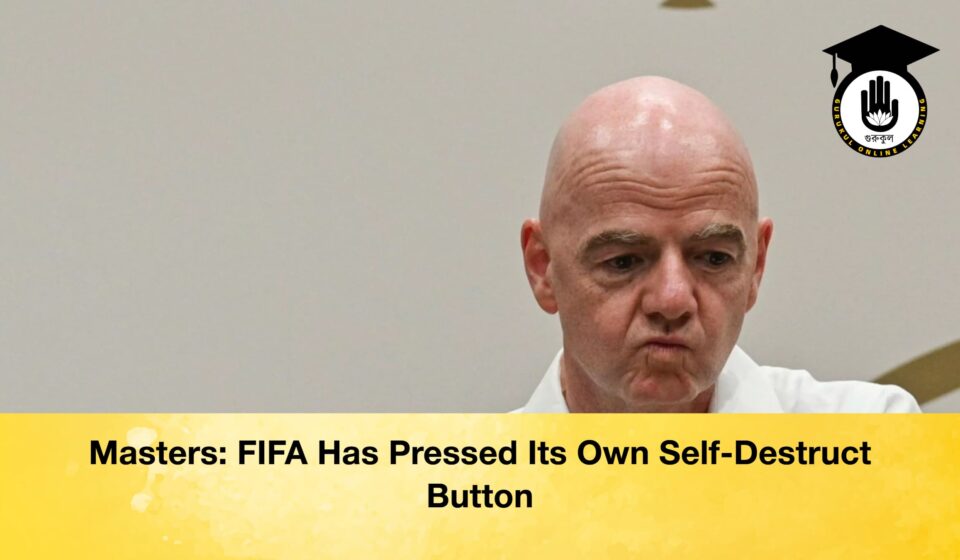

Premier League chief executive Richard Masters has launched a sharp criticism of FIFA president Gianni Infantino over a controversial plan concerning the commercial and ticketing rights of the World Cup and other FIFA competitions.
Masters accused FIFA of creating a crisis through its own decisions, saying the governing body had effectively ‘pressed the self-destruct button’ and now had to deal with the consequences.
The dispute centres on a proposal backed by Infantino to establish a new organisation responsible for managing the commercial and ticketing rights associated with FIFA competitions. Under the plan, 21 per cent of the new entity was due to be sold to a private investment firm.
The proposal was subsequently withdrawn after facing strong opposition from UEFA and several other football confederations. However, its collapse has not ended the controversy surrounding Infantino’s leadership.
The proposed organisation, known as FIFA Forward Enterprise, became a major source of tension within international football. UEFA, one of the most powerful confederations in the global game, was among the most vocal critics of the plan. Several other confederations also raised objections, increasing pressure on FIFA to reconsider the proposed structure.
The dispute became serious enough for UEFA to threaten a boycott of FIFA competitions. Although the threat did not ultimately lead to such a boycott, it demonstrated the depth of the disagreement between FIFA and influential bodies within European football.
At the heart of the dispute was the question of control over commercial rights. FIFA competitions, particularly the World Cup, generate substantial income from broadcasting, sponsorship, ticket sales and other commercial activities. Any proposal to alter the way those rights are managed therefore carries significant financial and strategic implications for the governing body and the wider football community.
The decision by the English Football Association to withdraw its support for Infantino has added another layer to the situation. Masters has backed the FA’s position and called for a new presidential candidate who could bring greater unity to international football.
Speaking to BBC Sport, Masters said the controversy was a problem created by FIFA itself.
‘It is a problem of FIFA’s own making,’ he said.
He went on to describe the episode as a self-inflicted crisis, arguing that FIFA had effectively ‘pressed the self-destruct button’. According to Masters, the organisation must now take responsibility for the difficulties created by its own decisions and find a way to resolve them.
The criticism reflects wider tensions over governance within international football. FIFA operates through a network of continental confederations and national associations, meaning major decisions often require a degree of cooperation among organisations with different interests and priorities.
The collapse of the proposed commercial venture has therefore become more than a disagreement over a business structure. It has raised questions about how FIFA should manage its commercial assets, how much influence external investors should have and how major decisions affecting the global game should be handled.
For Infantino, the controversy represents a significant challenge to his efforts to maintain support among football associations and confederations. The withdrawal of backing from the English FA, combined with criticism from senior figures such as Masters, has increased scrutiny of his leadership.
Masters’ call for a new candidate capable of uniting football also indicates that the debate could extend beyond the abandoned proposal. The immediate plan may have been dropped, but the divisions it exposed remain an issue for FIFA.
The governing body must now contend with the political fallout while maintaining relationships with the confederations and national associations that make up international football. At the same time, it faces the continuing challenge of managing the enormous commercial interests attached to its global competitions.
For Masters, however, the central issue is clear: FIFA created the problem through its own actions, and it is now responsible for finding a way out of the crisis.