

Football supporters across the world are celebrating the legacy of Diego Armando Maradona today, 30 October, on what would have been the Argentine legend’s 66th birthday. Born on 30 October 1960 in Lanús, Buenos Aires Province, Argentina, Maradona rose from humble beginnings to become one of the most gifted and influential players in the history of football.
For millions of fans, Maradona was far more than an ordinary footballer. Some regarded him as the ‘God of Football’, while others admired his rebellious personality and uncompromising character. Regardless of how he was perceived, his extraordinary ability with the ball made him a global sporting icon. His remarkable control, explosive acceleration, close dribbling and ability to outmanoeuvre several defenders in confined spaces distinguished him from his contemporaries. His magical left foot became one of the defining features of his playing style.
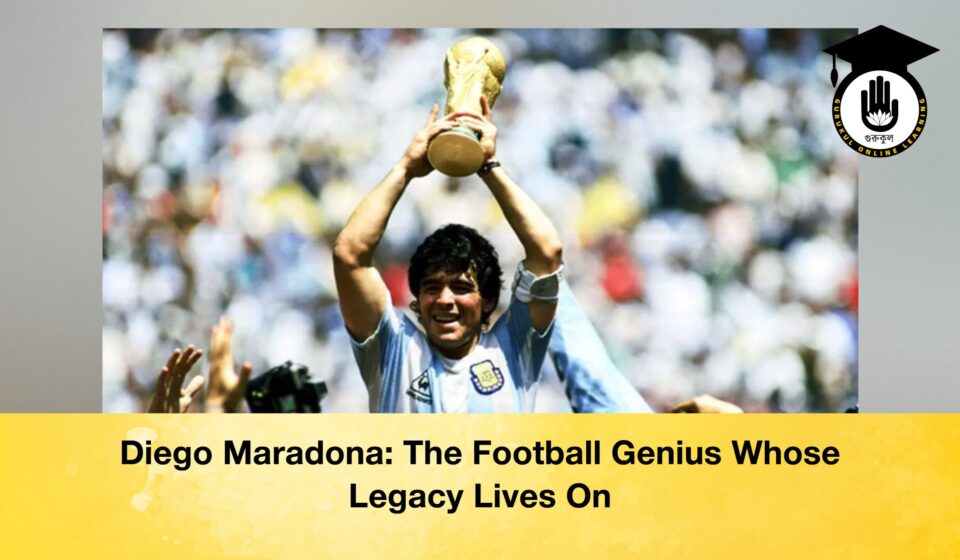
The greatest achievement of Maradona’s career came at the 1986 FIFA World Cup in Mexico, where he captained Argentina to their second world title. He was the driving force behind the team’s success, scoring five goals and providing five assists during the tournament. His outstanding performances earned him the Golden Ball, awarded to the competition’s best player.
The quarter-final against England remains one of the most memorable matches in football history. Maradona scored twice in Argentina’s 2–1 victory, producing two goals that became legendary for entirely different reasons. His opening strike, scored with his hand, became known as the ‘Hand of God’. Just four minutes later, he collected the ball inside his own half, dribbled past several English players and beat goalkeeper Peter Shilton to score an extraordinary solo goal. The second effort was subsequently voted the FIFA World Cup Goal of the Century.
Maradona continued to demonstrate his leadership at the 1990 World Cup in Italy, guiding Argentina to the final for a second successive tournament. However, the defending champions lost 1–0 to West Germany after Andreas Brehme converted a late penalty. His final World Cup appearance came in the United States in 1994, but his campaign ended prematurely after he tested positive for a prohibited substance and was withdrawn from the tournament.
His influence was equally significant at club level. Over a professional career spanning approximately two decades, Maradona represented six clubs, including Argentinos Juniors, Boca Juniors, Barcelona, Napoli, Sevilla and Newell’s Old Boys. He made his professional debut for Argentinos Juniors shortly before his 16th birthday. His exceptional talent quickly attracted attention, and the club later honoured him by naming its home stadium the Estadio Diego Armando Maradona.
However, it was at Napoli in Italy that Maradona established one of the most remarkable legacies in club football. Having joined the side from Barcelona in 1984, he gradually transformed its fortunes. Under his captaincy, Napoli won their first Serie A title in the 1986–87 season. They claimed another league championship in 1989–90 and lifted the UEFA Cup in 1989. His influence helped Napoli challenge the traditional dominance of Italy’s leading clubs, while his popularity among supporters turned him into an enduring symbol of the city.
Maradona scored 346 goals across his club and international career, according to the figures cited in the original report. His achievements extended beyond statistics. His ability to dictate the pace of a match, create opportunities and produce moments of individual brilliance made him one of the most influential footballers of his generation.
Despite his extraordinary sporting achievements, his personal life was often surrounded by controversy and difficulties. Nevertheless, his contribution to football remained immense, and his performances continued to inspire players and supporters long after his retirement.
Maradona died on 25 November 2020, aged 60. His death triggered widespread mourning in Argentina, Naples and across the international sporting community. In recognition of his contribution, Napoli renamed its stadium the Stadio Diego Armando Maradona in 2021.
Since his death, both Argentina and Napoli have enjoyed major successes. Argentina won their third World Cup at Qatar 2022, defeating France in a dramatic final. Napoli also returned to the top of Italian football by winning the 2022–23 Serie A title, ending a 33-year wait for another league championship. Sadly, Maradona did not live to witness either achievement.
His life combined extraordinary talent, sporting triumphs, personal struggles and controversy. Yet his footballing genius remains unquestioned. On what would have been his 66th birthday, supporters continue to remember the man whose extraordinary left foot and unforgettable performances helped shape an era. For Argentina, Naples and football fans everywhere, Diego Maradona remains a legend whose influence transcends generations.