
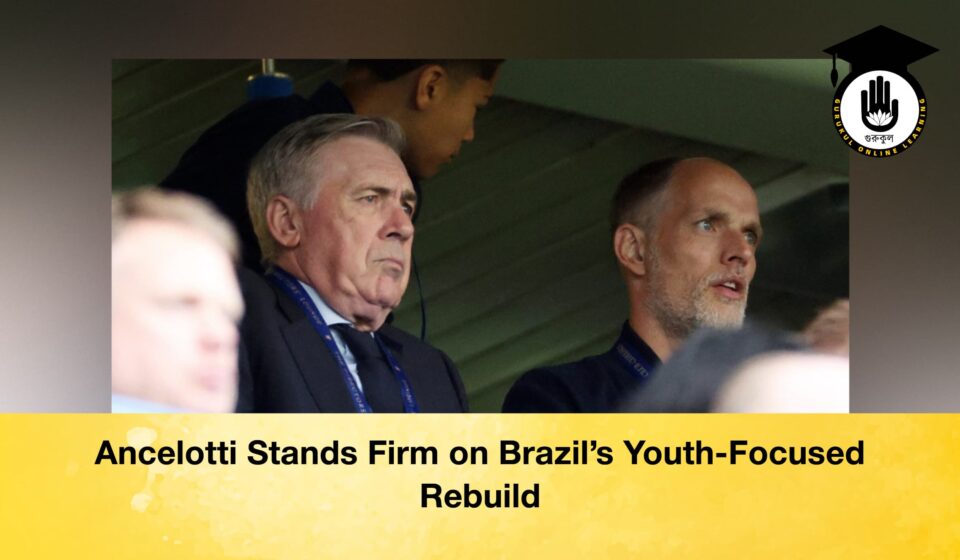

Brazil head coach Carlo Ancelotti has brushed aside the growing criticism surrounding the national team’s performances, insisting that negative reactions will not alter his plans to build a new generation of players.
Ancelotti’s approach comes as Brazil prepare for the next phase of their international campaign, with the coach using a series of friendly matches to assess emerging talent before selecting his squad for major competitions. Despite mounting scrutiny following a disappointing draw against Australia, the experienced Italian has made it clear that he intends to continue testing younger players.
Brazil were held to a 1-1 draw by Australia in Townsville last Friday, a result that prompted strong criticism at home. The five-time world champions are scheduled to face the Socceroos again four days later at Lang Park in Brisbane. Following the two matches in Australia, Brazil are expected to travel to India in October for another friendly.
The reaction to the first Australia match has been particularly sharp because it comes at the beginning of a new phase for the Brazilian side. The team had already faced disappointment after losing to Norway and exiting the World Cup at the last-16 stage. That early elimination had heightened expectations around the national team, making the performance against Australia another source of frustration for supporters and commentators.
Former Brazil international and World Cup winner Denilson described the display as an ‘extremely bad message’, while prominent commentator Galvão Bueno labelled the performance ‘shameful’. Sports journalist José Trajano also called for Ancelotti to be dismissed, despite the coach having signed a new four-year contract in May.
Ancelotti, however, has shown no indication that the criticism will force him to change course. Speaking at an event welcoming Brazil to Queensland, he acknowledged that scrutiny is an inevitable part of managing one of football’s most closely watched national teams.
He argued that criticism could even be regarded as a positive aspect of the job, but stressed that it would have no influence on his plans for Brazil’s future. His focus remains on identifying the players capable of forming the core of the national side in the years ahead.
The current squad reflects that strategy. Of the 26 players selected for the Australia tour, 17 have made no more than 10 international appearances, while 10 had yet to make their senior debuts before the first match. The fixture in Townsville consequently provided several players with an opportunity to make their first appearance for Brazil.
Nottingham Forest’s Jair Cunha, PSV’s Mauro Júnior and Manchester City’s Vitor Reis were among those who made their debuts. Ancelotti has also singled out Arthur Dias, Gabriel Bontempo and Jair Cunha for praise as he continues to examine the options available to him.
For the Italian coach, the value of these friendlies extends beyond the final score. He said the first match against Australia was not primarily about securing a result, but about giving young players meaningful opportunities and enough time on the pitch to demonstrate their abilities.
‘The result of the first match was not very important to us,’ Ancelotti said. ‘We are looking for something else — giving new and young players opportunities and enough space.’
At the same time, Ancelotti did not attempt to disguise Brazil’s shortcomings. He admitted that his team could have produced a better performance, while also crediting Australia for the quality of their display.
Australia, he said, played well and defended in a very compact manner. The assessment underlined the need to consider the opposition as well as Brazil’s own performance when evaluating the result.
The next stage of Ancelotti’s work will therefore involve further examination of the younger players available to him. Rather than settling on a squad too early, he wants to use competitive and friendly fixtures to gather more evidence before making important selection decisions.
His stated priority is to become familiar with the younger generation and reduce the possibility of making mistakes when choosing the squad for major international competitions. Each match is consequently being used as another opportunity to assess players under international conditions.
For Brazil, the process represents a period of transition in which established names and emerging talent must be assessed alongside one another. Ancelotti’s response to the criticism suggests that, at least for now, he intends to give the younger generation time to develop rather than abandon his rebuilding strategy after one disappointing result.