
FIFA’s Disciplinary Committee has issued stringent penalties against the Argentine Football Association alongside several senior national squad figures following chaotic scenes at the conclusion of last month’s World Cup final against Spain, as well as an unsanctioned political demonstration staged after their semi-final victory over England.
The world governing body reserved its most severe individual punishment for midfielder Leandro Paredes, handing him a 10-match international ban and a $90,000 fine. Full-back Nahuel Molina received a seven-match suspension alongside an identical $90,000 penalty. Forward Thiago Almada was given a one-match suspension and a $30,000 fine, whilst assistant coach Roberto Ayala was handed a three-match touchline ban and fined $30,000. Spanish midfielder Gavi was also penalised for his role in the post-match melee, receiving a one-match ban and a $30,000 sanction.
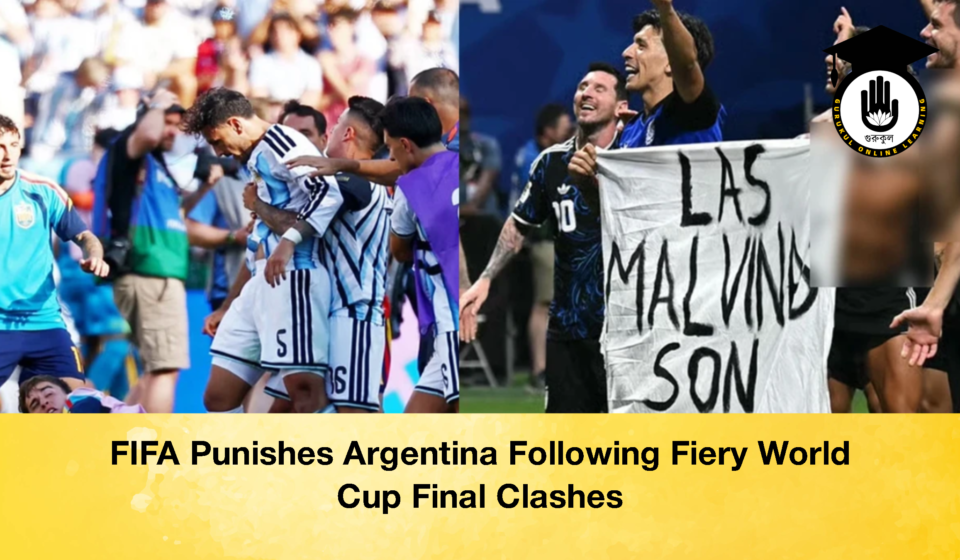
Beyond the physical confrontations on the pitch, world football’s governing authority penalised the South American side for displaying a controversial political banner following their semi-final victory over England. Argentine players were observed holding a banner declaring “Las Malvinas son Argentinas”, asserting sovereignty claims over the British Overseas Territory known internationally as the Falkland Islands.
The display, combined with various spectator infractions recorded across the tournament, resulted in cumulative financial penalties of $321,000 against the Argentine Football Association (AFA). The total sum comprises $10,000 specifically for displaying the unauthorised banner, $20,000 for disorderly crowd behaviour, and the remainder for repeated violations of FIFA’s anti-discrimination statutes. Argentina must also play their next home competitive match with stadium capacity restricted to 50 per cent. An additional 50 per cent stadium closure has been suspended, alongside $100,000 of the total fine.
The Falkland Islands remain an internally self-governing British Overseas Territory located in the South Atlantic. In a 2013 referendum, islanders voted overwhelmingly—by a margin of 99.8 per cent—to retain their political status under the British Crown. Sovereignty disputes over the archipelago date back centuries, culminating in April 1982 when Argentine forces launched an invasion, leading to a British military task force reclaiming the territory prior to the Argentine surrender in June of that year.
The semi-final banner incident drew immediate political rebukes from London. Liberal Democrat leader Sir Ed Davey called on sports administrators to ban the players involved, while Peter Kyle, then serving as Shadow Business Secretary, characterised the demonstration as entirely improper for an international sporting platform.
The AFA confirmed that its legal department will request the full reasoned grounds of the disciplinary rulings before lodging formal appeals with FIFA’s Appeal Committee. Argentine officials affirmed their readiness to escalate the case to the Court of Arbitration for Sport in Lausanne if necessary. Domestically, the federation has designated 15 July—the date of their semi-final win over England—as their annual “National Football Team Day”.